Staff draft asks for Administrator's Davos meeting with YouTube chief executive
A one-page January 2024 input document lists proposed requests to Google and YouTube on monetization, advertising and search visibility for independent media reaching Russia, Belarus and Moldova.
What this record contains
The document says the USAID Administrator will likely meet YouTube's chief executive at Davos, with a focus on helping content creators monetise and on civic resilience, and requests staff input by January 12. Proposed asks include letting producers based outside Russia monetise views from inside Russia, allowing organisations on an inclusion list managed by a press freedom NGO such as Internews to advertise to Russian audiences, and not downgrading blocked independent sites in search results. It also asks about a timeline for YouTube monetization in Moldova and refers to an ask on Belarusian-language content.
Full text of the record
Text extracted from the original PDF. Layout, tables and images are not reproduced. About 394 words.
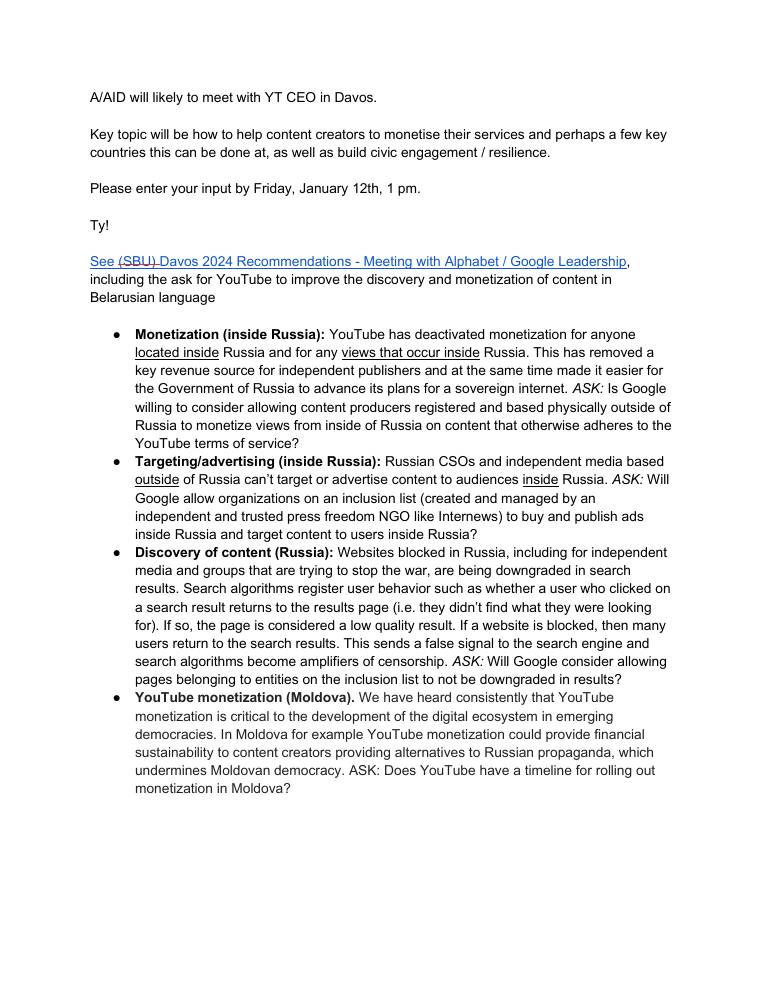
A/AID will likely to meet with YT CEO in Davos.
Key topic will be how to help content creators to monetise their services and perhaps a few key countries this can be done at, as well as build civic engagement / resilience. Please enter your input by Friday, January 12th, 1 pm.
Ty!
See (SBU) Davos 2024 Recommendations - Meeting with Alphabet / Google Leadership, including the ask for YouTube to improve the discovery and monetization of content in Belarusian language
• Monetization (inside Russia): YouTube has deactivated monetization for anyone located inside Russia and for any views that occur inside Russia. This has removed a key revenue source for independent publishers and at the same time made it easier for the Government of Russia to advance its plans for a sovereign internet. ASK: Is Google willing to consider allowing content producers registered and based physically outside of Russia to monetize views from inside of Russia on content that otherwise adheres to the YouTube terms of service? Targeting/advertising (inside Russia): Russian CSOs and independent media based outside of Russia can’t target or advertise content to audiences inside Russia. ASK: Will Google allow organizations on an inclusion list (created and managed by an independent and trusted press freedom NGO like Internews) to buy and publish ads inside Russia and target content to users inside Russia? Discovery of content (Russia): Websites blocked in Russia, including for independent media and groups that are trying to stop the war, are being downgraded in search results. Search algorithms register user behavior such as whether a user who clicked on a search result returns to the results page (i.e. they didn’t find what they were looking for). If so, the page is considered a low quality result. If a website is blocked, then many users return to the search results. This sends a false signal to the search engine and search algorithms become amplifiers of censorship. ASK: Will Google consider allowing pages belonging to entities on the inclusion list to not be downgraded in results? YouTube monetization (Moldova). We have heard consistently that YouTube monetization is critical to the development of the digital ecosystem in emerging democracies. In Moldova for example YouTube monetization could provide financial sustainability to content creators providing alternatives to Russian propaganda, which undermines Moldovan democracy. ASK: Does YouTube have a timeline for rolling out monetization in Moldova?
The original document
Page through the PDF exactly as released. If it does not display, open it directly.