Topic brief outlines USAID digital development work and implementation challenges
A November 2021 brief from the Technology Division of USAID's development, democracy and innovation bureau reviews the 2020-2024 Digital Strategy, partnerships and issues for leadership discussion.
Summary
The four-page brief describes digital technology's opportunities and risks, including digital authoritarianism and mis-, dis- and malinformation. It reviews the Digital Strategy launched in April 2020 and partnerships such as the Microsoft Airband Initiative and a fibre optic buildout in Liberia with Google. It says USAID lacks field-based technical expertise and funding, notes Chinese investment in digital systems, and lists emerging trends including 5G, artificial intelligence and cybersecurity. Key issues include incomplete implementation of the strategy and fragmented coordination. A clearance page is dated November 5, 2021.
Written by AI from the text of the record.
Full text
Text extracted from the original PDF. Layout, tables and images are not reproduced. About 1,429 words.
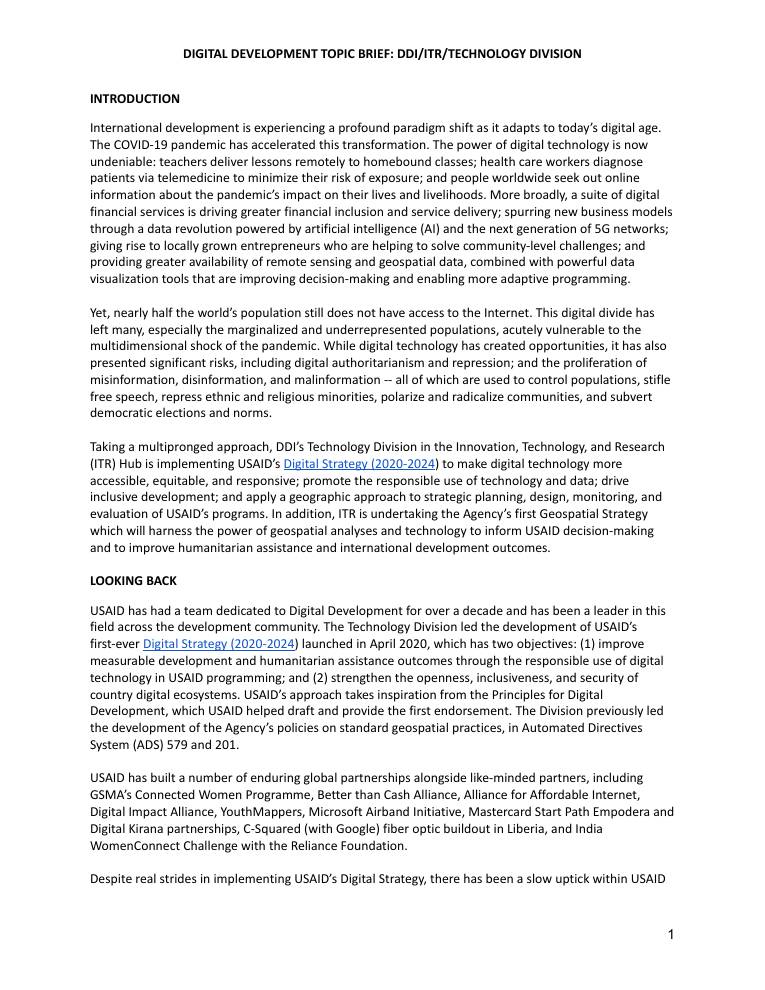
INTRODUCTION
International development is experiencing a profound paradigm shift as it adapts to today’s digital age. The COVID-19 pandemic has accelerated this transformation. The power of digital technology is now undeniable: teachers deliver lessons remotely to homebound classes; health care workers diagnose patients via telemedicine to minimize their risk of exposure; and people worldwide seek out online information about the pandemic’s impact on their lives and livelihoods. More broadly, a suite of digital financial services is driving greater financial inclusion and service delivery; spurring new business models through a data revolution powered by artificial intelligence (AI) and the next generation of 5G networks; giving rise to locally grown entrepreneurs who are helping to solve community-level challenges; and providing greater availability of remote sensing and geospatial data, combined with powerful data visualization tools that are improving decision-making and enabling more adaptive programming. Yet, nearly half the world’s population still does not have access to the Internet. This digital divide has left many, especially the marginalized and underrepresented populations, acutely vulnerable to the multidimensional shock of the pandemic. While digital technology has created opportunities, it has also presented significant risks, including digital authoritarianism and repression; and the proliferation of misinformation, disinformation, and malinformation -- all of which are used to control populations, stifle free speech, repress ethnic and religious minorities, polarize and radicalize communities, and subvert democratic elections and norms.
Taking a multipronged approach, DDI’s Technology Division in the Innovation, Technology, and Research (ITR) Hub is implementing USAID’s Digital Strategy (2020-2024) to make digital technology more accessible, equitable, and responsive; promote the responsible use of technology and data; drive inclusive development; and apply a geographic approach to strategic planning, design, monitoring, and evaluation of USAID’s programs. In addition, ITR is undertaking the Agency’s first Geospatial Strategy which will harness the power of geospatial analyses and technology to inform USAID decision-making and to improve humanitarian assistance and international development outcomes. LOOKING BACK
USAID has had a team dedicated to Digital Development for over a decade and has been a leader in this field across the development community. The Technology Division led the development of USAID’s first-ever Digital Strategy (2020-2024) launched in April 2020, which has two objectives: (1) improve measurable development and humanitarian assistance outcomes through the responsible use of digital technology in USAID programming; and (2) strengthen the openness, inclusiveness, and security of country digital ecosystems. USAID’s approach takes inspiration from the Principles for Digital Development, which USAID helped draft and provide the first endorsement. The Division previously led the development of the Agency’s policies on standard geospatial practices, in Automated Directives System (ADS) 579 and 201.
USAID has built a number of enduring global partnerships alongside like-minded partners, including GSMA’s Connected Women Programme, Better than Cash Alliance, Alliance for Affordable Internet, Digital Impact Alliance, YouthMappers, Microsoft Airband Initiative, Mastercard Start Path Empodera and Digital Kirana partnerships, C-Squared (with Google) fiber optic buildout in Liberia, and India WomenConnect Challenge with the Reliance Foundation.
Despite real strides in implementing USAID’s Digital Strategy, there has been a slow uptick within USAID
in elevating Digital Development across sectors and geographies. USAID still lacks a full contingent of field-based technical expertise and funds for digital programming. These gaps are even more acute in the face of significant and systematic People’s Republic of China (PRC) investment in digital technology over the last few years. Today, PRC-backed systems are dominant in many of the countries where we work. The wider challenges that USAID and the community of donors and investors have faced include:
• Fragmented and uncoordinated approaches to digital investments that have created silos, resulted in duplicative efforts, and led to inefficiencies. Financing gaps: According to the World Bank, reaching universal access to broadband connectivity by 2030 in Africa alone (where less than a third of the population has access to the internet) requires over $100 billion. Deployment of digital technologies and reforms: Investments are necessary not only for building digital infrastructure but also developing information and communications technology (ICT) skills and content, greater digital literacy, policies and regulatory reforms, and network operation and maintenance.
LOOKING FORWARD
There are a number of emerging digital technology trends that have significant implications for the Agency’s work and for improving people’s lives, including:
• 5G and open, secure, and inclusive digital infrastructure An explosion in the amount and availability of geospatial data and high-resolution satellite imagery as a digital public good (DPG) Cybersecurity and data privacy AI and the data revolution The rise of digital authoritarianism Capacity of USAID staff to responsibly and holistically use digital technology
Digital technology is a growing priority across the U.S. Government (USG) as highlighted in the Interim National Security Strategic Guidance and various Executive Orders issued by the Biden-Harris Administration. There are over a dozen lines of effort in the National Security Council (NSC) that have a digital component, including Build Back Better World (B3W) and Digital Africa, and a technology focus at the upcoming Summit for Democracy. The Technology Division is involved in many of these discussions. The National Security Commission on Artificial Intelligence, in its final report to the President and Congress in March 2021, highlighted this growing attention and the need for USAID to engage more robustly. In addition, U.S. Secretary of State Antony Blinken recently announced the intent to create a new Cybersecurity and Emerging Technology Bureau, mirroring similar announcements from other parts of the USG.
KEY ISSUES AND CHALLENGES FOR DISCUSSION
1) USAID has yet to fully implement the Digital Strategy. Despite several forward leaning Missions and OUs, digital is still thought of as a niche topic, or “nice to have” addition to programming. However, it has become a foundational component to achieving much of the Agency’s development and humanitarian assistance objectives, including the Administration’s priorities, and has far reaching implications for the countries and communities with which we work. Advocacy for every Mission to conduct a Digital Ecosystem Country Assessment (DECA) and hire
2)
3)
4)
5)
a Digital Development Advisor, and for every pillar bureau to develop a Digital Action Plan, is a critical component to moving implementation forward.
A lack of a public commitment to digital as a priority for USAID. Despite the attention digital technology has received across the USG, USAID leadership has yet to articulate a strong public commitment to the important role it plays in achieving USAID’s development and humanitarian objectives. Without this posture, it is a challenge to effectively and fully engage external partners, the interagency, and even Congress, as they wonder whether this is a priority for USAID.
Lack of resources for digital programming. Given the number of directives and earmarks attached to USAID’s budget, there is limited discretionary funds to support Digital Development. Previous budget requests of upwards of $82 million per year to execute the Digital Strategy have yet to materialize. In FY21, after taking into account staffing costs, there is less than $5 million for digital programming within the Technology Division. The Division routinely relies on limited, complementary funding from other intra/interagency sources to meet its fundamental programming, and this approach limits its ability to be strategic at a time when proactive attention is required.
Overreliance on short-term staffing mechanisms. Most Technology Division staff are either Institutional Support Contractors (ISCs) or short-term Direct Hires (Foreign Service Limited or Schedule A positions). This leads to increased turn-over and a lack of institutional knowledge and dedicated technical expertise.
Digital technology conversations are diffused across the Agency. Because of how pervasive and central digital transformation is to everything USAID does, it affects most of USAID programs and discussions. On one hand, this is very encouraging and we now have a very dynamic Digital Sector Council that shares digital programming, best practices and resources on a monthly basis. On the other hand, this diffusion often happens without the Technology Division’s involvement and lead; Technology Division technical experts are pulled into conversations by sectoral and regional teams often after the ideas have already been developed and discussed with senior leadership. This approach can further entrench challenges noted above, including fragmentation, duplication, and lack of strategic coordination across USAID’s digital investments.
CLEARANCE PAGE FOR B/IO BRIEF: DDI/ITR/T
Drafted By: John O’Bryan, jobryan@usaid.gov,
Approved: A-AA Karl Fickenscher: OK’d /s/ KWF 11/05/2021 Name
DDI/ITR/DAA: KRosen
DDI/ITR/A-ITR: TJones
DDI/ITR/T: Chris Burns
DDI/PO/Comms: JSteiger
DDI/PO/Comms Lead: EMcClintock
DDI/PO/Budget: KCronin
PPL/P: BSteiner
PPL/DAA: SFaraj
Clearance
clear w/edits
Clear
Clear
Clear with edits
Clear
Clear
Clear
Info
Date
11/5/2021
11/5/2021
11/5/2021
11/5/2021
11/5/2021
11/5/2021
11/5/2021
11/5/2021
At a minimum, these materials should receive clearance from the highest ranking career staff member within the B/IO and obtain input/clearance from B/IOs with equities.
Original document
The PDF as released. If it does not display, open it directly.