Draft compiles USAID bureau requests ahead of planned meeting with Meta
A 15-page predecisional draft gathers requests from USAID bureaus and missions for a planned late-September meeting with Meta on training, partner support and information sharing.
What this record contains
The draft, signed by USAID's technology and democracy adviser, sets out three categories for a meeting with Meta and WhatsApp: resilience building, support to missions and partners including expedited review of partner cases, and information sharing. A table lists requests by bureau and country, including Belarus, Moldova, Slovakia and Guatemala, covering fact-checking training, researcher data access, points of contact and migration-related issues. Comments note that Meta responses to reported content in Slovakia take five days to two weeks. Notes at the end say content referrals must be clearly distinguished from directives and request a session with the General Counsel.
Full text of the record
Text extracted from the original PDF. Layout, tables and images are not reproduced. About 3,032 words.
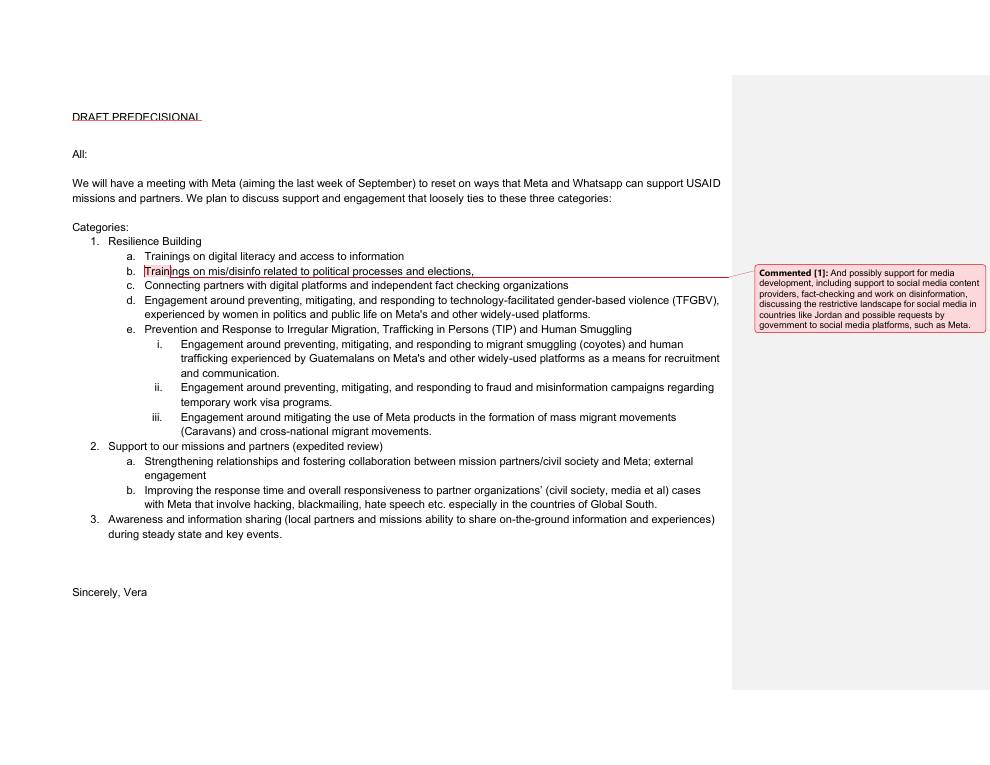
All:
We will have a meeting with Meta (aiming the last week of September) to reset on ways that Meta and Whatsapp can support USAID missions and partners. We plan to discuss support and engagement that loosely ties to these three categories: Categories:
1. Resilience Building
a. Trainings on digital literacy and access to information
b. Trainings on mis/disinfo related to political processes and elections,
c. Connecting partners with digital platforms and independent fact checking organizations
d. Engagement around preventing, mitigating, and responding to technology-facilitated gender-based violence (TFGBV), experienced by women in politics and public life on Meta's and other widely-used platforms. e. Prevention and Response to Irregular Migration, Trafficking in Persons (TIP) and Human Smuggling i.
Engagement around preventing, mitigating, and responding to migrant smuggling (coyotes) and human trafficking experienced by Guatemalans on Meta's and other widely-used platforms as a means for recruitment and communication.
ii.
Engagement around preventing, mitigating, and responding to fraud and misinformation campaigns regarding temporary work visa programs.
iii.
Engagement around mitigating the use of Meta products in the formation of mass migrant movements (Caravans) and cross-national migrant movements.
2. Support to our missions and partners (expedited review)
a. Strengthening relationships and fostering collaboration between mission partners/civil society and Meta; external engagement
b. Improving the response time and overall responsiveness to partner organizations’ (civil society, media et al) cases with Meta that involve hacking, blackmailing, hate speech etc. especially in the countries of Global South. 3. Awareness and information sharing (local partners and missions ability to share on-the-ground information and experiences) during steady state and key events.
Sincerely, Vera
Commented [1]: And possibly support for media
development, including support to social media content providers, fact-checking and work on disinformation, discussing the restrictive landscape for social media in countries like Jordan and possible requests by
government to social media platforms, such as Meta.
Categories
1. Resilience Building
2. Support to our missions and partners (expedited review)
3. Awareness and information sharing (providing local partners and missions w/ the ability to share on-the-ground information and experiences)
Bureau
Countries of Impact
Requests
POC
E&E
Belarus
Eurasia Non Presence (ENP)
Moldova
Resilience building:
• Trainings on cross Check, Meta Pro, Factchecking program
• Meta would provide tips on audience engagement/reach with the algorithm changes
• Information on the ad library and navigating it both for safety/security (if partners are purchasing) and targeting ads
• Training that focuses on monetization
Shannon Maguire
<smaguire@usaid.gov>
E&E
Slovakia
Open engagement/dedicated discussion of factShannon Maguire checking organizations, representatives of the Slovak <smaguire@usaid.gov> Olesia Gardner,
Media Council, and Meta on the following areas:
ogardner@usaid.gov
Awareness & info sharing:
• Providing data access to vetted researchers so that the researchers can validate or check platforms’ decisions to take down or moderate content, as well as recommendation systems.
Commented [2]: No immediate needs from civil
society and media. Let's to make any specific requests to Meta on support to civil society after the elections (September 30).
Support:
• Commented [3]: Yes, during the GLOBSEC Forum, Globsec facilitated a closed meeting between Meta, the European Commission and state representatives of Slovakia. Meta shared that they are investing in media literacy campaigns on Facebook, in cooperation with a Slovak NGO, however, it is not clear who exactly they have partnered with. The Council for Media Services of Slovakia, a body that is expected to be a Slovak Digital Service Coordinator under DSA, who was present at the meeting, confirmed that there is now an open socalled “escalation channel” between the Council and Meta, and they have regular meetings. We need to encourage Meta to continue close cooperation with the Council for faster take-downs of reported illegal content. It takes 5 days to 2 weeks right now for a response from Meta that an action was taken (without details).
Confirming points of contact for Slovakia, who
will have a fast-track channel to large
platforms (this seems to have started already
following the meeting with Meta, facilitated by
Globsec in May, but good to confirm and
check on how it's going)
Resilience building:
• E&E
Central Europe
Discussing measures of demonetization of
disinformation and recommendation
systems to stop recommending harmful
content to users.
As several Slovakia partners are very
skilled in identifying and tracking
disinformation (Globsec, Demagog,
Infosecurity, Gerulata), it would be useful to
hold a workshop on a new foundational
large language model, known as Large
Language Model Meta AI or LLaMA, which
is supposed to be free to the research
community.
Resilience building:
Regional training program for Central Europe more broadly to help build engaged and loyal audiences for fact-checking organizations (maybe members of the third-party fact-checking program in CE).
Commented [4]: Before asking Meta for specific skillbuilding workshops, I would like to reach out to them to crosscheck what their needs are. For example,
Demagog Slovakia just got their IFCN certification.
They will apply to Meta to become Meta's Third-Party
Fact-Checking Program in September. We should
encourage Meta to get them into the program ASAP.
Commented [5]: @ogardner@usaid.gov We're
planning to meet with Meta next week (I'll email you
with more soon), so if there are specific asks beyond
this, it would be good to know now!
Commented [6]: @Kayla, I will email you today with
questions/ asks for the upcoming call.
Shannon Maguire
<smaguire@usaid.gov>
Olesia Gardner
ogardner@usaid.gov
Commented [7]: These two have access to data and are able to scrape data from various social media platforms and analyze it pretty well. I would need to check with them first what their current needs are before making any asks from Meta.
Commented [8]: I don't think a training program is needed, but more open conversations between Meta and independent media organizations on
transparency. The EU’s Digital Service Act came into force in August 2023, in July Meta did a stress test on complying
...
A workshop could bring together fact-checking
organizations to innovate, learn from experts and one another, and collaborate on new strategies to
improve their business both on and off Meta.
Commented [9]: Can we please ask Meta to have this workshop during the CE Media Trends conference in December? It will really be appreciated.
We can connect Meta with Zinc, which is already
working in the region, and they could help organize such a training/workshop.
CPS
Libya, Mozambique, Papua
New Guinea, and the Coastal
West Africa region including
Benin, Côte d’Ivoire, Ghana,
Guinea, Togo, and Burkina
Faso
Plus OTI presence countries
and Belarus
Resilience building
• Digital literacy and resilience training for partners in SPCPS/GFA countries and regions (see list to the left)
• Training for CPS programs and partners on Meta policies, procedures, and features to better understand how to create, promote, target, and monitor content
• Online/digital safety training for women leaders and activists, especially in SPCPS/GFA countries and regions
• Ad credits, trainings, and mentoring to amplify the voices of USAID partners implementing WPS and gender equality activities, including women and youth-led communication campaigns
• Collaboration and potential partnership with Meta on the prevention and response to Technology Facilitated Gender-Based Violence (TFGBV) for women, girls, and other vulnerable populations
Amy Malessa
(amalessa@usaid.gov)
Kevin Melton
(kmelton@usaid.gov)
Information sharing
• Information sharing to better understand how Meta is preparing for and responding to content that might lead to violence and/or mass atrocities, including emerging trends and concerns from USAID’s perspective onthe-ground
• With appropriate privacy safeguards, providing data access for independent researchers who are studying trends related to disinformation, hate speech, and technology-facilitated violence Support
• Process to streamline the referrals into Meta’s Trusted Partner Network and Cross Check Program - and ask for a venue to discuss feedback and actions to improve the responsiveness of network
DRG/Electio
ns and
Political
Processes
(EPP) team
For the Support to Missions and Partners Category, key questions our partners would likely be interested in are:
• How does one get verified? Is there any prioritization for reviewing such groups' requests by Meta ahead of elections?
• How does Meta work to identify and combat foreign influence operations and other types of coordinated inauthentic activity on its platforms? When identified, what are Meta's plans for sharing information on such activity to EMBs and
Michael McNulty
(mmcnulty@usaid.gov)
other key election stakeholders?
• How does one report suspected disinfo or otherwise flag content that may be illegal or conflict with the terms of service? What does Meta do with flagged content?
• What is Meta doing to enhance account security for higher profile election stakeholders (e.g., EMB leaders, presidential candidates, party leaders, heads of observer groups, etc.)? LAC-CAM
El Salvador
Resilience building:
Support:
• Establish a permanent discussion table with CSOs and media to discuss algorithm implications for their work countering misinformation.
Claudia Martinez
(clamartinez@usaid.gov)
Guatemala
Information on how to take advantage of FB groups for creating safe networking spaces.
Spencer Milian
smilian@usaid.gov
Perception studies on specific topics, because.FB launches some surveys. We can try to take
advantage of them.
Engage the migrant diaspora with the local
governments for public accountability.
Information protection on personal data especially vulnerable groups.
Improve filters at the moment to review and approve posts.
The above comments also apply for Instagram.
Commented [10]: @smilian@usaid.gov hi! Can you
please expand on this? I'm not sure what the ask is for Meta
_Assigned to smilian@usaid.gov_
Digital Infrastructure: Meta could invest in building digital infrastructure to improve internet access and connectivity in underserved or remote areas within municipalities. This would help bridge the digital divide and enable more residents to access online services and information.
Community Engagement: Meta could create tools
and resources to help municipal governments better engage with their communities through social media and other online platforms. This might include
training programs for local officials on effective online communication and engagement strategies.
Data Analytics: Meta has access to vast amounts of user data. With appropriate privacy safeguards, this data could be leveraged to provide municipalities with insights into local trends, public sentiment, and emerging issues. This information could be valuable for informed decision-making.
Public Safety and Emergency Response: Meta could collaborate with municipalities to develop tools that enhance public safety and emergency response. This might include real-time communication platforms for first responders, community alert systems, and crisis response coordination.
Smart Cities Initiatives: Meta could partner with municipalities to support smart city initiatives. This might involve providing technology solutions for traffic management, waste management, energy efficiency, and other urban challenges.
Privacy and Data Security: Given its expertise in data privacy and security, Meta could assist municipalities
in developing robust data protection policies and cybersecurity measures to safeguard sensitive citizen information.
Guatemala Entrepreneurship Development
Initiative (GEDI) and Meta that can make a
partnership beneficial for both parties:
• Digital Access and Training: Meta can contribute by providing digital access and training resources to entrepreneurs in Guatemala. This includes helping entrepreneurs harness the power of digital marketing, e-commerce, and online platforms to expand their businesses and reach new markets. Access to Finance: GEDI focuses on improving access to finance for small and growing businesses. Meta could potentially support or facilitate connections with financial institutions or investors that align with GEDI's objectives, helping these businesses secure the funding they need to grow. Technology and Tools: Meta can provide access to its suite of business tools and resources, including advertising platforms, data analytics, and marketing insights. These tools can empower entrepreneurs to better understand and reach their target audiences. Youth Education and Digital Skills: GEDI aims to support youth education, particularly in regions with high levels of irregular migration. Meta can contribute to this by offering digital skills training programs for young people, helping them build valuable skills for the future job market.
• Networking and Collaboration: Meta can facilitate networking opportunities for GEDI by connecting it with other organizations, entrepreneurs, and stakeholders in the region. This can help GEDI expand its network and access new resources.
Engagement around preventing, mitigating, and
responding to migrant smuggling (coyotes) and
human trafficking experienced by Guatemalans on
Meta's and other widely-used platforms as a means for recruitment and communication.
Engagement around preventing, mitigating, and
responding to fraud and misinformation campaigns regarding temporary work visa programs,
Engagement around mitigating the use of Meta
products in the formation of mass migrant
movements (Caravans) and cross-national migrant
movements
—--------------------------Jose Lopez
Honduras
Nicaragua
Support (priority):
• Coordination tracking troll networks targeting our partners (and doxing removal)
• Rapid response/clear channels to tech assistance for account recovery
• Mitigation/preventative support to update accounts (2FA setup, correction for admin, etc.)
Amanda Fagerblom
(afagerblom@usaid.gov)
Capacity (from exile - out of Costa Rica):
• Trainings on cross Check, Meta Pro, Factchecking program; monetization
• Consultation for audience engagement/reach with the algorithm changes
• Information on the ad library and navigating it both for safety/security (if partners are purchasing) and targeting ads
• Effective disinformation awareness-raising campaign development Mexico LAC-SA
Peru
Meta is part of Internet para Todos (IpT), or Internet Carla Queirolo
for All, The company formed out of a collaboration (cqueirolo@usaid.gov)
between IDB Invest, the private-sector arm of the IDB Group, Telefónica, Meta and the Development Bank of Latin America (CAF). IpT plans to provide 4G
mobile internet access to 6 million people in more than 30,000 rural areas in Peru.
Specifically, Meta could invest in building digital infrastructure to improve internet access and
connectivity in underserved or remote areas of the Peruvian Amazon where illegalities take place. This would help bridge the digital divide and enable more population to access online services and information. USAID/Peru envisions building Connections by
promoting investments in secure, diverse, and
resilient Information and Communication’s
Technology areas.
Additionally:
Trainings on digital literacy and access to information
Trainings on mis/disinfo related to political processes and elections, and connecting partners with digital platforms and independent fact-checking
organizations
Engagement around preventing, mitigating, and
responding to technology-facilitated gender-based violence (TFGBV), experienced by women in politics and public life on Meta's and other widely-used
platforms.
Strengthening relationships and fostering
collaboration between mission partners/civil society and Meta; external engagement
C-TIP campaigns
LAC-CAR
AFR
DRG /
ACTF
Haiti
1) Fact checking and control of misinformation,
particularly around elections and planned
foreign (Kenyan) security forces. 2)
Collaboration with USAID’s misinformation
reduction program; and 3) helping to bolster/
enhance effectiveness of/ Meta’s Trusted
Partner program in Haiti to reduce
disinformation and ensure factual content.
Jamaica
1) Trainings on digital literacy and access to
information
2)
Erik Pacific
(epacific@usaid.gov)
ME
Libya
Support:
Our implementing partner BBC media action
(BBCMA) is blocked by Meta from boosting their
postings to share public interest stories, election related information and countering mis/disinformation with their El Kul platform on Facebook. USAID and BBCMA have failed to unlock this issue and now it is impacting critical life saving information to the humanitarian disaster in eastern Libya. How can we solve this issue to boost the reach of El Kul’s posts? El Kul is a Libyan social media platform with over 1.2 million followers. A team of Libya-based freelance reporters and Tunis-based BBC Media Action content producers make daily El Kul content that promotes the inclusion and participation of women in society and tolerance of diversity amid the conflict.
BBCMA has been struggling with boosting and
promoting posts related to elections related issues and has tried to address this issue with Meta
regionally throughout 2023 to their MENA teams.
They have also raised this issue with Vera when she was in Tunis in May 2023. However, the issue
remains unresolved.
Following the recent massive flooding in eastern Libya from Storm Daniel, Meta was blocking the
boosting of potential life saving information from BBCMA. El Kul is the only Libyan communication
platform providing emergency communication on
lifesaving issues such as cleaning drinking water, avoiding the most dangerous locations, and
effectively coordinating and accessing assistance at scale. El Kul was able to effectively appeal the
Sterling Roop
(sroop@usaid.gov)
blocking of 3 posts. It is yet to be seen if future boosts will also be blocked and necessitate appeals.
Notes from 9/7/23 group meeting:
What about regulation? E.g. EU is starting to regulate US tech companies. State working on language about regulation. How does that affect what we do?
-
Use agendas and clear talking points with GC: that way we have a paper trail of all the conversations we have in case needed for a legal reason
We can provide input into general principles, but let’s work closely with GC on anything that touches near content moderation Exercise additional caution if talking to social companies about their content moderation
• See point about agenda and talking points Encourage direct collaboration between platforms and partners, so we are not part of the conversation
Independent reporting
• We use reports about disinfo/etc. to inform platforms, but we’re not involved in what they do with those. Is that clear with GC?
-
Kayla/Chioma/Vera to discuss categories of outreach (regarding independent reporting, etc.) and how those categories are prioritized across B/IOs.
Doxxing/impacts on local staff. How can we address this? Is it covered by the injunction?
• Not covered by the injunction, but in case it is, there is a carve out in the injunction for this Concern: If partner discovers content that violates platform policy (e.g. illegal act, call for violence), by raising that to the platform, there’s an implicit suggestion of content moderation.
• Content moderation referrals are different than content moderation direction
• Make it clear that it’s a referral and not something else; we don’t want to cross the line into a directive
Request to have a session with GC on this with missions Challenges/ Difficulties with previous Meta engagement?
• LAC: Trainings for mission partners have not always been great. Feedback:
• Trainings were too basic for what we had requested (esp. Mis disinfo in elections)
• Others have been better
• One is being planned for mission doxx in LAC
• In general relationship has been positive and Meta has been responsive
• LAC has engaged Meta in some interagency discussions around civic space during public events
When working with Meta, have to work through existing tools they have available. They’re not going to spin up a new training/invest in a new country if it doesn’t suit their bottom line. What are the things that they already offer and how can we help direct some of those resources more strategically?
The original document
Page through the PDF exactly as released. If it does not display, open it directly.