Draft USAID framework sets out steps for assessing disinformation risks
An undated five-page internal draft, with reviewer comments, outlines how USAID would detect, assess and rate misinformation, disinformation and malinformation affecting the agency.
What this record contains
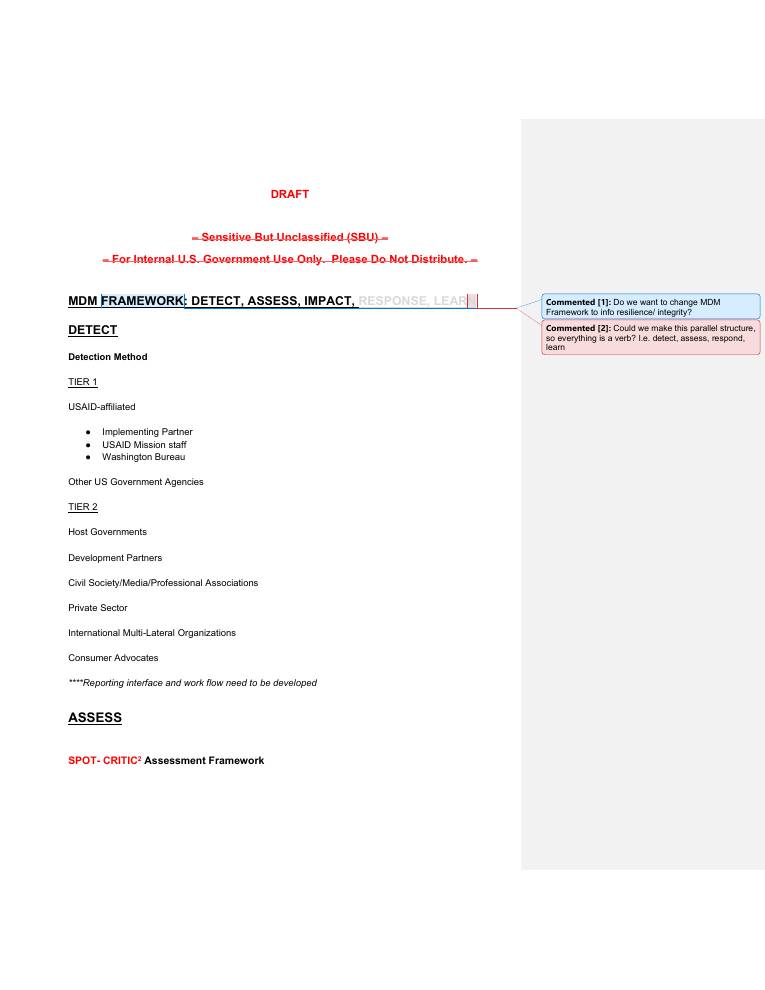
The draft, marked sensitive but unclassified, is organised under the headings detect, assess, impact, response and learn. It lists detection sources such as implementing partners, mission staff, other agencies, host governments and civil society, and an assessment scheme covering source, platform, objective, target, composition, reach, information resilience, theme, risk appetite, campaign and presence of a strategic competitor. Impact is rated on four levels according to effects on personnel security, program efficacy and USAID's reputation. Reviewer comments question terminology and categories, and the document notes that a reporting interface still needs to be developed.
Full text of the record
Text extracted from the original PDF. Layout, tables and images are not reproduced. About 674 words.
DRAFT
• Sensitive But Unclassified (SBU) –
• For Internal U.S. Government Use Only. Please Do Not Distribute. –
Mdm Framework: Detect, Assess, Impact, Response, Learn
Commented [1]: Do we want to change MDM
Framework to info resilience/ integrity?
DETECT
Commented [2]: Could we make this parallel structure, so everything is a verb? I.e. detect, assess, respond, learn
Detection Method
TIER 1
USAID-affiliated
Implementing Partner
USAID Mission staff
Washington Bureau
Other US Government Agencies
TIER 2
Host Governments
Development Partners
Civil Society/Media/Professional Associations
Private Sector
International Multi-Lateral Organizations
Consumer Advocates
****Reporting interface and work flow need to be developed
ASSESS
SPOT- CRITIC2 Assessment Framework
SOURCE: Identifiable individuals associated with a state or non-state actor, cutouts, “bots”, or a third party such as a moderator. Can also be anonymous/unknown.
PLATFORM: TV, Radio, website, social media, print media, advertising platform, etc.
OBJECTIVE: The stated or implied goal of the language or image content used in an influence operation.
TARGET: Intended audience of a campaign over a specific platform(s).
COMPOSITION: The specific language or image content used in an influence operation.
REACH:
Category 1: Circulation on fringe websites, media outlets, or social media networks
Category 2: Circulation on mainstream websites, media outlets, social media networks.
Category 3: Break out across multiple media platforms, engagement by key audiences or key opinion/decision makers
Category 4: Widespread circulation on reputable media platforms, quoted by key opinion/decision makers and eliciting a policy response
INFORMATION RESILIENCE:
Category 1: Target has access to a limited number of independent media resources and will have difficulty in developing an informed position.
Category 2: Target has access to a variety of interdependent media sources from which to inform their opinion.
THEME
Category 1: Targets a single policy issue or activity, or capability, but does not credibly undermine the mission orf core functions of USAID
Category 2: Targets multiple policy issues, activities, or capabilities, but does not credibly undermine the mission orf core functions of USAID
Commented [3]: I think we could have several other categories here, but perhaps that's not the point?
Category 3: Targets one critical policy issues, activity, or capability and has a risk of credibly undermininge the mission orf core functions of USAID
Category 4: Targets multiple critical issues, activities, or capabilities with a high risk of
Commented [4]: Does this take into account personnel security?
credibility undermining the mission or core functions of USAID
INTERNAL RISK APPETITE:
Low: Areas in which USAID avoids threats or acts to minimize or eliminate the likelihood and/or impact that threats may occur.
Medium: Areas in which USAID must continually strike a balance between opportunities
Commented [5]: I don't quite understand this. Does this mean threats aren't present? That USAID has taken action to mitigate them? That USAID ignores the threats or skirts around them?
and threats.
High: Areas in which USAID prefers evidence-based and disciplined risk taking.
CAMPAIGN:
A concerted effort (more than XX instances) by an adversary to spread MDM about a policy issue or activity, or capability or attempts to credibility undermine the mission of core functions of USAID
Category 1: Yes
Category 2: No
COMPETITOR
Presence of a strategic competitor in the country or region that seeks to undermine the mission or core functions of USAID as a national policy objective (outside assessment).
Category 1: Yes
Category 2: No
IMPACT
Impact Determination
Level 1: Minor Impact
Issue has little to no to affect on personnel security or efficacy of programs
Commented [6]: false narratives? or to manipulate information?
Level 2: Moderate Impact
Issue has the potential to affect personnel security or efficacy of programs
Level 3: Significant Impact
Issue has moderately affected personnel security or efficacy of programs and has the potential to affect USAID reputation.
Level 4 – Severe Impact
Issue has significantly affected personnel security or efficacy of programs and USAID reputation.
Data input sources
1. Self reported
2. Social media scraping
3. 3rd party monitoring
Data input format
1. Structured fields with classifications
2. Unstructured fields
a. Classification added after th
Data quality requirements
1. complete/trustworthy
2. Incomplete/partially trustworthy
3.
The original document
Page through the PDF exactly as released. If it does not display, open it directly.