Contractor review takes stock of USAID information integrity and resilience programs
A 147-page August 2023 program review prepared by NORC at the University of Chicago catalogs USAID's information integrity activities worldwide, assesses evidence of impact and makes programming and evaluation recommendations.
What this record contains
The report, prepared under a USAID contract, provides a stocktaking of the agency's information integrity and resilience activities, including theories of change, a proposed typology of activities, and monitoring and evaluation approaches. The executive summary notes that the focus on countering mis-, dis- and mal-information is relatively new and describes ongoing debates about the scale, scope and effectiveness of such work. It includes case studies on Ukraine, Georgia, Serbia, Indonesia, Nicaragua, Libya and Tanzania, discusses which interventions suit randomized controlled trials, and ends with programmatic and evaluation recommendations. The text reviewed here is an excerpt of the full document.
Full text of the record
Text extracted from the original PDF. Layout, tables and images are not reproduced. About 49,206 words.
PROGRAM REVIEW OF USAID
INFORMATION INTEGRITY AND
RESILIENCE ACTIVITIES
AUGUST 2023
Prepared under Contract GS-10F-0033M / 7200AA18M00016, Tasking N088
PROGRAM REVIEW OF USAID
INFORMATION INTEGRITY AND
RESILIENCE ACTIVITIES
AUGUST 2023
Prepared under Contract GS-10F-0033M / 7200AA18M00016, Tasking N088 Submitted to:
Matthew Baker, USAID COR
Submitted by:
Contractor:
NORC at the University of Chicago
DISCLAIMER
The authors’ views expressed in this publication do not necessarily reflect the views of the United States Agency for International Development or the United States Government.
|2
[Page Intentionally Left Blank.]
|3
TABLE OF CONTENTS
Acronyms
iii
1.
Executive Summary
Overview
Key Findings
Summary of Recommendations
Introduction
Goals and Research Questions
Methodology
Limitations
Stocktaking of Theories of Change
Conceptualizing Harms
Stocktaking of Theories of Change
Stocktaking of Activities
A Proposed Typology for USAID Activities Included in This Review
5.
Stocktaking of Approaches Related to Cross-Cutting Issues
6.
Stocktaking of MERL Approaches
7.
Analysis of Impact
Organizational and Systemic Support for Media
Improving Citizen Engagement with Media
Other Approaches: Fact-checking, Research, Media-Monitoring, Strategic Communications, and Information Resilience Hubs
2.
3.
4.
Public Health and Social and Behavioral Change Theory Offer Lessons for Program Design and Measurement
8.
Considerations Related to Time Horizon and Local Context
Conclusion and Recommendations
Conclusion
Programmatic Recommendations
MERL Recommendations
Annex A. Case Studies
A1. UKRAINE
A2. GEORGIA
|4
A3. SERBIA
A4. INDONESIA
A5. NICARAGUA
A6. LIBYA
A7. TANZANIA
Annex B. Theories of Change
Annex C. List of Indicators by Program Type
Annex D. Key Informant Interviews
Annex E. Key Informant Interview Guide
Annex F. Initial Typology of Information Resilience and Integrity Activities Developed by USAID
Annex G. Materials Included in the Document Review
Annex H. MEL Tip Sheet
Information Integrity & Resilience Programs
|5
ACRONYMS
CAMEL
Complexity-Aware Monitoring, Evaluations, and Learning
DRG
Democracy, Human Rights, and Governance
EGAP
Evidence in Governance and Politics
GESI
Gender Equality and Social Inclusion
GIIP
Georgia Information Integrity Project
IIR
Information Integrity and Resilience
IP
Implementing Partner
MDM
Mis-, dis-, and mal-information
MERL
Monitoring, Evaluation, Research, and Learning
M&E
Monitoring and Evaluation
OTI
Office of Transitional Initiatives
RCT
Randomized Controlled Trial
RQ
Research Question
TOC
Theory of Change
USAID
United States Agency for International Development
USG
U.S. Government
|6
1. EXECUTIVE SUMMARY
Overview
This Program Review provides a stocktaking of USAID’s information integrity and resilience
(IIR) activities around the world. It comes at a critical time for the agency and development
partners. On the one hand, there is a growing sense that mis-, dis-, and mal-information (MDM)
pose serious threats to democratic institutions, health interventions, and broad foreign policy
objectives related to peace and stability. In response, USAID and other partners have expanded
support to projects that aim to increase the supply of high quality information from independent,
credible sources and build societal resilience to MDM from malign actors, including antidemocratic leaders and foreign governments. This work cuts across multiple sectors and offices at USAID, including Democracy, Human Rights, and Governance (DRG), Health, the Office of
Transitional Initiatives (OTI), and others. While USAID has supported programming in this space
for decades, the focus on countering MDM is relatively new. By some accounts, it began in the
late 2000s and is reflected in program objectives only in the last five years.
At the same time, important ongoing debates raise questions about the appropriate scale and
scope of USAID’s support for IIR interventions. There is concern that efforts to counter foreign
malign influence might distract from more pressing development goals, especially those
addressed by long-standing media development efforts.1 Relatedly, some question whether IIR
strategies—particularly efforts to counter misinformation spread by malign actors—can be
effective both overall and in the most difficult contexts.2 While decades of research and
experience provide an evidence base for interventions related to media development, less is
known about strategies that aim to build societal resilience to non-credible information and
counter MDM. Another question is whether USAID should be engaged in social and behavior
change initiatives that seek to influence specific attitudes and beliefs.3 While such approaches
For a discussion of the impact of malign foreign influence, see Gavin Wilde, “Russian Propaganda in the Southern Hemisphere: A Simplistic Scapegoat,” Atlantik-Brücke (June 2023). See also Gregory Eady, Tom Paskhalis, Jan Zilinsky, Richard Bonneau, Jonathan Nagler, and Joshua A. Tucker, “Exposure to the Russian Internet Research Agency foreign influence campaign on Twitter in the 2016 US election and its relationship to attitudes and voting behavior,” Nature Communications (2023) and Christopher Bail, Brian Guay, Emily Maloney, and Alexander Volfovsky, “Assessing the Russian Internet Research Agency’s impact on the political attitudes and behaviors of American Twitter users in late 2017,” PNAS (January 2020).
For reviews of different counter-disinformation approaches, see Laura Courchesne, Julia Ilhardt, and Jacob Shapiro, “Review of social science research on the impact of countermeasures against influence operations,” Harvard Misinformation Review (September 2021) and Jon Bateman, Elonnai Hickok, Jacob Shapiro, Laura Courchesne, and Julia Ilhardt, “Measuring the Efficacy of Influence Operations Countermeasures: Key Findings and Gaps From Empirical Research,” Carnegie Endowment for International Peace (September 2021).
For a broader critique of the field, see Sacha Altay, Manon Berriche, and Alberto Acerbi, “Misinformation on Misinformation: Conceptual and Methodological Challenges,” Social Media + Society (2023). As an example of a critique of persuasion as a goal of policy, consider Gavin Wilde, “Disinformation,” Carnegie Endowment for International Peace (2022).
|7
are commonplace in the health field, their use as a strategy in overtly political domains is newer and more controversial within the agency.
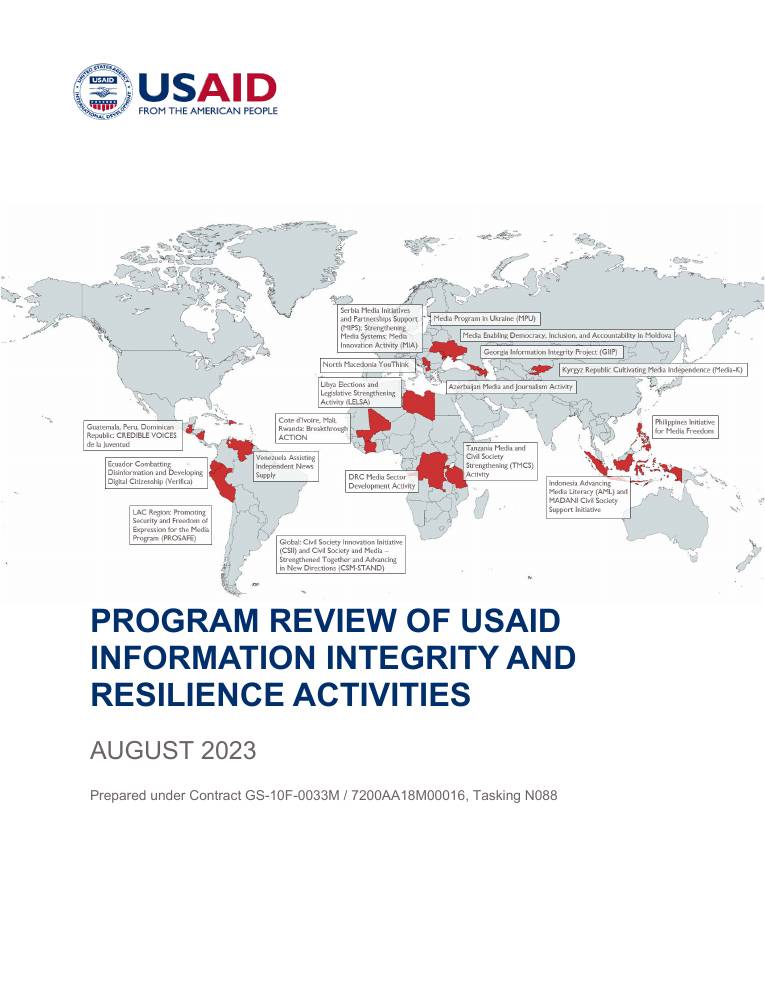
PROJECTS INCLUDED IN THE REVIEW
To assist USAID in charting the way
forward, this Program Review takes
stock of current activities and
approaches, the indicators being
used for monitoring and evaluation
(M&E), and the theories of change
(TOCs) that guide activities. It
assesses the availability of research
and evidence that USAID Missions
and Implementing Partners (IPs)
have collected to ascertain whether
there is an emerging evidence base
on what's working, what's not, and
why. While not a formal evaluation,
the stocktaking of available
evidence aims to provide USAID
with a foundation for making
programming decisions, identifying
gaps in the evidence base, and
developing monitoring, evaluation,
research, and learning (MERL)
strategies to fill those gaps.
Ukraine
Media Program in Ukraine (MPU)
Georgia
(GIIP)
Georgia Information Integrity Project
Serbia
Media Initiatives and Partnerships
Support (MIPS); Strengthening Media
Systems; Media Innovation Activity (MIA)
The Program Review draws on
information from 23 USAID-funded
projects implemented in 22
countries in all regions where
USAID works, including three
regional and global projects (see
text box). These projects provide a
representative sample of USAID’s
IIR activities. They were selected to
reflect the diverse set of projects
USAID supports, the vastly different
contexts in which they are
implemented, and the distinct
context-specific outcomes they aim
to achieve.
Peru, DR
N. Macedonia YouThink
Moldova
Media Enabling Democracy, Inclusion,
and Accountability in Moldova (Media-M)
Kyrgyz Rep.
K)
Cultivating Media Independence (Media-
Azerbaijan
Media and Journalism Activity
Tanzania
Tanzania Media and Civil Society
Strengthening (TMCS) Activity
DRC
Media Sector Development Activity
Cote d'Ivoire, Breakthrough ACTION
Mali, Rwanda
Ecuador
Combatting Disinformation and
Developing Digital Citizenship (Verifica)
Guatemala,
CREDIBLE VOICES de la Juventud
Venezuela
Assisting Independent News Supply
Nicaragua
Media Strengthening Program
LAC Regional Promoting Security and Freedom of
Expression for the Media Program
(PROSAFE)
Indonesia
Advancing Media Literacy (AML);
MADANI Civil Society Support Initiative
Philippines
Initiative for Media Freedom
Libya
Libya Elections and Legislative
Strengthening Activity (LELSA)
Global
Civil Society Innovation Initiative (CSII)
Global
Civil Society and Media -- Strengthened
Together and Advancing in New
Directions (CSM-STAND)
The report also includes seven
country case studies selected from
the broader set of countries included in the review: Ukraine, Georgia, Serbia, Indonesia,
|8
Nicaragua, Tanzania, and Libya. In the case study countries, the research team conducted indepth research through key informant interviews (KIIs) with Mission and IP staff, in addition to reviewing program documents. While no set of cases can fully capture the depth and breadth of
USAID’s IIR programming, the cases were selected in coordination with USAID to be
representative of the main contexts where USAID implements IIR activities and the types of
interventions it supports.
The report’s findings and recommendations are based on two information sources: an extensive
document review of more than 200 program documents provided by USAID and IPs, and 20
KIIs with 41 individuals, including USAID and IP personnel based in t the United States and
overseas.4
The projects included in this review operate in very different contexts and address distinct
issues and harms. Many projects are implemented in new and emerging democracies, where an
urgent priority is to support the emergence and capacity of independent media actors. Others
are implemented in countries where governments are hostile to media freedom or spread misand dis-information for instrumental political reasons. Another set of projects operate in contexts where malign foreign actors use MDM to weaken democratic institutions and undermine support
for the West and aligned governments.
USAID’s IIR programming encompasses a wide set of activities. Several included in this review
focus on media development, building on USAID’s long-standing efforts to foster independent,
high-quality media around the world by training journalists, improving newsroom capacity, and
improving the economic and regulatory environment for media. Typically, media development
activities do not conceptualize their goals in terms of countering MDM; more often, they aim to
improve the overall information ecosystem, contributing indirectly, if at all, to MDM efforts.
Examples include the Media Program in Ukraine (MPU), Strengthening Media Systems in
Serbia, and the Media Sector Development Activity in the Democratic Republic of the Congo.
Other activities—such as the Tanzania Media and Civil Society Strengthening (TMCS) Activity,
the Media Strengthening Program in Nicaragua, the Assisting Independent New Supply project
in Venezuela, and the Cultivating Media Independence project in the Kyrgyz Republic (MEDIAK) —provide critical lifelines to media outlets facing regimes that are hostile to independent information sources.
Multiple projects covered by this review focus on building societal resilience through media
literacy and public education. For example, the Media Literacy Program in Indonesia uses a set
of innovative strategies to inculcate skills needed to distinguish credible information sources
from MDM, particularly among new digital arrivals. In North Macedonia, USAID activities work
with the national education system to provide media literacy training through schools. In Latin
America, a regional activity helps in-country steering committees design civil society projects to
promote media literacy among young people.
The research team was not able to arrange interviews for one of the selected case study countries, Tanzania.
|9
A smaller number of activities in the review include components that directly aim to counter MDM through strategies including fact-checking, debunking, trust and safety strengthening, and strategic narratives. In Ukraine, USAID’s flagship IIR program, activities include a wide range of interventions, including components designed to counter false narratives from Russian news and social media related to the on-going war in Ukraine. One project, Breakthrough ACTION, focuses on combatting misinformation in the health sector, while two others aim to support civil society through regional hubs that build and support multi-country networks. To conceptualize the current scope of USAID’s investments in IIR programming as represented by the 23 projects included in this review, the research team developed an updated typology (see Figure 1 in Section 4) based on an initial version created by USAID’s Democracy, Resilience, and Innovation (DRI) Team. The typology groups activities into five broad categories with distinct goals and approaches. It relates these categories to the “supply and demand” conceptualization commonly used in IIR programming and shows how they overlap with goals related to Information Resilience (the ability of news ecosystems to produce high-quality, trustworthy content and citizens to access, identify, and interpret that content) and Harm Mitigation & Integrity (responses to the dissemination of MDM and the harms attributed to it), building on newer conceptualization of the IIR space.
The expanding focus on information integrity and resilience within USAID has created a need to take stock of current MERL approaches and to develop strategies for expanding the evidence base where gaps exist. Due to the inherent challenges of studying the effects of IIR activities on higher-order outcomes, donors and IPs typically focus on tracking outputs and short-term outcomes. Despite this, the document review and KIIs with USAID staff and IPs found a substantial evidence base for some interventions, particularly related to media development and media literacy/public education. While the evidence base for some newer approaches, particularly those that aim to directly counter MDM, is less developed, the review did not find evidence that any current approaches should be curtailed. As outlined below, the review recommends greater investment in MERL efforts to build the evidence base in several areas using a combination of qualitative and quantitative approaches.
Key Findings
The review offers 12 key findings, developed more fully in the main body of the report. An important caveat is that the findings are based on the 23 projects included in this review, not the full universe of USAID activities that relate to IIR goals. Accordingly, the findings are not exhaustive and may not be applicable to activity types not covered by this review. The findings are ordered sequentially according to the structure of the report, with those related to the stocktaking of activities first and others that relate to cross-cutting issues, MERL approaches, and program effectiveness following. This ordering is not meant to convey the relative importance of the individual findings.
1. Among the 23 activities reviewed, programming is concentrated in two main areas: media development and media literacy/public education. A smaller set of activities focus on supporting civil society; monitoring, understanding, and directly countering MDM; and
| 10
responding to MDM through strategic communications offering alternative narratives or debunking disinformation narratives.
2. While some activities explicitly seek to counter malign foreign influence, most reviewed for this report do not. Instead, many activities focus on other harms like limited government accountability, behaviors that negatively impact public health or social stability, and broader harms to democracy.
3. The diversity of USAID's IIR activities poses challenges for developing consistent approaches, TOCs, MERL strategies, and cumulative learnings. USAID currently supports a wide range of activities that respond to distinct issues in very different contexts. The objectives, TOCs, and MERL strategies reflect the diversity of activities, goals, and settings—making it difficult to develop standardized approaches and to accumulate evidence on what works in USAID’s IIR programming. While the available data is rich, it is more useful for answering questions about impact on the media sector or uptake of training materials than prevention or manipulation via MDM. Few activities are set up directly to address MDM and measure their effectiveness against that goal—a reflection of how new this priority is for USAID and the inherent challenges of measuring effects in the absence of counterfactuals.
4. Within USAID, there are differing views about the goals and objectives of IIR activities. USAID staff consulted for this report noted some important distinctions in how they understand core objectives. Some respondents conceptualize interventions as promoting information integrity and building a resilient media environment by ensuring the availability of credible information sources, while others view their efforts as designed to directly counter MDM, often related to context-specific threats and actors. While these differences may in part reflect contextual differences or lack of agreement on shared terminology, they have deeper significance since alternative frames inform how program designers and implementers conceive the theory of change and articulate the associated harms they aim to mitigate.
5. Respondents disagree on whether IIR activities should aim to produce social and behavior change. Even within the same program, IPs and USAID staff sometimes disagreed on whether behavior and attitudinal change was the goal of an activity or an appropriate measure of its success. This was especially true for media development and media literacy activities. However, in public health activities and strategic communications (specifically the Georgia Information Integrity Project), activities are explicitly aimed at changing individual attitudes, beliefs, and behaviors. Some USAID staff questioned whether strategic communications is part of USAID’s remit, while others cheered these approaches as innovative and more directly responsive to MDM than more common media development activities.
6. Relatedly, views differed on whether USAID is the right actor to pursue some types of strategic communications programming. The program review included two examples of activities categorized as strategic communications. USAID staff expressed uncertainty about
| 11
whether this approach should be adapted more widely across the Agency. Some expressed
concern that it is more suited to State Department public diplomacy efforts than international
development activities.
7. While there is widespread support for addressing cross-cutting issues related to
gender and marginalized/vulnerable groups, few activities make this a central goal.
Respondents expressed support for the general idea that USAID and IPs should do more to
address MDM related to gender and marginalized groups, including online harassment that
may increase the risks of violence against these groups and discourage participation in
politics, among other harms. Respondents agreed that these issues were often not
adequately considered during program design. Consistent with this, the program review
found that only eight of 23 activities incorporated cross-cutting issues in meaningful ways.
8. Respondents held differing views on whether IIR activities should be targeted to
address harms related to specific population segments. Some interviewees expressed
support for IIR activities designed to address group-specific harms experienced by women
and marginalized/vulnerable groups. However, others viewed activities as taking a “wholeof-society” approach that benefited all social segments, making targeting unnecessary. Additionally, there did not appear to be any programs addressing MDM with an
understanding of how gender norms and social cleavages are manipulated through
disinformation campaigns in order to influence political outcomes, including elections and
policy decisions. Some programs responded to instances of online violence against women
but they did not appear to be central objectives of any under this review—even though
gendered disinformation and misogynist narratives are a key strategy of some authoritarian
governments.5
9. TOCs are typically not assessed by existing MERL approaches. The TOCs articulated
in project documents often emphasize high-level, long-term impacts, including increased
availability of quality information, greater demand for impartial information, increased citizen
participation, improved inclusion and tolerance, and greater transparency and accountability
in government. These objectives are often long-term goals that would require decades to
achieve, even under the most favorable conditions. MERL plans, on the other hand, tend to
focus on outputs and short-term outcomes, including the number of journalists trained and
workshops held, the number of legal reforms attempted, the reach of content produced by
USAID-supported actors, and other related measures.
10. The focus on outputs and short-term outcomes in MERL plans reflects the inherent
difficulties of measuring long-term outcomes and impacts for most IIR activities. IIR
activities often face daunting challenges in assessing effectiveness since counterfactuals
cannot be observed, limiting opportunities to measure higher-order impacts with common
M&E indicators and approaches. In addition, many programs included in this review have
For reference, consider: “Monetizing Misogyny: Gendered Disinformation and the Undermining of
Women’s Rights and Democracy Globally,” Lucina Di Meco, She Persisted (February 2023), https://shepersisted.org/wp-content/uploads/2023/02/ShePersisted_MonetizingMisogyny.pdf.
| 12
not existed for long enough to measure their long-term impacts. Moreover, in some cases it is neither desirable nor feasible to focus on impacts, including in conflict-affected and transitioning countries, where evolving political conditions and project objectives may limit opportunities for measuring impacts. In other cases, though, opportunities exist for integrating MERL approaches that have the potential to narrow the gap between the goals expressed in TOCs and the data collected to track program effects.
11. There is a substantial evidence base for some well-established IIR interventions, particularly in relation to intermediate objectives. M&E data and academic literature suggest that media development and media literacy activities can be effective at building the capacity of media organizations and other stakeholders to provide accurate, unbiased information and helping citizens navigate complex information landscapes. However, because many media development projects were designed before countering MDM became a USAID priority, indicators and MERL plans for these activities seldom assess their broader impact on MDM.
12. The evidence base for some approaches, particularly newer, innovative strategies for countering MDM, is more limited. Some activities included in this review were too early in their implementation to provide concrete evidence of effectiveness. For example, Ecuador Verifica has just completed its first year. In addition, for some activity types it is not possible to assess the extent of the evidence base since only a small number or relevant activities were included in this review. For example, only two activities out of 23 focused on strategic communications. While the report offers insights from those activities, the research team cannot make broad inferences about the effectiveness of the overall approach from such a small sample.
Summary of Recommendations
Based on the key findings outlined above, as well as others described in subsequent sections, we offer a set of recommendations related to programming and MERL approaches to USAID and its partners. The recommendations are outlined in more detail at the end of the report. The ordering is not meant to reflect prioritization of some recommendations over others. Programmatic Recommendations
1. Make long-term investments in information integrity and resilience while pursuing short-term harm mitigation. USAID must be able to pursue both long-term change and rapid responses to emerging threats simultaneously. Whether short- or long-term approaches are most appropriate will depend on specific program objectives and contexts. For example, during elections, on-going conflicts, or crisis situations, a generational program to improve government accountability is not responsive to pressing needs. In these situations, USAID should have a ready set of short-term approaches to mitigate the risk of serious harms. More generally, however, USAID should invest in longer-term efforts to strengthen media environments and improve how citizens navigate information landscapes, building resilience to future shocks and challenges. Some activities, including strategic
| 13
communications capacity building, can address both short- and long-term objectives at the
same time: by enhancing civil society’s ability to influence public discourse through valuesbased messaging, USAID activities can promote long-term infrastructure used for advocacy of democratic values while also addressing more immediate threats.
2. Continue pursuing media development objectives independent of the IIR agenda—but
where appropriate, tie those activities to IIR-related goals and indicators and study
the relationship between the two areas more closely. Media development activities have
demonstrated positive effects on indicators related to their longstanding objectives: they can
quantify, for example, increases in revenue after adoption of best practices or improvements
in the perceived credibility of news content. However, as noted in the previous
recommendation, they do not typically measure whether investments in independent media
produce follow-on benefits by counteracting harms from MDM related to civic participation,
social cohesion, or societal distrust. A robust independent media is necessary but not
sufficient for information resilience. If USAID activities want media development activities to
speak more directly to harms from MDM, they should adopt directly relevant MERL
approaches. Additionally, USAID could support internal and external research exploring the
relationship between media development and information resilience more closely.
3. Prioritize testing and refining media literacy approaches. Media literacy and public
education are common components of IIR activities. As described in Section 4, the review
found that 43 percent (10 of 23) of activities included such components. Both USAID MERL
data and academic literature suggest that media literacy can be effective at reducing the
audience and impact of low-integrity information. However, few USAID activities are set up
to assess whether the provision of media literacy education leads to enduring changes in
behavior such as verifying source credibility or avoiding untrustworthy outlets. An exception
is the Advancing Media Literacy project in Indonesia, which iteratively tests and improves
digital media literacy campaign strategies and publishes the results in scholarly journals.
The content of curricula also varies widely. Academic literature provides many competing
variants of “media literacy” and suggests that information literacy specifically is important for
resilience against MDM. Given the prominence and promise of this intervention type, greater
resources should be devoted to studying the effectiveness of differing media literacy
approaches, curricula, and delivery mechanisms, with programmatic refinements made
based on the evolving evidence base.
4. Consider whether and how to proceed with strategic communications activities
designed to counter MDM in the political sphere. Despite the promise of strategic
communications activities, few activities included in this review adopt this strategy. USAID
should pause to consider whether and how it wants to proceed in this area of programming,
which carries both promise and risk. In doing so, it should emphasize collecting more
evidence of impact. As noted, the limited number of activities of this type included in this
review makes it difficult to adequately assess this approach.
| 14
5. Fund iterative, experimental activities designed to generate insights for future activities. USAID should support activities designed to test and repeat common approaches to fill crucial knowledge gaps. These might be shorter term initiatives or longer activities designed to include multiple iterative cycles. For example, USAID could explore the most effective ways to deliver media literacy training to adults outside the classroom through an iterative, adaptive program in one or more countries—borrowing insights from the Advancing Media Literacy project in Indonesia.
6. Consider ways of integrating non-media programming more fully in the information resilience and counter-MDM toolkit. As noted above, media development is the most common IIR activity type included in the activities covered by this report. In interviews, USAID staff and partners frequently mentioned activities using the arts and other avenues to promote social dialogue around key issues, like the public “Propagandarium” virtual reality exhibit on media literacy in Ukraine6 and partnerships with folk musicians in Georgia. USAID should expand linkages between media and other activities to avoid missing valuable opportunities to address IIR issues more holistically.
7. Develop objectives that match project scopes and timelines. For activities with TOCs, this means making them more narrow, achievable, and measurable by including a series of more modest, discrete steps that can be completed in the allotted timeframe and with available resources. Activities without a formal theory of change should also develop specific, achievable, and attributable objectives that reflect project timelines and the scope of activities. While this recommendation relates to MERL approaches, it is also important at the program design stage.
8. Encourage deeper consideration of GESI issues. As noted, relatively few of the activities in this review incorporate GESI considerations in program designs in meaningful ways. USAID and IPs should consider1) whether programming should more directly address harms specific to women and marginalized groups; 2) whether and how existing activities impact these groups differently than men and people from non-marginalized groups; and 3) how to make the positive impacts on women and people from marginalized groups sustainable.
MERL Recommendations
9. USAID should increase resources for a broad set of monitoring, evaluation, research, and learning approaches for IIR activities to expand the evidence base on what works. The biggest modifiable challenge related to assessing the impact of activities is a lack of resources, including funds, time, and staff. USAID should prioritize funding MERL and should expand the use of both qualitative and quantitative strategies as part of routine M&E conducted by IPs and through the greater use of independent evaluations and research. USAID should integrate research efforts into project M&E plans, with the goal of generating findings that can be shared with others working on IIR programming. The agency
https://internews.ua/en/project/propagandarium.
| 15
should also invest in independent research and evaluations that complement project M&E approaches.
10. Consider funding multi-project evaluations to expand the evidence base for priority activity areas. As noted in Finding 12, the evidence base for newer, innovative approaches is more limited. For priority areas where USAID needs to develop deeper understanding of effectiveness, the agency should fund evaluations that employ research designs beyond the scope of this review. For example, USAID could fund an evaluation that examines a specific intervention type, such as fact-checking or strategic communications. The evaluation would focus narrowly on activities that include such components and would include more substantial data collection and analysis—including more extensive document review, KIIs with a wider range of in-country partners, and the collection of original survey data. 11. USAID and IPs should consider increased usage of complexity-aware MERL strategies. Activities facing high uncertainty and that aim to quickly test interventions, adapt, and iterate can benefit from MERL systems that adapt with the activity.
12. Expand MERL approaches designed for adaptability, iteration, and learning. As noted in recommendation 5 above, USAID should consider expanding flexible, iterative program designs. As a complement, the agency can also employ iterative MERL strategies. For example, USAID’s OTI runs activities on significantly shorter timeframes than most USAID teams and includes frequent pauses to reflect, assess, learn, and adapt. This iterative process treats research and practice as a loop in which each component continually informs and supports the other. Other USAID activities could benefit from this approach, particularly those using newer, more innovative strategies for which there is a smaller evidence base. 13. USAID should increase the use of impact evaluation methods for some types of activities. Impact evaluations based on randomized controlled trials (RCTs) are the gold standard for evaluating program impacts. Building a stronger evidence base will require selectively identifying opportunities for using RCTs as part of a broad suite of monitoring and evaluation strategies. RCTs should complement, not replace, routine monitoring and performance evaluation strategies that are critical for tracking project implementation and learning lessons through other data collection methods. The Advancing Media Literacy project in Indonesia already incorporates RCTs, but more could follow suit. 14. USAID and IPs should track how activities affect women and people from marginalized groups as part of routine project monitoring. Activities should do more to monitor their GESI impact throughout the project life cycle with a combination of indicator data and qualitative data. Currently, most project indicators only track inclusion in activities (e.g., the number of women included in training sessions), rather than follow-on outcomes. 15. National opinion surveys in most cases should not be used for outcome indicators. National opinion surveys are valuable for understanding baseline attitudes and behaviors and tracking their evolution over time. However, national opinion surveys are typically not
| 16
appropriate for use as outcome indicators, since it usually impossible to attribute shifts in national-level data on views and behaviors to project activities, separate from the multitude of other influences.
16. Content reach is not a strong outcome indicator and should be coupled with other strategies for assessing audience impact, when possible. Many activities use audience reach indicators as evidence of program effects. While reach is important, it is only the first step in achieving meaningful effects related to project goals in many cases. To complement indicators that measure reach, activities should consider both qualitative and quantitative approaches that track impact.
2. INTRODUCTION
As part of the Democracy, Human Rights, and Governance Learning, Evaluation, and Research (DRG-LER) II Activity, USAID asked NORC at the University of Chicago to carry out a program review of USAID’s information integrity and resilience programming. This review aims to inform USAID’s Democracy, Resilience, and Innovation Team’s efforts to identify promising approaches, develop tools and trainings for USAID staff and to inform potential program design and USAID activities. This study will also help improve USAID’s MERL strategies.
Goals and Research Questions
The goal of the program review is to examine a representative set of USAID-funded activities related to information integrity and resilience. This review does not serve as an evaluation of USAID-funded activities; rather, it aims to take stock of USAID programming and examine TOCs, approaches to cross-cutting issues, monitoring and evaluation strategies, and evidence of effectiveness. The review is guided by a set of research questions (RQs) initially presented in the Concept Note for this task and subsequently refined with input from USAID after project launch:
(RQ1) Theories of Change. How do USAID projects define information integrity and resilience and conceptualize the harms associated with MDM? What types of theories of change are being used by projects seeking to prevent or address these harms? Are there ways to improve TOCs for USAID’s activities?
(RQ2) Stocktaking of Activities. What approaches are USAID and its implementing partners using to build information integrity and resilience and to counter MDM? How are these related to the above theories of change? What is the appropriate typology for information integrity and resilience projects and adjacent activities? Are there types of activities that are over- or under-represented?
(RQ3) Stocktaking of Approaches Related to Cross-Cutting Issues. What share of projects are addressing issues related to gender and marginalized groups (e.g., immigrants, minorities, LGBTQI+ communities, etc.)? What strategies are being used?
| 17
(RQ4) Stocktaking of MERL Approaches. What MERL strategies (and indicators) are currently being used by USAID and its implementing partners? Are TOCs being used to inform MERL strategies?
(RQ5) Analysis of Impact. Which of the current approaches seem to be working best to increase information integrity and resilience and to address MDM? Which of the current approaches have the most evidence to support their effectiveness? What contextual factors affect the impact of these approaches?
(RQ6) Recommendations. Which approaches appear to be most promising? What approaches are missing in USAID’s current activities? What indicators should USAID use to track program effectiveness? What additional MERL approaches should be considered?
Methodology
Document review. The research team compiled and examined more than 200 program documents provided by USAID related to 23 activities. The set of 23 activities was chosen by USAID from a list of more than 70 projects to provide a representative sample of the types of IIR activities supported by USAID and the contexts in which they are implemented.7 Documents included: (1) program work plans, (2) quarterly and annual reports, (3) MERL plans, and (4) evaluation/research reports (see Annex G for a complete list of documents). Based on this material, the team catalogued activities by type, refined the typology of USAID information integrity and resilience programming, and analyzed information related to the core research questions, focusing on TOCs, MERL strategies, cross-cutting issues, and evidence of impact. Key Informant Interviews. The study team conducted 23 KIIs with a total of 45 participants. This included interviews with headquarters personnel from USAID and Implementing Partners. The team also conducted interviews with USAID Mission staff and IPs in six case study countries: Ukraine, Georgia, Serbia, Libya, Nicaragua, and Indonesia.8 The KIIs for the case studies were designed to complement information obtained through the document review and allow for further exploration of core topics. The set of case study countries was chosen in collaboration with USAID to ensure the inclusion of multiple project types and implementing partners, and to cover multiple regions and political regime types. The study team conducted all KIIs remotely between May 12 and July 14, 2023.
Limitations
This program review encountered five main limitations.
1. The program review does not include all types of USAID-funded IIR activities. While the 23 activities included in this review cover many of the IIR interventions and As noted under Limitations, some activities are under-represented in this review, particularly those related to elections and conflict settings.
The set of case study countries also included Tanzania, though the research team was not able to arrange an interview with relevant personnel in time for this report.
| 18
contexts where they are implemented, the review is not exhaustive. USAID indicated the
Agency currently supports more than 70 activities that relate to IIR in one way or
another. Inevitably, due to time constraints, security concerns, communication delays
between USAID teams and missions, and information availability, the team was unable
to examine some project types, including interventions designed to address MDM during
elections and in conflict contexts apart from Ukraine.
2. Some IIR activity types were not well represented in the set of activities included
in this review. This review aimed to be inclusive of the main project types falling under
the IIR umbrella. This meant that for several activity areas, the review included just one
or two projects. For example, the review includes two activities that employ strategic
communications approaches, one health project, and two activities with substantial factchecking components. As a result, it is not possible to offer broad, general conclusions about these approaches or their effectiveness from such limited samples.
3. Access to program information was limited for some activities. In some cases, the
research team was not able to access documents containing information about aspects
of the activities included in the review. For example, we were unable to access
information about MERL indicators and approaches used for Nicaragua’s Media
Strengthening Program due its sensitive nature. In addition, the team was unable to
schedule KIIs with the Tanzania Mission or IPs for the TMCS activity. As a result, there
are gaps in the report’s description of some program components. Relatedly, the short
timeline for this review allowed very little time for follow up with Missions and IPs to
request additional documents or KIIs.
4. Data on project effectiveness is limited. The initial tasking request for this program
review asked that, in addition to other objectives, the research team assess “which
[activities] are more successful or promising and why or under what conditions these
interventions are most effective.” The research design anticipated that the team would
draw on three information sources to assess effectiveness: 1) program reports and M&E
data from the included activities, 2) KIIs with USAID personnel and IPs, and 3)
independent evaluations conducted by learning partners. However, the available
program documents mainly provided information on project activities and short-term
outputs, not outcomes/impacts that relate to broader questions about effectiveness. In
addition, the team was only able to access a small number of independent evaluations.
DESPITE THESE LIMITATIONS, THE REPORT offers notional conclusions about
effectiveness based on the available evidence. It also provides guidance on additional
MERL strategies that would expand the evidence base and allow for more definitive
conclusions where gaps exist.
5. The case study interviews were conducted jointly with Mission staff and IPs. Due
to the short timeline for this review, the research team opted to conduct joint KIIs for the
case studies that included both Mission personnel and IPs. In some cases, this may
have limited respondents’ ability to speak candidly, since Mission staff may have
| 19
hesitated to share critical comments about activities, and IPs may have demurred from sharing challenges and failures. Nonetheless, the team’s impression was that respondents were quite forthcoming in discussing both challenges and successes during the KIIs.
3. STOCKTAKING OF THEORIES OF CHANGE
RQ1.1: How do USAID activities define information integrity and resilience and conceptualize the harms associated with MDM?
RQ1.2: What types of TOCs are being used by activities seeking to prevent or address these harms?
This section explores competing conceptions of the core problem, examines the types of harms activities aim to address, and summarizes common interventions used to prevent or mitigate those harms. It also discusses how activities describe what they aim to achieve and how they hope to achieve it—often referred to as a “theory of change.”
The distinction between promoting high-integrity information and a resilient media environment and countering or preventing harms from MDM was an important theme during interviews. Which of these frames an activity used often informs its TOC—as does the way it articulates the associated harms.
Among the 23 activities included in this review, 12 contained an explicit TOC in documents provided to the research team (see Annex B). For activities without an explicit TOC, the research team inferred an implied TOC from stated objectives. The team also inquired about TOCs during KIIs for the case study countries. KII participants conveyed that the TOC pursued by an activity is influenced by multiple factors, including the social and political context, the overall donor landscape in a country, and the available implementing partners. While responding to malign foreign influence is often a goal of IIR activities, many focused on other harms such as reduced government accountability, behaviors that negatively impact public health or social stability, or abstract harms to democracy. The most sophisticated TOCs associated low-integrity information with specific harms and identified appropriate interventions.
Conceptualizing Harms
One challenge USAID faces is defining the problem. Three
main points emerge from the KIIs and document review
regarding the frameworks USAID and IP staff use to
conceptualize information integrity and resilience programming
and the harms associated with MDM. First, mis-, dis-, and malinformation remains the dominant framework used by most USAID personnel. Second, other frameworks, including one
recently developed by the National Science and Technology
Council in 2022, offer complementary approaches, despite
We agree with the
standard
definitions—disinformatio
n is intentional spread of
misinformation;
misinformation is
unintentional spread of
inaccurate information.
| 20
some important differences. Third, USAID-funded projects are designed to address a wide range of distinct harms related to MDM.
Definitional questions limit most attempts to describe the harms associated with mis-, dis-, and mal-information. All KII participants were familiar with the term MDM as laid out by Wardle and Hossein’s work on “Information Disorder.”9 Respondents typically understood these terms as Wardle and Hossein do: misinformation is the incidental, unintentional spread of false or misleading information—essentially rumors—while disinformation is understood to be intentional. (Mal-information is used less commonly and refers to accurate information used intentionally to harm, such as the release of hacked materials.) Some interview participants felt these terms and definitions, while widely cited, lacked a necessary degree of clarity around nuanced and sometimes sensitive issues. Several expressed an appetite for more precise terms, noting for example that even “MDM” obscures important differences between mis- and disinformation. Others said that terms like “countering MDM” and “foreign interference” evoke geopolitical aspects of strategic communications by external authoritarian governments, sometimes in contexts where domestic sources of MDM were more influential and harmful. Interviewees also expressed concern that responding to foreign influence does little to address underlying social issues such as food insecurity or conflict—which mis- and disinformation can exacerbate but rarely cause.
Wardle and Hossein’s “MDM” construct is not the only definition on offer. While this report does not endorse one framework in what remains an on-going debate, alternatives can provide useful insights. The National Science and Technology Council, a U.S. government (USG) interagency working group, provided a useful alternative in a December 2022 “Roadmap for Researchers on Priorities Related to Information Integrity Research and Development.” It distinguished between “high-integrity” and “low integrity information10 and defined “resilience” as the ability of people to operate in the context of potentially questionable information and of communities to “maintain appropriate levels of information integrity” despite uncertainty or active manipulations.”11 It described this as a separate priority from preventing or minimizing “avoidable harms” from information manipulation (a term with significant overlap with the “disinformation” component of “MDM”).
Claire Wardle. “Understanding Information Disorder,” First Draft News (September 22, 2020),
https://firstdraftnews.org/long-form-article/understanding-information-disorder/.
“Roadmap for Researchers on Priorities Related to Information Integrity Research and Development,” Information Integrity Research and Development Interagency Working Group, National Science and
Technology Council (December 2022), https://www.whitehouse.gov/wpcontent/uploads/2022/12/Roadmap-Information-Integrity-RD-2022.pdf. This framework distinguishes between “information integrity” and “information resilience,” two terms often used in KIIs but seldom defined as clearly as MDM. Not every KII participant agreed that these distinctions were significant. Some dismissed them as jargon, while others felt one or the other was more politically palatable. Most made some distinction along the lines above, and some felt that as a development agency USAID should work more holistically than a narrow “counter-MDM” frame or even media-bounded conceptions of resilience—that its work in this area should include larger issues of governance, democratic norms, and social cohesion and draw more often on civil society beyond the media sector like artists, activists, and advocacy organizations.
| 21
KII participants typically agreed that promoting information resilience is a longer-term, broader goal than countering MDM (or “low integrity information”). A few said that countering MDM was more “reactive” than promoting IIR. But mitigating harms from MDM—distinct from both countering it and promoting resilience—remains important. Contexts like elections or armed conflicts do not usually have the luxury of long-term transformations, and respondents in some KIIs warned that MDM can may never be fully solved, even through information resilience programming. Some cautioned that every project in the media program would somehow have to confront harms from MDM.
The roadmap, KIIs, and document review provide examples of potential harms USAID programming can address, either through resilience or harm reduction:
Individual susceptibility to fraud.
Negative health outcomes from false beliefs.
Safety concerns such as violence against women and violent extremism. Reputational harms such as defamation or politically motivated harassment. Reduction in rule of law.
Affective polarization (extreme antipathy toward members of another party). Manipulation of voter beliefs and behavior during elections. Participation in election violence.
Lack of faith in legitimate electoral outcomes.
Disengagement from civic processes; and
Distrust in political institutions and the media.
Stocktaking of Theories of Change
This review groups TOCs developed for USAID’s IIR activities into five categories, reflecting the distinct strategies they employ (see text box). This sub-section describes the TOCs that fall under each category and provides illustrative examples from activities that included an explicit TOC.
By far the two largest categories are: 1) activities
Five Categories of Theory of
working to support national media sectors through
Change:
systemic reform and increase capacity in individual
organizations and 2) activities helping citizens navigate
1. Systemic and Organizational
the media landscape through media literacy and factSupport to Media
checking. A smaller set of activities focus on connecting
2. Citizen Engagement with
and augmenting the work of other stakeholders, on
Information
monitoring and understanding MDM and its sources,
and on responding to MDM through strategic communications debunking disinformation narratives and offering alternative narratives.
Among the 23 activities covered in this review, 12 included explicit TOCs in the documents available to the research team (Annex B provides a complete list). For activities without an
| 22
explicit TOC, it was generally possible to infer what one might look like from project objectives
and activity descriptions, and from KIIs. While most explicit TOCs were clear and logically
coherent, some contained gaps, leaps of logic, or vagaries that can lead to disconnect between
the TOC and MERL indicators, as discussed in Section 5 on MERL approaches.
A key theme that emerged from the KIIs was a lack of clarity regarding whether TOCs should be
expressed in terms of lofty, long-term goals or more narrow, short-term objectives. Interviewees
questioned whether the intended changes should be conceived in broad, generational terms or
discrete, measurable steps detectable within project timelines. For some activities, especially
those that deal with attitudinal change or “change in people’s minds,” the right time horizon
might be generational. For others, like reforming media business practices, the program may
aim to achieve an objective and wind down after five to ten years. While there is no one-sizefits-all answer, interviewees emphasized the need for specificity on this question. As described in Section 5 on MERL strategies, the research team encourages USAID and IPs to generally
adopt narrower TOCs that imply specific measurable outcomes that plausibly could be attributed
to the project during its lifespan.
1. Systemic and organizational support to media. Activities sometimes draw an explicit link
between audience demand for high quality content—driven by their ability to recognize and
access it—and the increased supply of that content, driven by various forms of support to the
media sector, individual outlets, and related civil society groups.
Many activities centered their TOC on this support, which can include training for journalists,
legal and technological support, grants to modernize newsroom business practices, provision of
new infrastructure or equipment, advocacy for legal and regulatory reforms affecting the
enabling environment for media, and support for independent high-quality content, among other
things. KII respondents noted that much of this is “traditional media activity” that USAID has
supported for many years, and that these activities are valuable for reasons beyond contributing
to IIR. For example, some project documents pointed to the watchdog role of media, while
others emphasized that only professional, credible media can establish the bonds of trust with
audiences necessary to inform the public. Some stressed that to survive and reach their full
potential, media needs to make significant improvements to its business operations.
Example TOCs in this area include:
The purpose of [this program] was to increase media independence and create a more competitive and self-sustaining media environment [so that] citizens can be informed and hold their government accountable. To achieve its purpose, the Activity had two intermediate objectives: to support the development of a more enabling legal, regulatory, and market environment for media, and to support the development of financial sustainability, innovation, and partnerships in the media sector. (Serbia, Strengthening Media Systems)
If the legal and regulatory environment for media is strengthened, targeted media outlets become more independent and professional, and access to high quality
| 23
public interest reporting increases, the media sector will be more vibrant, independent, and capable of shaping democratic discourse. (Democratic Republic of the Congo, Media Sector Development Activity)
IF the media enabling environment…is improved and legal restrictions on the press and freedom of expression are reduced while journalist safety is promoted; and IF the skills and capacity of national media outlets, community radio stations, and journalists including women and youth is strengthened…THEN media and civil society will be better able to provide accurate and impartial information that represents the voices of all citizens, including women and youth, and enables citizens to engage in democratic processes. (Tanzania Media and Civil Society Strengthening Activity)
2. Citizen engagement with information. Activities in this area tend to focus on the wellinformed citizen as a necessary component of democracy. These activities often work to provide “neutral information” to audiences so they can, for example, make informed decisions during
elections. They might also seek to mitigate harms like voter suppression through disinformation.
Many activities focus on developing some element of media literacy. Media literacy is
understood in many different ways, and activities include those aiming to educate citizens about
the media ecosystem, raise awareness of MDM, and help citizens identify and avoid sharing
rumors and propaganda.
Examples of the types of TOCs used in this area include the following:
IF critical thinking skills and media information literacy among citizens are strengthened…THEN citizens will use more accurate, objective news and information in their decision-making. (Azerbaijan Media and Journalism Activity)
IF public demand for quality journalism grows…THEN the civically relevant role of media will be strengthened, and citizens will be equipped with quality information that counters malign influence and supports European integration. (Media Program in Ukraine)
IF youth gain and apply media literacy and critical thinking skills as part of their education and in other youth-friendly formats…and IF they demand and drive increased volume of high-quality, fact-based, and relevant professional media content, THEN youth will be able to not only navigate but also shape an information ecosystem that informs and engages as opposed to divides and polarizes, resulting in increased resilience to disinformation and efforts to undermine democracy. (North Macedonia, YouThink)
3. Networks and hubs focused on the information environment. Some activities aimed to increase the capacity of local partners through innovation or communications hubs dedicated to research, training, and co-creation of projects and campaigns to include combatting disinformation, promoting human rights, and supporting social change leaders and issues. The
| 24
follow project description implies a TOC in which regional hubs spur strategic responses to context-specific challenges:
The network is founded on the idea that regional hubs are the drivers of change and creators of innovations that address their civic space challenges. Over the years, the resources, innovation processes, research, workshops, and campaigns developed and used by each regional hub have flowed across the network and spread from one regional hub to another. (Civil Society Innovation Initiative)
4. Research and media monitoring. Other activities focused on understanding narratives within the media environment and how they spread. Interviewees said this was crucial for designing better interventions that effectively target context-specific sources of MDM, particularly in countries where assumptions about the sources of MDM and their influence have not been rigorously tested. But no project was primarily or solely devoted to researching, monitoring, or exposing MDM. Hub activities like the GIIP often included a research component. In fact, the GIIP was one of the few to mention a research tool in its TOC, shown below. 5. Strategic communications. The GIIP was also one of the few activities with a TOC in the final category: the use of strategic communications to offer alternatives to disinformation narratives. Its full TOC reads:
IF the USAID GIIP is able to map the actors, vectors, channels and audiences within the disinformation ecosystem in Georgia; AND IF: the project can bring together a diverse network of private and public sector actors across Georgia, building their capacity to work collectively to develop and test responses to disinformation identified through the ecosystem map, THEN: Network Partners can develop evidence-based, effective, scalable initiatives to counter disinformation in Georgia, sharing learnings throughout the network; AND IF: stakeholders can understand the impact of scalable solutions on target audiences, enabling the identification of sustainable responses to disinformation, and using learnings to drive advocacy for policy change at government level; THEN: vulnerable audiences in Georgia will develop and awareness of and response to disinformation, increasing societal resilience to misinformation and malign influence. (Georgia Information Integrity Project)
The alternative narratives offered by the GIIP were not intended to fact-check false claims. Rather, they can be seen as serving both a supply and a demand function: they supply narratives that reframe social issues for audiences in ways that lower the demand for MDM and reduce its effects. For example, the “Fruits of Heroism” social media campaign developed by the GIIP and its Georgian partners was designed to promote cohesion within Georgia and weaken disinformation narratives targeting anxieties about Georgia’s relationship with Europe and NATO. It encouraged consumers in Georgia’s capital city, Tbilisi, to buy produce from farmers living near occupied territories as a show of support. Individuals associated with this program said that communities in those areas often feel cut off, neglected by Tbilisi, and vulnerable to Russian hostility. This campaign recast them as patriotic heroes on the front line and
| 25
encouraged Georgians in the capital to consume produce from those regions in a show of solidarity.
4. STOCKTAKING OF ACTIVITIES
RQ2.1: What approaches are USAID and its implementing partners using to build
information integrity and resilience and to counter MDM?
RQ2.2: How are these related to the theories of change above?
RQ2.3: What is the appropriate typology for information integrity and resilience activities
and adjacent activities?
RQ2.4: Are there types of activities that are over- or under-represented?
This section takes stock of USAID’s information resilience and integrity activities, identifying
common approaches, relating activities to theories of change, and noting gaps in programming.
It also provides an updated typology of USAID-funded activities designed to assist USAID in
communicating current IIR programming in a concise, visual format for a variety of audiences,
including Mission personnel and others interested in exploring potential intervention strategies.
Across this new typology, the most prominent activities are those related to media development
and support, followed by media literacy efforts. These types of activities promote “information
resilience,” though media literacy can also be considered a form of harm mitigation. Less wellrepresented are “counter-MDM” approaches that aim to understand and respond directly to lowintegrity information and its purveyors. Several include research and media monitoring components; only a few incorporate strategic communications or “information resilience hubs”
designed to promote collaboration.
A Proposed Typology for USAID Activities Included in This Review
The proposed typology in Figure 1 aims offers a simple framework that groups current USAID IIR activities—as represented by the 23 activities included in this review—into a smaller number of broad categories. These are the same categories developed for the TOCs above; they apply as well to the assumptions and objectives behind activities as they do to the activities themselves. They are not meant to be reflective of the totality of U.S. government programming in this space. Other institutions, like the State Department and the Department of Defense, have their own activities, some of which overlap with this typology but some of which may not. Activities implemented by other government agencies are beyond the scope of this review. As a starting point, the research team considered the initial typology developed by USAID (included in Annex F). This typology captured most of the activities included in this review, but its nine categories had significant overlap. For example, legal and regulatory reform was included both as its own category and as an activity under media development. To make the typology easier to use and interpret, the revised typology condenses the nine original categories into five based on the similarity of their approaches and objectives.
| 26
The original typology also offered little analysis about how different categories addressed information resilience and MDM and how they compared with one another. This typology attempts to address this by organizing activities across two axes. First, column labels on the top of the typology show how the five categories relate to core goals connected to (1) information resilience (activities improving media production and consumption) and (2) harm mitigation and information integrity (activities focused more directly on understanding and reducing the effects of low-integrity information). Second, labels on the left show how the categories relate to the supply-demand categorization scheme that is commonly used to describe IIR/MDM approaches. Information resilience hubs, in the middle, increase capacity across other categories. Two additional points are important. First, many USAID-funded IIR program contain multiple activities, with components in more than one category. It is probably not feasible—or even helpful—to create a typology in which each program fits into only one category. Second, an important caveat is that the revised typology is based on the 23 activities included in this review and does not reflect other activity types that USAID—or other donors and IPs—may support. The remainder of this section describes each typology category and relates the 23 activities in the review to them.
| 27
Figure 1. Revised Typology of USAID Information Integrity and Resilience Programming
| 28
| 29
To examine how USAID-funded activities relate to this typology, the research team counted how many activities include components in each of the five categories and sub-categories (see Figure 2). As noted above, the most well-represented category is systemic and organizational support for media, which captures various supply-side strategies for improving IIR. The second most well-represented is improving citizen engagement with media—which includes methods for promoting IIR by increasing audience demand for high-integrity content and reducing demand for its opposite. Less well-represented are categories focused on understanding and mitigating harms from low-integrity information (either on the supply or demand side), including trust and safety strengthening and fact-checking. .
Figure 2. How USAID Supports Information Integrity and Resilience
| 30
Notes: Figure shows the number or activities (out of the 23 contained in this review) that include activities related to each activity type. Because a project may contain multiple activity types, the total does not add up to 23.
Category I: Media Organizational and Systemic Support (17 of 23 activities). Activities in this category tend to focus on increasing the “supply” of quality media. They may do so by improving the legal and regulatory environment for free media, improving the economic viability
| 31
and sustainability of media outlets through business
reforms
to media
or other
Activities
included
in Category
I: mechanisms,
supporting the ability of individual media outlets to reach audiences and create engaging Ukraine
Media Program in
content, and offering legal and security assistance
to embattled journalists. Many of these
Ukraine
activities can be described as “media development,” which the Center on International Media Serbia
Strengthening Media Systems
Assistance defines as “evolution and change in the fields of news media and communications,” Media Innovation Activity
related to a “range of institutions, practices, and behaviors including the rule of law, freedoms of Media Enablingcapacities
Democracy,of
expression and press, education systems for Moldova
journalists, business environments,
Inclusion, and Accountability
journalists and managers, as well as
Kyrgyz Republic
Cultivating Media
support for a diversity of views in
Independence
society.”12
Examples come from the case studies for
this report. In Ukraine, the media sector
is still transitioning from the Soviet era.
USAID activities have helped both the
national public broadcaster and 18
regional outlets transition from state to
public media, making them more
responsive to community information
needs. The MPU also supported
investigative journalism and provided
legal and security resources to journalists
who face legal and physical intimidation.
Other types of trainings offered by the
MPU have increased the professionalism
of the media sector, helping foster
audience trust in a media that is
increasingly balanced and objective.
MPU-supported civil society advocates
have also played a key role in supporting
media reforms and overcoming
legislation harmful to free expression.
Azerbaijan
Media and Journalism Activity
Tanzania
Media and Civil Society
Strengthening Activity
Africa Multi-Country
Breakthrough ACTION
DRC
Media Sector Development
Activity
LAC Multi-Country
CREDIBLE VOICES de la
Juventud
Venezuela
Assisting Independent News
Supply
Nicaragua
Media Strengthening Program
LAC Regional
Promoting Security and
Freedom of Expression for the
Media Program
Indonesia
MADANI Civil Society Support
Initiative
Philippines
Initiative for Media Freedom
Libya
Elections and Legislative
Strengthening Activity
Global
Civil Society &
Media—Strengthened
In Serbia, USAID and its partners have taken a different approach. The main barriers to independent media in Serbia are not legal or regulatory—they are financial. Years of dependence on grant funding have made many outlets slow and even resistant to adapting to the digital age and adopting strong business practices. In addition, state capture of the advertising market has made other sources of financing difficult for independent media to access. USAID has worked with these outlets to increase audience reach and improve the fiscal
It is important to note that this report uses media in a broad sense, referring to any actor providing information to the public. CSOs, for example, are not typically classified as media—but when they produce content meant to be consumed as a supplement to news and information, they are treated that way by this typology.
| 32
sustainability of outlets in a context that heavily favors state-friendly media. USAID has assisted media outlets to modernize their business practices and decrease their reliance on grants. The words organizational and systemic were chosen purposefully for Category 1 in the typology. Many activities in this review work to improve what is often called the “enabling environment” for media outlets—factors like the legal and regulatory regime and business climate for media. These activities help media as a system thrive. Other activities offer training, equipment, audience research, funding for content, or other forms of capacity and support to individual media partners.
Most activities in Category 1 were not developed primarily in response to MDM; many predate USAID’s focus on that priority. Partners and Missions have pivoted to address MDM and IIR themes more directly through these activities, but their initial designs, objectives, and MERL plans often do not mention or directly respond to MDM. They have come to take an indirect approach, blunting efforts at manipulation by creating more vibrant, sustainable, resilient media environments.
Category 1 also includes media infrastructure development. In interviews, one participant specifically noted that USAID activities include support for “hard infrastructure” that increases access in hard-to-reach areas. The respondent shared that, “Access to life-saving information is a piece in and of itself, but it’s also a place where disinformation can be particularly harmful.” Category II: Improving Citizen
Activities included in Category II:
Engagement with Media (11 of 23
Ukraine
Media Program in
activities). This category includes
Ukraine
efforts to better equip citizens to
Serbia
Media Initiatives and Partnerships
navigate the information environment,
Support
identify credible news sources, and
N. Macedonia
YouThink
distinguish them from untrustworthy
Moldova
Media Enabling Democracy,
sources. This often involves some
Inclusion, and Accountability
form of media literacy education—in
Kyrgyz Republic
Cultivating Media Independence
schools, through adult training
activities, or in other venues.
Ecuador
Combatting Disinformation and
Developing Digital Citizenship
Sometimes education occurs online
through social media campaigns or
LAC Multi-Country
CREDIBLE VOICES de la
Juventud
games designed to impart media
literacy skills or best practices. It also
Indonesia
Advancing Media Literacy
includes forms of content, like factMADANI Civil Society Support
checks, designed to help individuals
Initiative
assess the veracity of claims. Many of
Philippines
Initiative for Media Freedom
these activities aim to amplify their
Libya
Elections and Legislative
reach by providing training to
educators or peer-to-peer trainers, who share lessons learned with others.
| 33
Media literacy activities are both conceptually and practically diverse: there are many definitions of media literacy and many ways to deliver training. In Indonesia, USAID has partnered with a university to assess the effectiveness of an online game, memes, and short form videos at delivering media literacy education to populations known to engage MDM. In Ukraine, the MPU also contains a large media literacy component: it offers training to teachers, librarians, and other professionals as well as novel sources of media literacy awareness such as public exhibitions. In Ukraine these trainings teach media consumers to recognize, check, and avoid untrustworthy sources of information. Meanwhile, in Serbia, USAID’s MIPS program teaches news consumers about the country’s media landscape, how media ownership is distributed, and how journalism is produced in Serbian society.
TOCs in this category often emphasize the relationship between a robust media and an informed citizenry capable of holding government actors accountable—what one program called a “vibrant, independent media sector capable of shaping democratic discourse.” They sometimes frame this as increasing “demand” for high-quality content by helping citizens recognize and access trustworthy journalism. The relationship between supply and demand means there is significant overlap between Category I (systemic and operational support for media) and Category II (improving citizen engagement with media). Most projects with activities in Category II also included components in Category I.
Category III: Understanding, Exposing, and Responding to MDM (8 of 23 activities). This category includes efforts to monitor disinformation, expose its sources, understand how it spreads, and evaluate or pursue appropriate responses. Sometimes this takes the form of media-monitoring. When fact-checking is used to inform programmatic or other responses in addition to correcting claims for the public, it can also fit in this category. Likewise, efforts to strengthen social media platform trust and safety fit in this category. Because these activities take MDM and its spread as their focus, they are considered to be “supply-side” activities looking to detect and reduce low-integrity information.
Relatively few of the 23 activities reviewed
for this report fell in Category III. Only two
of them comprised activities other than
research, and their TOCs rarely hinged on
these activities; this may be appropriate
from the standpoint that too much
research merely “admires the problem.” In
the activities reviewed, research and
monitoring were often more practical: they
support and inform other programming
goals, such as capacity-building, media
literacy training for election officials, or
strategic communications. This was the
case in Ukraine, where media monitoring
helps assess the professionalism of
outlets receiving USAID support. In
Activities included in Category III:
Ukraine
Ukraine
Media Program in
Georgia
Information Integrity Project
Serbia
Media Initiatives and
Partnerships Support
Moldova
Media Enabling Democracy,
Inclusion, and Accountability
Kyrgyz Republic
Cultivating Media
Independence
Africa Multi-Country
Breakthrough ACTION
Ecuador
Combatting Disinformation
and Developing Digital
Citizenship
Global
Civil Society Innovation
Initiative
| 34
Ecuador, USAID activities work with public officials and other key stakeholders to improve media literacy and monitor disinformation narratives affecting the country. There is significant overlap between this category and Category V (information resilience hubs); three of the four activities included in this category were also included in Category V. This is probably a reflection of the fact that research findings are valuable to many organizations, making it useful to embed research in network-building activities so researchers can collaborate and findings can be shared widely.
Category IV: Strategic Communications (2 of 23 activities). Only two activities—the GIIP and Cultivating Media Independent in the Kyrgyz Republic—contained significant strategic communications components. Of these, the most illustrative was the GIIP, which serves as a capacity hub helping civil society and media create communications campaigns (among other things).
Some of these involve what this review
Activities included in Category IV:
calls “narrative debunking,” or the use of
Georgia
Information Integrity Project
messages to directly rebut MDM
narratives—for example, Russian claims
Kyrgyz Republic
Cultivating Media
Independence
that NATO sought to open a second front
in the Ukraine conflict by drawing Georgia
into war with Russia, countered by a campaign proclaiming “Russia Wants War, Not the West,” which resulted in several MPs from the ruling party walking back previous allegations about NATO. Narrative debunking isn’t fact-checking. It doesn’t focus on the factual basis for specific claims, but instead addresses the bigger story being told. But it is not counter-propaganda, since it still relies on factual information to tell an accurate version of the story. Other communications approaches tackle MDM less directly and seek to provide alternative narratives to audiences. These narratives are also not fact-checking activities; rather, they are designed to reframe social discourse in ways that promote social cohesion and democratic governance. In doing so, they may make MDM less appealing for news consumers or less impactful for those who do consume it.
Strategic communications as a category might be considered both supply- and demand-focused because content produced by activities like the GIIP is meant (in part) to reduce demand for other, more harmful content. It is also distinct from other USG activities often described as “strategic communications,” including forms of public affairs or public diplomacy. Because the GIIP was conceived as a capacity-building network, most of the activity indicators have more to do with capacity building of partner organizations than the effectiveness of their communications efforts. An exception is an indicator related to the reach of communications campaigns developed through the GIIP. The limitation is that reach says little about how those campaigns impact the audience. According to interview participants, GIIP measures this through qualitative data from focus groups and sentiment analysis of social media
| 35
comments—information that is not routinely included along with other M&E data provided to USAID staff in Washington.
Category V: Information Resilience
Activities included in Category V:
Hubs (4 of 23 activities). Finally,
Georgia
Information Integrity Project
information resilience hubs help
Ecuador
Combatting Disinformation
coordinate and augment the activities of
and Developing Digital
partner organizations linked together in a
Citizenship
network. While the GIIP is a flagship
LAC Multi-Country
CREDIBLE VOICES de la
program for this category, three other
Juventud
activities contain networking, coordination,
Global
Civil Society Innovation
and capacity building elements:
Initiative
CREDIBLE VOICES de la Juventud,
Ecuador Verifica, and the Civil Society Innovation Initiative (CSII). These are not all related to strategic communications in the same manner as the GIIP; Ecuador Verifica and the CSII, for example, involved more researching, monitoring, and exposing of low-integrity information, while CREDIBLE VOICES is concerned with the operational capacity and media literacy of key stakeholder groups.
5.
STOCKTAKING OF APPROACHES RELATED TO CROSSCUTTING ISSUES
RQ3.1: What share of activities are addressing issues related to gender and marginalized groups (e.g., immigrants, minorities, LGBTQI+ communities, etc.)?
RQ3.2: What strategies are being used?
Across the 23 activities included in this review, there was significant variation in the extent to which activities prioritized and addressed cross-cutting issues, including GESI and engagement of marginalized groups (e.g., youth, immigrants, minorities, indigenous, disabled, and LGBTQI+ communities.). Of the 23 activities reviewed, eight incorporated these cross-cutting issues in meaningful13 ways and nine did so in cursory14 ways. For the other six, the research team found no evidence of GESI inclusion in the documents we reviewed and the discussions we had with program staff. However, it should be noted that the research team only had interviews with personnel involved in two of the six activities that had not incorporated GESI principles, and it is possible that we were simply missing GESI-related documents for the others.
By “meaningful,” we mean programs that included activities explicitly designed to address issues or challenges faced by one or more of these groups. These activities showed a deep level of consideration of GESI issues, beyond simply ensuring that women and marginalized groups had access to their programming.
By “somewhat cursory,” we mean programs whose activities showed a relatively shallow consideration of GESI issues. This typically included ensuring that women and marginalized groups had access to their programming. We also included a couple of programs that had no documented GESI planning but whose activities had a positive effect on women and marginalized groups.
| 36
Most interview respondents agreed that GESI and
Programs with Evidence of
engagement of marginalized groups were important
Meaningful GESI Incorporation
considerations in designing IIR activities. Respondents
noted with concern that disinformation related to gender
Azerbaijan Media and
and marginalized groups can be used to incite violence
Journalism Activity
against these groups and to push women and
CSM-STAND
marginalized people out of politics. Bad actors may
DRC Media Sector
exploit entrenched biases and patriarchal norms to
Development Activity
defame political rivals and mobilize public support from
conservative social factions. Appeals based on gendered disinformation harm not only individual
candidates but can undermine democratic processes more broadly. These problems are often
difficult to address with traditional counter-MDM activities, such as fact-checking, because they
tap into entrenched biases. Furthermore, some key informants reported that disinformation
campaigns target women and people from marginalized groups differently than nonmarginalized men. The attacks tend to be more personal and more likely to lead to real-world violence—calling for more attention to the distinct ways in which MDM impacts women.
Despite widespread support for addressing cross-cutting issues in IIR activities, these issues
are often not a central priority during program design. One respondent noted that too often in
USAID when people think about gender, they think only about gender-based violence,
overlooking the need for gender approaches in other programming. We also noted a lack of
consensus on the importance of GESI approaches in our conversations with USAID Mission
staff and implementing partners. Respondents varied in how much such issues should be
priority focus areas for IIR activities. Although many respondents expressed support for GESI
approaches, some said gender was not relevant to their activities. When asked how they build
considerations of gender and marginalized communities into programming, one respondent
said, “not really much…information affects everyone no matter their gender. Disinformation
narratives target men and women equally.” This view is inconsistent with the facts in many
contexts.15 Another respondent noted that because their program targeted small media
organizations, most run by women or people from other marginalized groups, there was no
need to target these groups or adopt a GESI lens for program design.
Examples of strategies used to address cross-cutting issues are presented in Table 1. Activities
with cursory inclusion of GESI issues tended to target women and people from other
marginalized groups to participate in their activities or had some indicators disaggregated by
gender, ethnicity, or age. Activities with more substantial incorporation of GESI issues used a
variety of approaches, including promoting GESI topics to public audiences elevating
marginalized voices, fostering dialogue, ensuring accessibility, protecting marginalized
communities, creating GESI MERL approaches, and supporting organizational change or
capacity building. Projects with more holistic approaches typically used multiple methods to
ensure their activities comprehensively addressed GESI topics. These approaches focused on
both individual inclusion or protection, such as ensuring accessibility for people with disabilities,
Victoria Scott, “Understanding the Gender Dimensions of Disinformation,” Countering Disinfo (April 1,
2021), https://counteringdisinformation.org/node/13/.
| 37
and activities that indirectly address the exploitation of gender norms and other biases by promoting alternative narratives and increasing community-wide understanding of GESI issues, such as elevating the voices of women and marginalized groups). However, none of the activities directly addressed the exploitation of gender norms and other biases, such as those related to online (which leads to offline) violence against women.
| 38
Table 1. Strategies Used by IIR/MDM Activities to Meaningfully Incorporate GESI Topics MEANINGFUL INCORPORATION OF GESI TOPICS
Supporting Organizational Change and Capacity Building
Ensured that activities and training sessions included a critical review of gender roles, norms, and dynamics in target communities and within partner organizations and participating organizations.
Raised awareness of the need for gender-sensitive reporting within newsrooms.
Increased opportunities for women in media.
Increased the coordination and capacity of civil society organizations (CSOs) to apply social and behavioral change principles that engage and empower communities to eliminate all forms of human rights violations and GBV against LGBTQI+ communities.
Increased inclusion of women in CSOs.
Mainstreamed gender issues into CSO daily activities.
Focused on developing media organization and CSO ability to advance GESI issues, empower women, and develop policies related to gender equity and inclusion.
Elevating Marginalized Voices and Fostering Dialogue
Used publications and live programming to make marginalized groups, such as women, indigenous communities, LGBTQI+ communities, and migrants, more visible.
Supported content creators, media organizations, and educators to promote equity by elevating women’s voices and amplifying stories offered through perspectives of marginalized groups.
Supported the production of radio content in local languages and included audio and visual resources—in part in local languages—on social media platforms preferred by women.
Collaborated with media organizations from marginalized groups to disseminate stories.
Created a safe and democratic space for dialogue by supporting the dissemination of media content by, for, and about women and youth, and incorporating women and youth voices, issues, and perspectives in talk shows, social media, and online conversations.
| 39
Protecting Marginalized Communities
Provided gender sensitivity training for journalists and physical security training for female journalists in war zones.
Recognized the unique risks that marginalized groups face and analyzed or mitigated these.
Promoting GESI Topics to General Public Audiences
Developed media / CSO capacity to use a GESI lens to consider the way they report on issues.
Carried out gender awareness campaigns within social networks.
Supported content creation on socially important topics such as gender equality, minority rights, rights of elderly people, and rights of persons with disabilities.
Created content on gender issues.
Encouraged journalists to commit to better gender balance in quoting experts.
Ensuring Accessibility
Ensured all project activities are accessible for people with disabilities and provided accommodation as needed.
Considered issues related to internet/device access and connectivity for activities that required an online learning environment.
Creating GESI MERL Approaches
6.
Incorporated a gender-sensitive and inclusion awareness approach to all M&E activities and methodologies to ensure an accurate understanding of the level of participation according to gender identity, ethnic and linguistic identity, rural or urban status, minority subgroups, and other factors.
STOCKTAKING OF MERL APPROACHES
RQ4.1: What MERL strategies (and indicators) are currently being used by USAID and its implementing partners?
RQ4.2: Are TOCs being used to inform MERL strategies?
This section provides an overview of MERL strategies employed in the 23 activities included in this review. We note that activities rely mainly on theory-based MEL approaches and suggest
| 40
projects could benefit from greater use of complexity-aware MEL (CAMEL). The section then
describes common indicators used for the main activity types and examines how they relate to
TOCs. A key finding is that most MEL plans focus on output and short-term outcomes rather
than higher-order impacts. While this reflects the inherent difficulty of measuring impacts for
most IIR activities, it means that TOCs often cannot be assessed with project M&E data. Finally,
the section notes that KII respondents consistently reported MERL efforts are hampered by
insufficient resources, including funds, time, and staff availability.
M&E Strategies
The MERL strategies used by activities can be categorized into two types of approaches:
theory-based MERL16 and CAMEL.17 These are complementary approaches that are often used
together. All activities in this review engaged in theory-based MERL by developing results
frameworks and collecting monitoring data on preselected indicators.18 Complexity-aware
approaches are used by some activities to track unpredicted outcomes.
Theory-based MERL is the more common approach. It focuses on assessing the predictable
aspects of an activity based on work plans, results frameworks, and TOCs. This type of MERL
typically uses indicators and targets to assess an activity’s progress. Complexity-aware
approaches, on the other hand, focus on monitoring unpredictable aspects of an activity. This
includes identifying changes in the external context of the program, emergent or unexpected
program outcomes, and other uncertain or contested aspects of an activity. The complexityaware approach typically does not use indicators or targets, which would require predictions. Instead, activities identify aspects of the program that may be vulnerable to complexity by noting
the outcomes that might be at risk if key assumptions do not hold or areas where outcomes are
simply difficult to predict in advance. Then, the program collects data on those areas so it can
adapt, as needed.
Review of Indicators
The vast majority of indicators included in M&E plans measure program outputs (e.g., number of
people reached, number of social media acts of engagement) or short-term outcomes (e.g.,
percent of trainees with increased knowledge after the training, average increase in revenue for
supported media organizations). Few indicators of longer-term outcomes or impact were noted.
Table 2 provides a list of illustrative indicators used across some of the major activity types. A
complete list of all indicators used by activities in this review is included in Annex C.
The Monitoring & Evaluation Toolkit. (n.d.) Theory-Based Approach. Available at
https://thetoolkit.me/approaches-tools/theory-based/
USAID, Discussion Note: Complexity-Aware Monitoring (2021), Available at
https://usaidlearninglab.org/sites/default/files/resource/files/dn_-_complexityaware_monitoring_final2021_1.pdf We were able to obtain MEL plans, learning agendas, quality assurance surveillance plans, or performance management plans for 12 of the 23 programs. However, a review of other documents, including work plans, quarterly reports, and evaluation reports, it was clear that other programs had monitoring indicators based on development objectives and intended results within a results framework.
| 41
Table 2. Illustrative List of Indicators by Program Type Indicator
Indicator Type
Media Organizational and Systemic Support:
Media Development Activities
Number of journalists trained and supported
Output
Number of non-state news outlets assisted by United States government
Output
Number of media system actors that receive assistance on content format, promoting media partnerships, developing management and financial strategies
Output
Number of journalists applying new media tools following participation in project activities
Outcome
Percent of target radio stations with increased revenue from nongrant sources
Outcome
Average score on the media-sector organizational capacity assessment
Outcome
Media Organizational and Systemic Support:
Legal and Regulatory Support Activities
Number of advocacy actions supported by project
Output
Number of instances of legal advice provided to journalists and media managers
Output
Number of public policies adopted, repealed, changed, or implemented with United States government assistance
Outcome
Number of laws, policies, or regulations improved as a result of United States government-supported engagement on targeted issues
Outcome
Media Organizational and Systemic Support:
Content Support Activities
Number of reports/pieces of content produced with United States government support
Output
Number of followers of grassroots campaigns supported by advocacy innovation fund
Output
Audience of socially relevant content produced with United States government support
Outcome
Improving Citizen Engagement with Media:
Media Literacy Activities
Number of people trained to detect and combat disinformation in
Output
| 42
electoral processes
Total number of individuals reached by project media and digital literacy activities
Output
Percent reduction among the treatment population in loyalty to unreliable media sources
Outcome
Percent of individuals with improved digital literacy following participation in United States government-assisted activities
Outcome
Understanding, Exposing, and Reacting to MDM:
Research Activities
Number of partners engaged in investigations
Output
Number of learning products created based on audience research findings
Output
Number of articles/media content (including TV programs) created based on investigation findings
Outcome
Understanding, Exposing, and Reacting to MDM:
Media Monitoring Activities
Number of media monitoring reports published/presented for public discussion
Output
Number of disinformation networks detected and reported
Output
Information Resilience Hubs
Number of partners trained
Output
Number of stakeholders, organizations, and partners in the network
Output
Number of jointly developed interventions
Output
Number of new actors who started counter disinformation interventions
Outcome
Number of new policies/strategies/initiatives developed by the network and the government
Outcome
Media Organizational and Systemic Development: Many activities in this category have indicators that relate to media development outcomes. However, not every program directly ties output indicators to outcomes. For example, many activities measure the number of journalists trained or supported, without measuring changes in the impact those journalists make on the information environment – likely due to the difficulty of quantifying higher-order impacts. To fill the gap between outputs and outcomes, some projects rely on qualitative measures, like the passage of reforms after an advocacy campaign. While causality can be difficult to demonstrate in these cases, such indicators still provide useful evidence of impact.
| 43
Improving Citizen Engagement with Media: It can be difficult to draw a causal line connecting participation in media literacy interventions, retention of the lessons learned, their application in daily life, and changed behaviors. At their most rigorous, MERL plans for activities in this category may conduct controlled trials to establish a causal link between outputs such as training and outcomes such as improved literacy. More often, activities use qualitative research to help fill this gap in casual inference. However, that research is not always included in MERL documents.
Understanding, Exposing, and Reacting to MDM: Interestingly, this review found few outcome indicators for activities in this category, likely due to the small number of activities in this category and the fact that the most obvious outcome indicator—the number of actors who take up research findings—does not measure whether that uptake improved their work in the desired way.
Information Resilience Hubs: MERL plans for these activities typically contain metrics designed to capture increased organizational capacity among partner groups, the degree of collaboration and sharing within the network, and the number and impact of key outputs like trainings or communication campaigns. In the activities reviewed for this report, these were often measured through a combination of hard numbers (such as individuals receiving training) and the use of surveys and other tools to gauge increases in partner capacity.
There’s a missing piece. We’ve
Do Theories of Change Inform MERL Strategies?
got output indicators, outcome
indicators, and then sometimes
Activities with explicit TOCs consistently develop MERL
huge impact indicators, like
strategies informed by those TOCs. However, activities
whether a country is a democracy.
typically focus on collecting data related to the “IF”
And nothing in between.
statements and not the “THEN” statements from the
TOC. In some cases, the nature of the “THEN”
• Interview Respondent statements, which are often expressed in terms of ambitious, long-term (sometimes generational) changes, inhibits measurement. As a result, we can see whether IPs successfully implement the program, but we often cannot see whether activities led to the desired impact or whether their TOCs held true overall. As one key informant stated, “There’s a missing piece. We’ve got output indicators, outcome indicators, and then sometimes huge impact indicators, like whether a country is a democracy. And nothing in between.” As a result, there are gaps in knowledge about causal chains and whether or how particular interventions contributes to larger societal or institutional changes related to IIR and MDM. An illustrative example of the challenges activities have with theory-based MERL is presented in Figure 3. Although the program changes described in this example are unique, the challenges related to the TOC are representative of the activities included in this review.
| 44
Figure 3. Illustrative Example of Theory-Based MERL Challenges
One program included in this program review had a theory of change that said, “If media independence is increased and if a more competitive and self-sustaining media environment is created, then citizens can be informed and hold their government accountable.” This theory of change has a few issues that make it difficult to evaluate.
1. This theory of change seems to be missing some critical steps/assumptions between the “IF” and “THEN” statements. It does not specify what needs to happen between media independence increasing in a competitive and self-sustained media environment so that citizens can be informed and hold their government accountable.
2. The “THEN” statement is a very long-term goal, one that would likely take much longer than the typical five-year project lifespan.
3. USAID requested that the project cut its media environment improvement activities and focus on supporting media independence, but the documents we reviewed did not show any updates to the program’s theory of change. It was not clear whether 1) the program made this change because they believed the theory of change was wrong and “a more competitive and self-sustaining media environment” was no longer needed to achieve the “THEN” statement, or 2) the program no longer expected to achieve the “THEN” statement since it was now missing a critical piece of the initial theory of change.
4. The program never measured the “THEN” statement, making it impossible to evaluate the accuracy of the theory of change.
Common Challenges: Complexity and Resources
| 45
Interview respondents noted several challenges in measuring the outcomes and impact of IIR and countering MDM activities. Chief among these challenges is the fact that IIR/MDM take place in complex, ever-changing contexts and we have very limited knowledge about how changes in the context affect activity goals. Thus, it is difficult to assess the degree to which observed outcomes and impacts can be attributed to the activity.
Interview respondents noted that building IIR and countering MDM are “complex” or “wicked” problems – posing significant challenges for developing appropriate MERL strategies. Complex problems are those for which there are key knowledge gaps in the scientific evidence about the problem or the solutions, and for which multiple stakeholders, each with different expertise and knowledge gaps, are required to address the issue. Evidence-based decisions are often difficult to make because of gaps in knowledge. Wicked problems are those for which there is minimal scientific evidence about the problem or the solutions, and multiple stakeholders, often with conflicting values or interests, are required to address the issue. Making purely evidence-based decisions is often impossible, due not only to the lack of evidence but also to the lack of agreement among stakeholders.19,20
Because of this complexity or wickedness, and because addressing IIR/MDM issues typically requires changes to entire systems (e.g., media environments, social attitudes or cohesion), it can be difficult or impossible to predict all the effects an activity will have on society. Many activities acknowledged this and integrated complexity-aware MEL approaches into their MEL plans to monitor for emergent activity outcomes or changes in context that would affect the activity’s ability to meet their intended outcomes. CAMEL approaches used in the activities we reviewed include outcome harvesting; the use of sentinel indicators to watch for changes in context; developing and implementing learning agendas that cover complex aspects of an activity, like how to build audience trust; and conducting learning activities, such as pause and reflect sessions.
The other major challenge reported was a lack of appropriate resources for MEL. Respondents were quick to point out that the resources needed include funding, time, and staff. It can be difficult to find MEL experts with sufficient complexity-aware and systems-thinking skills to support IIR/MDM activities. Furthermore, to do complexity-aware monitoring well, activities either need more time or they need to reduce the size of their theory-based monitoring plans so staff can shift their focus. Respondents also noted that it would be helpful for USAID to provide more encouragement to update TOCs and results frameworks as activities adapt to changes in the context or in USAID requirements.
John Alford and Brian Head, “Wicked and less wicked problems: A typology and a contingency framework,” Policy and Society (2017): 36: 397-413.
Independent Group of Scientists appointed by the Secretary-General, Global Sustainable Development Report 2019: The Future is Now – Science for Achieving Sustainable Development, United Nations, New York (2019).
| 46
7.
ANALYSIS OF IMPACT
RQ5.1: Which current approaches seem to be working best to increase information
resilience and integrity and to address MDM?
RQ5.2: Which current approaches have the most evidence to support their
effectiveness?
RQ5.3: What contextual factors affect the impact of these approaches?
This section presents key findings related to the analysis of what’s working, the evidence base
for assessing effectiveness, and contextual factors. The findings reflect perspectives shared
with the research team by USAID personnel and IPs, along with the team’s own review of the
available evidence from M&E documents, evaluations, and other activity materials. We outline
three principal findings organized in relation to the five categories of activities defined by the
proposed typology in Section 4.
First, there is a substantial evidence base for activities in Category 1: Media
Organizational and Systemic Support. Evidence shows these activities have strengthened
media outlets, increased the capacity to provide high-quality content, and improved legal and
regulatory frameworks in many contexts. As noted throughout this report, media development is
among the predominant IIR strategies currently employed by USAID and builds on decades of
experience from all regions where USAID works. Among the 23 activities covered by this
review, 15 included media development components. Implementing partners employ welldeveloped strategies that have been tested and refined over many years. As described below, the research team observed clear evidence of effectiveness for activities implemented in diverse
contexts, including but not limited to Ukraine, Serbia, and the Democratic Republic of the
Congo.
At the same time, we note that media development activities historically have not defined their
goals in terms of countering MDM, and there is disagreement among USAID and IP staff about
whether media development activities can or should do so. Thus, the Media Program in Ukraine
explicitly aims to counter MDM indirectly by improving the overall information ecosystem. Other
activities, including in Tanzania, Serbia, and Nicaragua, do not explicitly include countering
MDM as a project objective. A priority for USAID going forward will be to continue internal
discussion about whether and how the Agency relates media development to MDM
programming, and to invest in studying the effectiveness of such activities in building societal
resilience to MDM.
Second, there is also a substantial evidence base for activities in Category 2: Improving
Citizen Engagement with Media. Media literacy and public education activities, in particular,
have been shown to help citizens become critical consumers of media and avoid non-credible
information sources. As described below, several activities in this review offer evidence of
effectiveness, including in Ukraine, where national-level surveys suggest the activity has
| 47
contributed to increased public ability to identify credible news sources and may have contributed to a decline in consumption of Russian-backed media—though we caution that it is difficult to isolate project effects from other factors that may have influenced this shift. An important caveat from academic literature is that not all types of media literacy are created equal: teaching verification skills appears to be much more effective for building resilience against online falsehoods than for understanding of digital technology, the media industry, or journalistic ethics. USAID’s media literacy activities employ a wide range of approaches, and the agency should prioritize those shown to be most impactful.
For fact-checking, the evidence base is more limited, in part because relatively few activities in the review included substantial fact-checking components, and the available M&E data focuses on outputs, like the number of items debunked or reports produced, not higher-order impacts related to citizen consumption or internalization of misinformation. KII respondents held mixed views on whether fact-checking should be a core investment for USAID.
Third, for activities in Categories 3 – 5, the evidence base is limited. This stems in part from the fact that some interventions in these categories reflect newer, innovative approaches that have not been studied as extensively as more well-established strategies. In addition, as noted in the Limitations section above, this review included only a small number of activities in these categories, limiting the team’s ability to identify common themes. For Category 3: Understanding, Exposing, and Reacting to MDM, examples from Georgia, Ukraine, and the global Civil Society Innovation Initiative show how research and monitoring can inform other activity areas by assessing the professionalism of a country’s media sector, identifying underserved audiences, and tracking disinformation narratives over time. However, project indicators typically do not measure how these research outputs affect broader IIR goals. For Category 4: Strategic Communications, available evidence comes mainly from the Georgia Information Integrity Project and suggests that communications campaigns produced jointly with civil society partners attract positive public attention, though more time and study is needed to evaluate whether they produce lasting change. For Category 5: Information Resilience Hubs, country, regional, and global activities suggest that this approach can be a significant force multiplier by bringing civil society organizations together, connecting them to practical research, and encouraging them to design collaborative activities that advance shared objectives. But those joint activities must be evaluated independently of the hub responsible for them. Indicators measuring the number of collaborative activities completed, for instance, say little about effects on the ground.
The next two sub-sections provide an extended discussion of Categories 1 and 2, for which more evidence is available. Following that a sub-section covers other types of activities for which there is less evidence. Next, we explore how behavior change approaches can improve the way objectives are designed and measured to inform future program design, drawing on insights from USAID public health activities. Finally, we discuss contextual factors related to program design and assessment.
Organizational and Systemic Support for Media
| 48
Summary of Accomplishments
Activities in this category have demonstrated the ability to strengthen the professionalism, sustainability, accessibility, and independence of media systems and individual outlets. By doing so, activities in this category promote resilience, either by providing high-integrity news and information or by helping consumers access news and information despite of attempts at manipulation. This is a familiar, longstanding set of priorities for USAID programming which has relevance today, with some adaptations. It is less clear if these results go on to limit the impact of low-integrity information by promoting healthy civic behavior, and it remains to be measured whether they prevent or minimize avoidable harms from information manipulation. Examples of success come from several activities, including the following:
The Media Program in Ukraine assisted eighteen local and regional media outlets in their transition from state-run media to publicly funded media.21 With USAID support, Ukrainian Civil Society also successfully advocated for reforms to the Ukrainian national public broadcaster and against proposed legislation that would have hampered media freedom.
In Serbia, the Strengthening Media Systems program tracks the revenue and audience growth of small local outlets who transitioned from government and grant funding to more commercially viable models of journalism. For every dollar in grant support, grantees generated $1.50 in revenue from subscriptions, crowdfunding, and other sources. Grantees also reached larger audiences. For example, after the IP helped rebuild the web portal for an outlet called Danas, it attracted roughly 20 million monthly page views, making it among the top fifteen digital news sources in the country.
In the Democratic Republic of the Congo, radio stations that received USAID-supported trainings were rated as more professional by their listeners. Monitoring and evaluation data found that in 2023, 49 percent of content produced by radio partners met professional standards, up from 22 percent two years earlier.
Relating Media Development Activities to IIR / MDM Goals
These accomplishments contribute to the creation and development of independent, highquality media. However, as noted above, the current evidence base is insufficiently developed to allow firm conclusions of whether such achievements lessen the effects of MDM—including in
relation to harms inferred from the TOCs for activities in this review, such as:
foreign malign influence,
intolerance,
lack of citizen participation,
social division and polarization,
As of 2022, based on MELP report for period from October 2021 to September 2022.
| 49
inability of citizens to engage in democratic discourse, citizen reliance on inaccurate and unobjective news sources, lack of government accountability or transparency, citizen distrust in political institutions,
poor electoral integrity,
social instability, and
public vulnerability to manipulation.
Mitigating these harms is a secondary goal for most media development activities. Often these activities take the existence of a free, robust press as good in and of itself. However, since they represent the largest group of activities covered by this review, it is significant that the relationship between media development activities and IIR objectives is at present often assumed, but not well-measured. Key questions remain. For example: Are citizens who consume USAID-supported media content more likely to participate civically and less likely to engage in hate speech? Does belief in key narratives propagated by foreign authoritarian governments decrease as consumption of independent media increases?
The assumption that media development may help societies become more resilient to MDM is also found in academic literature. For example, Wasserman (2022) observes that: Central to media development strategies is the assumption that a strong,
independent, and viable media is vital for democracy. From this perspective, information disorder poses a double threat: not only is the public sphere awash with false, confusing, or unverified information, but this contamination of the online public sphere has happened in parallel with a financial and political crisis affecting traditional, quality, fact-checked news sources.22
Wasserman notes that the assumption that media development can strengthen independent journalism while also lessening harms from MDM is unproven.
Other academic research suggests a causal relationship between the health of the media ecosystem and some of the broader harms attributed to MDM, including declines in civic participation, distrust of institutions, increasing belief in conspiracy theories, and political polarization.23 For instance, U.S. cities with strong local newspapers tend to exhibit higher rates Azamat Ababakirov, Ahmed Ashour, Ramathi, Bandaranayake, Ruwanka de Silva, Dominique Diouf, Herman Wasserman (editor), Meeting the Challenges of Information Disorder in the Global South, International Development Research Centre, Government of Canada (2022).
See, Jackie Filla and Martin Johnson, “Participation,” Urban Affairs Review (May 25, 2010); Martin Baekgaard, Carsten Jensen, Peter B. Mortensen, and Soren Serritzlew, “Local News Media and Voter Turnout,” Local Government Studies (January 2014); Danny Hayes and Jennifer Lawless,“The Decline of Local News and Its Effects: New Evidence from Longitudinal Data,” Journal of Politics (October 18, 2017); Jay Jennings and Meghan Rubado, “Newspaper Decline and the Effect on Local Government Coverage,” University of Texas at Austin (November 2019); Jeffrey Hiday, “Combating Disinformation by Bolstering Truth and Trust,” RAND Institute (May 24, 2020); Katherine Ognyanova, David Lazer, Ronald E. Robertson, and Christo Wilson, “Misinformation in action: Fake news exposure is linked to lower trust in media, higher trust in government when your side is in power,” Harvard Misinformation Review (June
| 50
of civic engagement, political awareness, and split-ticket voting (a sign of low polarization).
Recent research suggests these findings hold across geographic, cultural, and political
contexts.24
It is important to note that measures like polarization and trust are broad factors, and it is difficult
to determine whether media development activities improve them by promoting resilience to
MDM or through some other mechanism(s). Evaluations of media development activities
reviewed for this report did not typically assess the impact of strengthened and professionalized
news media on individual news consumers or link its consumption to changes in political
attitudes or behaviors. These kinds of questions were more often associated with media literacy
activities, as discussed in the following section.
If media development is considered a primary means of mitigating harms from MDM, more
evaluation is needed to assess effectiveness. Likewise, proposals to step back from MDMfocused work and promote media development and IIR as alternatives would need further assessment. Reducing other activities on the assumption that media development alone can
respond to MDM would be a gamble, based on current evidence. A vibrant media environment
in which journalism can thrive may be a necessary but insufficient condition for information
resilience. Further, some USAID staff expressed private misgivings about “instrumentalizing”
support for independent media in pursuit of counter-MDM objectives.
Improving Citizen Engagement with Media
Activities designed to improve citizen engagement with media were the second most common activity type in this review. Unlike media development, they respond more directly to preventing or minimizing “avoidable harms” from MDM by helping citizens become critical consumers of media capable of avoiding “low integrity” sources of information through inoculation theory—which promotes the ability to recognize objective news coverage and distinguish it from partisan, sensationalist, or outright false content.
Media literacy in particular boasts evidence of success worth further investment. Some of this evidence comes from USAID assessments. The Advancing Media Literacy project in Indonesia has a particularly strong MERL approach: it regularly pauses to evaluate and refine its digital media literacy campaigns (making use of advertisements, short-form video produced by social media influencers, and online games) and partners with researchers at the University of Notre Dame to conduct rigorous academic assessments of those activities for publication in scholarly 2020); and Will Jennings, Gerry Stoker, Hannah Bunting, Viktor Orri Valgarðsson, Jennifer Gaskell, Daniel Devine, Lawrence McKay, and Melinda C. Mills, “Lack of Trust, Conspiracy Beliefs, and Social Media Use Predict COVID-19 Vaccine Hesitancy,” Vaccines (June 2021).
Consider for example: Homero Gil de Zúñiga, Trevor Diehl, and Alberto Ardevol-Abreu, “Assessing Civic Participation Around the World: How Evaluations of Journalists’ Performance Leads to News Use and Civic Participation Across 22 Countries,” American Behavioral Scientist (2018) and Antonis Kalogerpoulos, Jane Suiter, Linards Udris, and Mark Eisenegger, “News media trust and news consumption: factors related to trust in news in 35 countries,” International Journal of Communication (2019).
| 51
journals. These assessments include randomized control trials—the “gold standard” for impact
evaluation. The activity found that short-form video and online games can engage a large online
audience and that groups that received this content performed better in assessments than a
control group that was asked to play the game Tetris for a similar amount of time—though the
effects seem to fall off after a few weeks. As a result, the activity must work vigorously to refresh
news consumers’ memories with subsequent campaigns.
Another example comes from Ukraine, where the MPU found that the number of respondents in
a media literacy survey who could identify MDM in an assessment increased from 48 percent in
2020 to 72 percent in 2022—though we caution that it is difficult to isolate project effects from
other factors in large-scale survey results. Consumption of Russian media has also fallen
dramatically, although this outcome is difficult to disentangle from the ongoing conflict with
Russia, which almost certainly has a large independent effect on trust of Russian information
sources.
There have also been innovations in the methods for delivering media literacy education. In
Indonesia, users spent twelve times longer interacting with a gamified media literacy training
than materials on a related website. In Ukraine and North Macedonia, USAID activities
successfully integrated media literacy education into schools. Interviews with key informants in
Ukraine found that journalists and education professionals felt this was the most promising
avenue for increasing media literacy in the long-term. Likewise, online quizzes following
consumption of media literacy content on social media found large increases in users’ ability to
identify false headlines. However, it is unclear whether this improvement persists over time; the
AML in Indonesia found that these lessons might only stick for a few weeks before audiences
need a refresher.
More evidence for media literacy’s effectiveness comes from academic literature and
evaluations. However, “media literacy” is not a term with a common consensus definition,25 and
some approaches are better supported by academic literature than others. USAID activities use
multiple approaches to media literacy, sometimes using alternative terms such as “information
literacy” and “digital literacy.”26 Only rarely do activities define or distinguish between these
terms, though the distinctions can be critical to an activity’s impact.
There is compelling academic evidence that, measured against the goal of being able to identify
misleading news content, information literacy—which the American Library Association defines
as the ability to “recognize when information is needed and have the ability to locate, evaluate,
The Journal of Media Literacy, an academic publication that has existed in various forms since 1953,
regularly publishes articles using competing terms and definitions for a broad family of concepts.
For more discussion on this from a context beyond North America and Europe, consider Peter CunliffeJones, Assane Diagne, Alan Finlay, Sahite Gaye, Wallace Gichunge, Chido Onumah, Cornia Pretorius and Anya Schiffrin, “Misinformation Policy in Sub-Saharan Africa: From Laws and Regulations to Media
Literacy,” (University of Westminster Press, 2021). This volume contains a helpful breakdown of
competing types of “literacy” and how they do and do not apply to the challenge of misinformation. In
particular, see the section 9.1.1, “Broad Media Literacy Is Not a ‘Fake News’ Antidote. Misinformation
Literacy Requires Specific Knowledge and Skills,” p54. In a review of seven African countries, they found
elements of “misinformation literacy” in only one province.
| 52
and use effectively the needed information”—outperforms other literacies such as knowledge of
the media industry or understanding of internet technologies.27 This may be in part because it
promotes lateral reading—the evaluation of a claim against additional sources known to be
credible, another strategy shown to be effective in media literacy trials.
The information literacy approach is similar to IREX’s Learn to Discern methodology, which was
praised by interviewees and referenced in documents for multiple activities (including the AML
in Indonesia, which modeled its own content after Learn to Discern). In evaluations, participants
in Learn to Discern showed significant, durable gains in their ability to assess sources and
identify low-integrity information. Interviewees described IREX’s evaluation approach as best-inclass.28 Yet, it is important to note that Learn to Discern is primarily geared toward helping individuals recognize MDM so they can seek out other sources. This goal is distinct from other
common objectives across USAID activities. For example, the Media Initiatives and Partnership
Support (MIPS) program in Serbia aims to educate citizens about the “complex media and
information landscape,” including knowledge of the workings of journalism and digital
technology.
Future USAID activities should carefully consider the range of media literacy strategies and how
their impact is measured. Broad surveys are imprecise tools for tracking specific behavior
changes like consumption of content from specific propaganda outlets or decisions to share (or
not share) false information online. Delivery mechanisms should also be tested more
thoroughly. Implementers in KIIs noted that while getting media literacy into school classrooms
can be a major achievement, it can be harder to provide these skills to busy adults. For this
reason, IPs have experimented with games, virtual reality exhibits, and public art displays to
engage the wider public. However, to date there is limited evidence on whether these strategies
are effective.
Other Approaches: Fact-checking, Research, Media-Monitoring, Strategic
Communications, and Information Resilience Hubs
Other types of activity were less well-represented in this review or did not provide sufficient MERL data for a systematic assessment. Further, activities in these remaining categories often 27 For this definition of information literacy, see “Information Literacy,” American Library Association (accessed July 5th, 2023), https://literacy.ala.org/information-literacy/. For evidence on information literacy’s effectiveness and discussion of different conceptions of media literacy, see Mo Jones-Jang and Tara Mortensen, “Does Media Literacy Help Identification of Fake News? Information Literacy Helps, but Other Literacies Don't,” American Behavioral Scientist (August 2019); see also Brigitte Huber, Porismita Borah, and Homero Gil de Zúñiga, “Taking Corrective Action When Exposed to Fake News: The Role of Fake News Literacy,” Journal of Media Literacy Education (July 2022). For more information on lateral reading, see Folco Panizza, Piero Ronzani, Carlo Martini, Simone Mattavelli, Tiffany Morisseau, and Matteo Motterlini, “Lateral reading and monetary incentives to spot disinformation about science,” Nature (April 2022) and Sam Wineburg, Joel Breakstone, Sarah McGrew, Mark D. Smith, and Teresa Ortega, “Lateral Reading on the Open Internet: A District-Wide Field Study in High School Government Classes,” Journal of Educational Psychology (April 2022).
For an example, see Erin Murrock, Joy Amulya, Mehri Druckman and Tetiana Liubyva,“Winning the war on state-sponsored propaganda: Gains in the ability to detect disinformation a year and a half after completing a Ukrainian news media literacy program,” IREX (2018).
| 53
flow into one another. For example, both strategic communications activities contain research
elements, and only one IIR hub does not contain a research element. Still, KIIs, outside
literature, and the available data allow for some tentative conclusions.
Fact-checking. KII respondents held mixed views on whether fact-checking should be a core
investment for USAID. In the words of one KII participant, fact checkers “may measure how
many people were reached online,” but may not “actually get the attitude change that they
want.” Very few activities in this review had substantial fact-checking components or included
indicators related to fact-checking in M&E plans. Moreover, the available MERL data focuses on
outputs such as the number of items debunked or reports produced, not higher-order impacts
related to citizen consumption or internalization of misinformation. And while there is an
extensive academic literature on fact-checking, findings are mixed.29
However, in some KIIs, participants warned USAID not to over generalize about fact-checking’s
effectiveness. Some cautioned against discarding approaches out of hand, saying that USAID
should be “careful about deciding what is valuable.” Others suggested that fact checks can be
an important media-monitoring tool and can be invaluable during life-or-death emergency
situations when rumors and disinformation fill voids not yet covered by credible media. Given
the limited evidence base for fact-checking, it would be premature to curtail investments in this
approach.
Understanding, Exposing, and Reacting to MDM. Activities such as media-monitoring, opensource investigation of MDM, and other forms of research rarely include their own evidence of success beyond simple output indicators. Most often, they are used to inform and evaluate other
activities. For example, the Media Program in Ukraine uses media monitoring and fact-checking
to collect data on the professionalism and objectivity of the media sector to assess USAIDsupported media development activities. Between 2019 and 2022, hundreds of monitoring reports found that the objectivity of TV news content rose from 57 percent to 73 percent and
more than doubled in print outlets—an increase from 21percent to 47 percent.
Additionally, few USAID programs focus on strengthening trust and safety in and on social
media platforms or supporting civil society partners working in this area. Interview participants
noted that the GIIP had hoped to do more in this area but was stymied, in part, by layoffs across
the tech sector. Given the importance of social media to media sustainability and viability and
the health of the overall media ecosystem in most countries, USAID could explore how to
engage further in this area.
Survey or laboratory studies suggest fact-checking can cause subjects to reject false claims: see for
example Ethan Porter and Thomas Wood, “The global effectiveness of fact-checking: Evidence from
simultaneous experiments in Argentina, Nigeria, South Africa, and the United Kingdom,” PNAS
(September 10, 2021). Other research by Porter and Wood suggests that claims fact-checking can
“backfire” are overblown: see Thomas Wood and Ethan Porter, “The Elusive Backfire Effect: Mass
Attitudes’ Steadfast Factual
Adherence,” Political Behavior (2019). But numerous studies question both the durability of fact-checking
(whether or not false beliefs resurface with time) and its deeper effect on sentiment (attitudes informed by
false beliefs can persist even after factual correction). Consider for instance Emily Thorson, “Belief
Echoes: The Persistent Effects of Corrected Misinformation,” Political Communication (2015).
| 54
Strategic Communications. As mentioned above, most evidence available for this category comes from the Georgia Information Integrity Project. The GIIP uses survey data, focus groups, sentiment analysis from social media, and other tools to study potential audiences and identify MDM narratives which civil society could work to address through strategic communications campaigns. One example comes from the Georgian town of Gori, where citizens have a high degree of Soviet nostalgia because it is the birthplace of Joseph Stalin. The GIIP and its partners created a social media campaign designed to elevate other sources of civic pride in Gori.
In KIIs, USAID staff and partners stressed that these approaches require flexibility and speed. Public discourse shifts quickly, and insights from audience research go stale fast. Interview participants stressed that strategic communications interventions require iteration and audience feedback, with flexible program strategies and MERL plans. Some lamented that longer-term MERL plans had been superseded by events like the COVID-19 pandemic, reducing their value. Others warned that strategic communications must involve a tolerance for failure. Campaigns can also backfire: during a KII, USAID staff from the Office of Transition Initiatives described the example of a video message featuring a celebrity urging people to stay indoors during the pandemic—from the bedroom of their mansion.
Some USAID staff expressed concern that strategic communications might not fall under USAID’s development mandate. USAID should take up this question at a high level. If the Agency does invest more in strategic communications programs, it should evaluate their persuasive potential and second-order effects on governance and IIR. At present, IPs capture important information through qualitative analysis, but that information is not always incorporated in MERL plans. A better approach would draw a line from reach of content, through audience reaction, to some ultimate, enduring change in civic life.
Information Resilience Hubs. A few projects have established networks (across countries, regions, or the world) to connect and augment the work of local civil society partners. The GIIP’s previously mentioned approach provided support to partners through capacity-building research and communications hubs and a series of joint “design sprints” leading to new tools and campaigns. Globally, the Civil Society Innovation Initiative created regional hubs that develop research and monitoring activities to understand MDM and inform civil society responses. In Latin America, two projects (Ecuador Verifica and CREDIBLE VOICES de la Juventud) also use networks of civil society partners to provide media literacy training to the public, government officials, and other stakeholders.
Public Health and Social and Behavioral Change Theory Offer Lessons for Program Design and Measurement
A few activities included in this review used communications efforts to shift the attitudes of target audiences and reduce harmful “end-state behaviors” motivated by MDM. This is a relatively novel area for USAID’s media and democracy programming. Thus, the GIIP, the
| 55
activity that fits most squarely under “strategic communications” in the above typology, was
consistently described as novel, innovative, and distinct.
In KIIs with IPs, mission staff, and DC-based USAID interviewees, there was disagreement on
whether behavior change is an appropriate goal for USAID’s democracy and governance
activities. For example, USAID mission staff in one country explicitly described a media literacy
activity as focused on changing a specific behavior: reducing consumption of information from
untrustworthy sources. But the implementing partner was averse to this description, saying “I
hate the idea that we are trying to promote behavior change. I don’t think that’s our business.
We are just trying to make sure [people] have access to reliable information and they know
where that information is.”
It is noteworthy that USAID staff focused on public
[Resilience] has to do with being
health saw behavior change as an uncontroversial
able to not trigger these
and longstanding objective of their activities—and as
unhealthy end-state behaviors, to
more important than anything having to do with the
be able to recognize when you’re
information environment. Public health activities have
being deceived…But it’s also the
been focusing on links between communication,
broader context.
attitudes, and behavior since at least the AIDS crisis.
Activities can target these links through social and
behavior change programming: a systematic,
evidence-driven approach to improving and sustaining key behaviors and social norms by
addressing their individual, social, and structural determinants. No matter what rumors are
circulating, health personnel consider an activity effective if it can be demonstrated to improved
concrete behaviors like handwashing or vaccine uptake. The goal is the adoption of positive
public health behaviors, not the eradication of untrue information.
The use of social and behavior change initiatives in public health activities (and some counterMDM activities such as the MADANI initiative in Indonesia) during the COVID-19 pandemic provide two insights that can benefit strategic communications efforts, media development, and
literacy activities intended to produce tangible changes in citizen behavior.
The first insight is that it is more straightforward to pursue and measure behavior change than to
neutralize propaganda. In KIIs, USAID staff said that focusing on behavior change shows
promise from both an impact and MERL standpoint. While designing tangible behavioral goals
and monitoring progress toward them can be challenging, the results are less ambiguous.
These dynamics are especially apparent concerning various types of training. Given the
prominence of training activities among the activities reviewed for this report, the measurement
gap between receipt of training, retention of knowledge, and behavior change is a major
challenge for evaluating program impact. MERL specialists interviewed for this report noted that
“the natural bent is toward training and changing knowledge, without following up on behavior
change”—which this report considers an important part of mitigating MDM harms.
The second insight is that high-integrity information and media literacy alone often cannot
overcome the social determinants of behavior and belief. For that, activities may need
| 56
approaches that take the social dimension into account. In many cases, information may be less important than addressing community concerns and tapping into sources of social influence. Individuals might fail to adopt crucial behaviors not because they are misinformed or ignorant but because behavior change would affect how they are seen by their in-group. Thus, for example, even highly educated individuals often became skeptical of health authorities if surrounded by skeptical friends and family. Overcoming such barriers may require designing campaigns that involve authoritative figures, such as faith leaders, in target communities. These community leaders can also act as role models by publicly partaking in desirable behaviors like vaccination.
Respondents shared examples of campaigns that successfully
integrated
local leaders.
[Implementers]
livetrusted
and breathe
for
During COVID-19 many activities worked more closely with prominent local community figures serving the communities they work
to promote health-related behaviors. Another example comes from the 2014 Ebola outbreak, in. They’re not dealing with great
when rumors circulated that the bodies of deceased patients were being used for organ power competition or propaganda;
harvesting—a false claim that, in the words of an interviewee “get into the sacred.” As a result, they are
looking
to serve
fewer individuals reported deaths of loved ones from Ebola,
greatly
increasing
the risk of
communities
as
best
they
can.
transmission as they chose to handle human
Programs need to make the
remains themselves. USAID partners combatted
distinction between the values in the
these rumors by switching from black body bags
to clear ones and even making the walls of some
community and sources of wrong
medical facilities transparent. People could
information.
confirm for themselves that no organ harvesting
occurred. Without this verification, individuals were
unwilling to trust official reassurances about the handling of their loved ones’ remains. Authorities and communities had to work together to find practices that were both safe and culturally sensitive.
Considerations Related to Time Horizon and Local Context Time Horizons
What will work and what is less
The time horizon during which activities are
likely? Depends on what issue you
expected to show results varies considerably, and
are trying to address. Critical
interview participants expressed frustration that the
U.S. government does not always take the long
thinking skills just scratch the
view. For example, respondents involved with the
surface… When we really think
Media Program in Ukraine lamented that most
about something that will drastically
funding for media development work there dried up
create measurable change, in terms
after the Orange Revolution in 2005. Because of
of changing perceptions and action,
the scale of their project—bolstering media literacy
this is very slow. It takes many
and journalistic sustainability across a country of
years… We don’t have time to do
more than 40 million people—they think of the
this. We are restricted by resources.
change they seek as generational. In Serbia, on
the other hand, USAID mission staff said they have
a narrow goal of promoting media sustainability through improvements to the reach, influence,
| 57
technological tools, and business operations of independent outlets—something they hope can be achieved in five to 10 years. Broadly, MERL experts interviewed for this report said that activities should either be comfortable taking the long view or should specify measurable goals that are achievable in a specified period.
The Importance of Local Context
The challenge is compounded by outstanding answers to key questions, many of which depend on local context. Research into these issues can be counterintuitive: interview participants cited demographic studies in Ukraine and Indonesia, for example, that found no significant difference in receptivity to MDM by age or education. Public health activities have reached similar conclusions. In Indonesia specifically, an interview informant said that this research also disproved their assumptions about who shares MDM and why—but these findings may not apply in other contexts.
When USAID staff change mission postings,
We want to know what is useful
interview participants said it is especially important
everywhere that could be applied
for them to keep geographic particularities in mind.
but don’t want it to be prescriptive
Some described prior experiences with USAID
across the board: Don’t expect
mission staff who changed country postings and
every country to take this as a
sought to apply lessons from previous posts that
mantra. But best practices and
did not translate well to their new location. An
tools from other places are
authoritarian context like Venezuela calls for
helpful.
approaches significantly different from Ukraine, a
relatively open society where reputational risk is
nonetheless high because of a persistent adversary determined to discredit USAID’s partners. Because there are some similarities between contexts, interview participants were eager to trade observations with others, but cautioned against establishing best practices expected to be applied universally.
Media development activities provided several examples of how context matters for program success. In Serbia, interview participants said that pursuing regulatory reform was a low-impact strategy. Rather, the lack of business fundamentals among local independent media was seen as a bigger challenge than legal or regulatory restrictions on media. In Serbia, rules around things like licensing are not the primary mechanism for government control of information; access to capital is a more powerful and more commonly used means. Years of dependence on grants meant that media outlets often had little working experience building subscription bases, and state capture of advertising and other sources of finance led to an unfair media market across the country. However, in Ukraine USAID activities demonstrated concrete gains in the legal and regulatory environment that furthered goals of reforming a media apparatus that still bears the imprint of the Soviet era, particularly state ownership of media. Another example came from Nicaragua, where almost all independent media is now in exile. USAID works with these outlets to help them professionalize and establish credibility with audiences wary and cynical after years of propaganda. Past assessments of USAID activities
| 58
there found that without donor support, there might be no alternative to government-controlled media. In a context like authoritarian Nicaragua, survival itself might be the key metric of success—though in more favorable environments, it would hardly be considered so. Strategic communications activities also demonstrate how crucial context can be. When asked about the GIIP’s goal of creating attitudinal change, interviewees reported that Georgia’s specific geopolitical situation—on the Black Sea, far from most of Europe, partially occupied by Russia, with a government that is increasingly skeptical of Western partnerships—explains a great deal about the GIIP’s distinct approach. The GIIP offers another lesson: despite calls for a “whole of society” approach to MDM in the field of international development, local context often makes this impossible. But in many places, government is not a partner but a major, if not the primary, source of the problem. Further, it sometimes works to actively undermine USAID activities. In these contexts, the provision of alternative narratives may be one of the most effective avenues available.
Even though geographic and political context can be constricting, cross-country learning is not fruitless or impossible. Assessing which best practices are truly “best” in a given place, however, requires sensitivity to local context.
8.
CONCLUSION AND RECOMMENDATIONS
Conclusion
The USAID activities assessed in this report are caught in a crosswind. Many of the 23 activities included here started long before 2018, when the Agency began considering responses to MDM an urgent U.S. government priority, according to several interviewees. As a result, some activities conceived as straightforward media development activities are expected to also be responsive to MDM—though their original objectives, TOCs, and evaluation approaches do not reflect this goal. At the same time, some U.S. government analysis and outside observers question the wisdom of “reactive” strategies to counter MDM, advocating instead for broader efforts to create resilient media environments less vulnerable to political manipulation and more conducive to vibrant, pluralistic democratic societies. “Legacy” media development activities fit this mold, even if it is difficult to use currently available evidence to draw direct causal lines between their objectives and the diminished impact of MDM.
As noted throughout this report, some USAID staff expressed concerns that support for the media sector might be “instrumentalized” as efforts to counter the influence of actors opposed to U.S. policy goals. Going forward, USAID should explore which types of IIR activities are within its mandate and guiding ethos as a development agency. Others held similar concerns about the use of strategic communications to support democracy and governance objectives—though activities under the Office of Transitions Initiatives and public health also recognize the importance of communications, identity, and social relationships in mitigating harms from MDM. During the same period, parts of USAID have begun experimenting with novel responses to MDM. The Georgia Information Integrity Project stands out for its distinct use of strategic
| 59
communications to provide alternative narratives to vulnerable audiences—promoting social cohesion, democratic values, and resistance to illiberal and authoritarian narratives. These two streams of activity are united under this report, but they respond to a complex challenge in different ways. USAID has not reached consensus on the most appropriate way to pursue information resilience objectives—be it through media development, citizen education, strategic communications, or some other combination of approaches. Without this strategic clarity, the combination of shifting priorities and novel approaches often renders evidence for impact on IIR and MDM suggestive at best. In future rounds of program design, USAID should reevaluate where in the Agency responsibility for IIR and MDM lies, which activities aim explicitly to address these concerns, which have other goals like media development or social cohesion, and how to best design monitoring, evaluation, research, and learning agendas that can provide more definitive answers about effectiveness.
This report concludes with a set of programmatic and MERL recommendations to assist in this process. As noted in the in the introduction, the order of the recommendations generally follows the structure of the report and is not meant to convey that some recommendations are more important than others.
Programmatic Recommendations
1. Make long-term investments in information integrity and resilience while pursuing
short-term harm mitigation. USAID must be able to pursue both long-term change and
rapid responses to emerging threats simultaneously. Whether short- or long-term
approaches are most appropriate will depend on specific program objectives and contexts.
For example, during elections, on-going conflicts, or crisis situations, a generational program
to improve government accountability is not responsive to pressing needs. In these
situations, USAID should have a ready set of short-term approaches to mitigate the risk of
serious harms. More generally, however, USAID should invest in longer-term efforts to
strengthen media environments and improve how citizens navigate information landscapes,
building resilience to future shocks and challenges. Some activities, including strategic
communications capacity building, can address both short- and long-term objectives at the
same time: by enhancing civil society’s ability to influence public discourse through valuesbased messaging, USAID activities can promote long-term infrastructure used for advocacy of democratic values while also addressing more immediate threats.
2. Continue pursuing media development objectives independent of the IIR agenda—but
where appropriate, tie those activities to IIR-related goals and indicators. Media
development activities have demonstrated positive effects on indicators related to their
longstanding objectives: they can quantify, for example, increases in revenue after adoption
of best practices or improvements in the perceived credibility of news content. However, as
noted in the previous recommendation, they do not typically measure whether investments
in independent media produce follow-on benefits by counteracting harms from MDM related
to civic participation, social cohesion, or societal distrust. A robust independent media is
necessary but not sufficient for information resilience. If USAID activities want media
| 60
development activities to speak more directly to harms from MDM, they should adopt directly
relevant MERL approaches.
3. Prioritize testing and refining media literacy approaches. Media literacy and public
education are common components of IIR activities. As described in Section 4, the review
found that 43 percent (10 of 23) of activities included such components. Both USAID MERL
data and academic literature suggest that media literacy can be effective at reducing the
audience and impact of low-integrity information.30 However, few USAID activities are set up
to assess whether the provision of media literacy education leads to enduring changes in
behavior like verifying source credibility or avoiding untrustworthy outlets. An exception is
the Advancing Media Literacy project in Indonesia, which iteratively tests and improves
digital media literacy campaign strategies and publishes the results in scholarly journals.
The content of curricula also varies widely. Existing literature provides many competing
variants of “media literacy” and suggests that information literacy specifically is important for
resilience against MDM. Given the prominence and promise of this intervention type, greater
resources should be devoted to studying the effectiveness of differing media literacy
approaches, curricula, and delivery mechanisms, with programmatic refinements made
based on the evolving evidence base.
The need for additional testing of core strategies has been noted in some activity
documentation. For example, the mid-term evaluation for the Media Program in Ukraine
noted that, “In order to independently verify whether ML [media literacy] efforts actually
increased citizens’ abilities to determine quality information and to consume more highquality content, it would be necessary to study citizens who have been reached by MPU ML activities, rather than the journalism professionals who were interviewed or surveyed for this
evaluation. Even in a mass survey, the issue of the link between ML efforts and any
changes in the mass data would be elusive without an experimental setup comparing control
and treatment groups.” Likewise, in Indonesia, the Advancing Media Literacy for New Digital
Arrivals in Developing Countries FY 2022 first quarterly progress report reached similar
conclusions. Moonshot, one of the implementing partners, wrote that it is planning a “series
of experiments” on media literacy to “establish a more accurate measurement for behavioral
and attitudinal change.”
Media literacy activities should be evaluated not just with national surveys or post-training
test scores but also with approaches that measure whether conveyed skills make a
difference in the daily lives of citizens and their communities over time. This can be more
difficult to measure—the midterm evaluation for the MPU above indicates more scientific
approaches like longitudinal studies and RCTs, which can be expensive and complex—but
the effect on individuals experiencing the intervention is the ultimate test of impact. It is also
important to avoid self-assessments as a metric for media and information literacy.
Research has also shown individuals to be susceptible to the Dunning Kreuger effect when
“Evaluation Report: Evaluation of Media Literacy Projects in Europe and Eurasia,” U.S. Department of State, April 2022.
| 61
evaluating their own ability to navigate the media environment—that is to say, many individuals are overconfident in their level of literacy.31
4. Consider whether and how to proceed with strategic communications activities designed to counter MDM in the political sphere. Despite the promise of strategic communications activities, few activities included in this review adopt this strategy. USAID should pause to consider whether and how it wants to proceed in this area of programming, which carries both promise and risk. In doing so, it should emphasize collecting more evidence of impact. As noted, the limited number of activities of this type included in this review makes it difficult to adequately assess this approach.
The strategic communications campaigns under GIIP are among the more innovative activities reviewed for this report. Disinformation often involves narratives, beliefs, and social divisions that are subjective and non-falsifiable; strategic communications are an appropriate way of addressing these issues. For example, the GIIP program attempted to create economic links between Tbilisi and regions of Georgia that felt economically isolated and exposed to a hostile Russia—addressing the sort of social divisions and economic inequities that make societies vulnerable to disinformation in the first place. While USAID teams working in public health and conflict resolution often use strategic communications and counter-messaging activities in their work, this review found some hesitance to do so for IIR activities. In an interview, one USAID staffer involved with the GIIP said it could be characterized as promoting attitudinal change; they expected, but to date have not heard, concerns that it is out of scope for USAID and more befitting a State Department public diplomacy program. Some DRG implementing partners also described discomfort with the notion of pursing behavior and attitudinal change in their work. In an interview, one USAID staffer also expressed concerns that “counternarratives” are not effective, raising the possibility that to justify investments in strategic communications activities, “alternative narratives” must be sufficiently distinct from attempts to merely present USG perspectives more assertively in the face of adversarial propaganda. 5. Fund iterative, experimental activities designed to generate insights for future activities. USAID should support activities designed to test and iterate upon common approaches to fill crucial knowledge gaps. These might be shorter term initiatives, or they might be longer activities designed to include multiple iterative cycles. For example, USAID could explore the most effective ways to deliver media literacy training to adults outside the classroom through an iterative, adaptive program in one or more countries—borrowing insights from the Advancing Media Literacy project in Indonesia.
USAID’s Office of Transitions Initiatives runs activities on significantly shorter timeframes than most USAID teams; timelines are measured in months, not years, and include frequent pauses to reflect, assess, learn, and adapt. This iterative process treats research and practice as a loop in which each component continually informs and supports the other.
Jones-Jang and Mortensen (2019).
| 62
USAID activities run by other teams could benefit from this approach. This is especially true for activities whose ultimate objective either includes or implies some form of behavior or attitude change.
6. Consider ways of integrating non-media programming more fully in the information resilience and counter-MDM toolkit. As noted above, media development is the most common IIR activity type included in the activities covered by this report. In interviews, USAID staff and partners frequently mentioned activities using the arts and other avenues to promote social dialogue around key issues, like the public “Propagandarium” virtual reality exhibit on media literacy in Ukraine32 and partnerships with folk musicians in Georgia. USAID should expand linkages between media and other activities, so it does not miss valuable opportunities to address IIR issues more holistically. In KIIs regarding the GIIP, for example, USAID staff and partners expressed a desire to work with more than the “usual set” of Civil Society partners and to expand the network to include artists, musicians, youth leaders, and other less typical partners. In Indonesia, IPs experimented with online games to engage new audiences. USAID staff should continue exploring novel partners and approaches like these—and it should use them to address broader themes and issues related to MDM outside the media space.
7. Develop objectives that match project scopes and timelines. For activities with TOCs, this means making TOCs more narrow, achievable, and measurable by including a series of more modest, discrete steps that can be completed in the allotted timeframe and with the available resources. Activities without a formal TOC should also develop specific, achievable, and attributable objectives that reflect project timelines and the scope of activities. While this recommendation relates to MERL approaches, it is also important at the program design stage.
USAID activities are often developed and renewed on five-year cycles, but many interviewees described the changes they hoped to achieve as generational. TOCs often include “then” statements with lofty macro-social goals like more accountable government, social stability, or resilience against attempts to undermine democracy – outcomes that typically cannot be realized on a five-year cycle. TOCs should include a series of more modest discrete steps that can be achieved and measured in the allotted timeframe. It may be the case that the ultimate objective is still generational change, and activities may even stipulate this in writing—but it should be made clear how each iteration of a five-year program will incrementally contribute toward the envisioned end goal. 8. Encourage deeper consideration of GESI issues. As noted, relatively few of the activities in this review incorporate GESI considerations in program designs in meaningful ways. USAID and IPs should think about 1) whether programming should more directly address harms specific to women and marginalized groups; 2) whether and how existing activities impact these groups differently than men and people from non-marginalized groups; and 3)
https://internews.ua/en/project/propagandarium.
| 63
how to make the positive impacts on women and people from marginalized groups sustainable.
For example, instead of addressing GESI solely by ensuring that a certain percentage of the journalists trained are women, media development activities can train journalists to report on major issues through a GESI lens. They can also help media organizations and government institutions develop and implement GESI policies that promote equal opportunities for women and people from marginalized groups—activities that will likely produce sustainable results and have a greater long-term impact on women and people from marginalized groups. Similarly, media literacy activities can acknowledge that, although many people may be exposed to the same MDM, the messages may affect non-marginalized men differently than women and people from marginalized groups. Using this knowledge, activities can include in their trainings information on how MDM is sometimes targeted to certain groups and against other groups in ways that undermine social cohesion.
MERL Recommendations
9. USAID should increase resources for a broad set of MERL approaches for IIR activities to expand the evidence base on what works. The biggest modifiable challenge related to assessing the impact of activities is a lack of resources, including funds, time, and staff. USAID should prioritize funding MERL and should expand the use of both qualitative and quantitative strategies as part of routine M&E conducted by IPs and through the greater use of independent evaluations and research. USAID should integrate research efforts into project M&E plans, with the goal of generating findings that can be shared with others working on IIR programming. The agency should also invest in independent research and evaluations that complement project M&E approaches. A useful target would be to dedicate a minimum of 5 percent of each program’s budget to monitoring, internal evaluation, and learning.33 In addition, USAID should plan to set aside funding for external evaluations, including performance and impact evaluations for a subset of high-priority activities that are amenable to these approaches (see recommendation 13 below on impact evaluations). Beyond funding, USAID should also recognize the time required to design and implement high-quality MERL plans and allow activities more flexibility for program learning and adaptation. Finally, USAID can encourage IPs to update TOCs and results frameworks as they adapt their programming.
10. Consider funding multi-project evaluations to expand the evidence base for priority activity areas. As noted in Finding 12, the evidence base for newer, innovative approaches is more limited. For priority areas where USAID needs to develop deeper understanding of effectiveness, the agency should fund evaluations that employ research designs that are beyond the scope of this review. For example, USAID could fund an evaluation that examines a specific intervention type, such as fact-checking or strategic communications. The evaluation would focus narrowly on activities that include such components and would M&E budgets typically range from 3 percent to 10 percent of the overall project budget. See https://ocic.on.ca/wp-content/uploads/2017/07/Financing-Monitoring-and-Evaluation-Sample-Toolkit.pdf
| 64
include more substantial data collection and analysis – including more extensive document review, KIIs with a wider range of in-country partners, and the collection of original survey data.
11. USAID and IPs should consider increased usage of complexity-aware MERL strategies. Activities facing high uncertainty and that aim to quickly test interventions, adapt, and iterate can benefit from MERL systems that adapt with the activity. This means reducing the size and burden of theory-based MERL systems to allow time and resources for complexity-aware and flexible approaches.
Often when considering about complexity-aware approaches, people think about data collection methods, like outcome harvesting or most significant change. Although these methods can be used in complexity-aware ways, CAMEL is first and foremost a set of principles that guide the way activities use MERL. These principles include: 1. Attend to the blind spots of program theory-based monitoring and evaluation. Identify and assess uncertain and unpredictable cause and effect relationships in the project logic model.
2. Monitor systemically (interrelationships, perspectives, and boundaries). 3. Synchronize MEL with the pace of change.
CAMEL is particularly appropriate when:
There are uncertain and unpredictable cause and effect relationships in the project logic model.
A project is subject to influence by contextual factors.
A project is likely to contribute to emergent (unpredictable) outcomes. Stakeholders bring diverse perspectives; goals and strategies are contested; and consensus is impractical.
The pace of change is dynamic, and changes in the context lead to new opportunities and needs.
Adaptive management is necessary to effectively implement an activity.
Activities will always have limited resources and will need to prioritize what they monitor. Most activities will have some parts of the program that are particularly sensitive to complexity and others that are not. When prioritizing what and how to monitor, USAID and IPs should use CAMEL approaches to monitor the aspects of the program that are sensitive to complexity and theory-based MERL approaches (e.g., indicators) to monitor the parts of the program were uncertainty is lower.
12. Expand MERL approaches designed for adaptability, iteration, and learning. As noted in recommendation 5 above, USAID should consider expanding flexible, iterative program designs. As a complement, the agency can also employ iterative MERL strategies.
| 65
13. USAID should increase the use of impact evaluation methods for some types of activities. Impact evaluations based on RCTs are the gold standard for evaluating program impacts. Building a stronger evidence base will require selectively identifying opportunities for using RCTs as part of a broad suite of monitoring and evaluation strategies. RCTs should complement, not replace, routine monitoring and performance evaluation strategies that are critical for tracking project implementation and learning lessons through other data collection methods.
RCTs have several well-known limitations: they are costly and time consuming; they are not appropriate for some types of activities and contexts; they are difficult to implement and sometimes fail due to non-compliance with the randomization protocol; and they sometimes do not produce actionable insights. Despite these limitations, it is critical to include RCTs as part of a broad set of M&E strategies for learning about what works (and what doesn’t) in building resilient information ecosystems. However, in our document review, we identified only a single RCT-based evaluation in the 23 activities examined (for a journalist training activity in Tanzania34).
RCTs are most useful and appropriate for interventions that meet three criteria. First, the activity type is being (or has the potential to be) implemented in multiple countries. For activities that are specific to a small number of countries or distinct contexts, there is generally less value in conducting RCT-based evaluations since the results will not have relevance to a large set of countries. Second, the intervention must be amenable to a randomized implementation approach that creates control and treatment groups.35 Some types of activities are not appropriate because there are not enough participants to allow for this division or it would be contrary to program goals to exclude some individuals or organizations to create a control group. Third, RCTs are most useful when there is a limited or mixed evidence base for an intervention, either because there is a lack of prior research, previous findings are mixed, or there is considerable skepticism about its efficacy within USAID or IPs.
In our assessment, all USAID-funded activities included in this review have widespread usages (or potential usage) and would be amenable to an RCT-based approach (at least for some project components). Table 3 identifies the four interventions that meet the other two criteria, making them most suitable for RCT-based impact evaluations. First, activities that provide support for independent high-quality content frequently include a journalist training component with a large number of participants, potentially allowing for a randomized implementation plan. Moreover, the Tanzania RCT-based study mentioned above found that the training program had no measurable effect on key outcomes, suggesting a need for additional research. Third, the literature review found limited evidence that media literacy USAID, “Impact Evaluation of An Intensive Journalism Training Activity in Tanzania: Final Report.” Washington, DC: USAID 2021.
While model-based impact evaluation strategies (including regression discontinuities, natural experiments, instrumental variables, and matching) are widely used, designed-based approaches that integrate randomization into project implementation is often viewed as the preferred strategy.
| 66
activities produce durable shifts in skills or behaviors in the Global South. Fourth, we are unaware of any RCT-based research on alternative narratives.
Table 3. Suitability for RCT-based Impact Evaluations
Project Type
Amenable to
RCTs
Weak / mixed
evidence
base
Media development
Legal and regulatory
Support for independent high-quality content
Media literacy and public education
Fact checking
Research
Media Monitoring
Trust and Safety Strengthening
Alternative Narratives
Information Resilience Hubs
We suggest two strategies for increasing RCT-based research to expand the evidence base for information resilience and integrity programming. First, USAID could make provision for impact evaluations in current or new activities. Because RCTs require significant buy-in from Missions and IPs, USAID would need to be opportunistic in identifying suitable activities where there is considerable interest in supporting an RCT-based evaluation. Second, USAID could provide support to a learning partner to implement a set of linked studies that examine a particular project type. One useful model to consider is the Metaketa approach that Evidence of Government in Politics (EGAP) has used to study interventions related to information and accountability, taxation, policing, women’s inclusion in politics, and others.36 In this model, the learning partner would collaborate with academics and implementing organizations to conduct a set of related studies on a single topic in multiple countries, providing a strong evidence base for determining whether the intervention works overall and across contexts.
14. USAID and IPs should track how activities affect women and people from marginalized groups as part of routine project monitoring. Activities should do more to monitor their GESI impact throughout the project life cycle with a combination of indicator data and qualitative data. Currently, most project indicators only track inclusion in activities (e.g., the number of women included in training sessions), rather than follow-on outcomes. Some activities also assess GESI impact in mid-term and final evaluations, but often there is little data available for external evaluators. For indicators, activities should consider disaggregating their outcome and output indicators by gender and other marginalized
https://egap.org/our-work/the-metaketa-initiative/
| 67
groups. For example, in addition to disaggregating an output indicator on “number of people trained,” training activities can also disaggregate an outcome indicator on “percent of
trainees who demonstrated increased knowledge after the training.” Activities can also
disaggregate average post-test training scores and training satisfaction surveys by
gender/marginalized groups and analyze results to see if there are aspects of the training that are understood differently by different groups. These learnings, along with program staff observations and conversations with training participants, can then be used to improve the training and identify other types of interventions that may be needed to better support
women and marginalized groups. As another example, activities that have output indicators
related to the “number of people reached” can, to the extent possible, disaggregate the
numbers reached by gender or marginalized community, based on social media profiles.
Furthermore, they can conduct content analysis on comments to see 1) if women and
marginalized groups tend to have different responses than non-marginalized men, and 2)
whether any comments are about women or marginalized communities and if so, what kinds
of attitudes are represented in those comments.
15. National opinion surveys in most cases should not be used for outcome indicators.
National opinion surveys are valuable for understanding baseline attitudes and behaviors
and tracking their evolution over time. However, national opinion surveys are typically not appropriate for use as outcome indicators, since it usually impossible to attribute shifts in national-level data on views and behaviors to project activities, separate from the multitude of other influences.
There are at least three challenges related to survey-based outcome indicators. First, even the most successful activities generally produce small marginal changes in attitudes and
behaviors that may be too small to be detected in nationally representative surveys of 1,000 to 1,200 respondents (the typical sample size for many surveys). Small changes (positive or negative) in self-reported attitudes and behaviors from one survey to the next are likely to be attributable to random variation between survey samples, rather than statistically significant shifts. Second, survey-based measures are subject to response biases that may be difficult to detect. For example, short-term changes in self-reported media consumption data could
reflect shifting perceptions about the social desirability of “admitting” which media sources respondents consume. Also, shifting contextual factors can affect self-assessments of
media literacy skills, as noted in KIIs with respondents in Serbia. Third, and most important, it is typically not possible to isolate the effect of USAID-funded activities on national-level measures of attitudes and behaviors from surveys. Doing so requires identifying and
accounting for the myriad other factors that influence these measures, which is usually not possible. Due to this attribution problem, USAID should discourage IPs from using surveybased measures as outcome indicators. 16. Content reach is not a strong outcome indicator and should be coupled with other
strategies for assessing audience impact, when possible. Many activities use audience
reach indicators as evidence of program effects. While reach is important, it is only the first step in achieving meaningful effects related to project goals in many cases. On its own,
reach says little about audience reaction or uptake of messages. For some activities like
| 68
media literacy or strategic communications, uptake and impact of the content on the consumer is all-important. Reach can also be somewhat beside the point: content with high reach could potentially backfire, for example, while content with lower reach might have important effects in specific communities.
To complement indicators that measure reach, activities should consider both qualitative and quantitative approaches that track impact. During the KII interviews, Mission and IP staff indicated that they sometimes use qualitative assessments to determine how content is received. For example, many activities use focus groups, while the GIIP also conducts sentiment analysis of the comments under social media posts. Additionally, experimental approaches – including survey experiments and randomized-controlled trials – may be useful in some contexts to document the impact of content on citizen attitudes, beliefs, and behaviors, as described in recommendation 6.
| 69
ANNEX A. CASE STUDIES
A1. UKRAINE
Name:
Media Program in Ukraine (MPU)
Type:
Media Development, Legal and Regulatory, Support for Independent HighQuality Content, Media Literacy & Public Education, Media Monitoring
Implementer:
Internews Network
Period:
2018-2023, extended to September 2025
Budget:
Initially $35 million; extended by $40 million
CONTEXT
In 2013, the Euromaidan protests (sometimes called the “revolution of dignity”) led to the exile of
former Ukrainian President Yanukovych and the election of a new government. It decidedly
changed the country’s political course and orientation, shifting it toward European integration.
But the next year, Ukraine’s post-revolutionary hardships were compounded by the Russian
seizure of the Crimean Peninsula and stoking of separatist rebellions in Ukraine’s east and
south. This military crisis was accompanied by a media blitz on Russian state television and
over social media, which frequently repeated false narratives about Ukrainian reprisals against
ethnic Russians and a “Nazi regime” in Kyiv. Because of this, the 2014 start of the RussoUkrainian conflict is sometimes seen as a revolution in information warfare. These momentous challenges arose in the context of a former Soviet republic where wealthy
oligarchs owned and operated media outlets as instruments of political influence. Truly
independent media was difficult to sustain—both financially and because of violence against
journalists by the state and organized criminal actors.
USAID and other development agencies have a long history of working to improve Ukraine’s
media environment. The Media Program in Ukraine (MPU) builds on decades of work to
improve media sustainability, democratic accountability, and good governance in Ukraine.37
Interview participants reported that commitment lapsed following the Orange Revolution, when
Ukraine rejected attempts to steal the Presidential election for the pro-Russian and notoriously
corrupt Viktor Yanukovych. The Orange Revolution was seen as a major political opening for
reform, but instead it led to political infighting and stagnation. During this period, many donors
reduced their support to Ukrainian media. The country’s upward trajectory was reversed after
For an in-depth look at international media development efforts in Ukraine from a broader perspective
than information resilience or countering-MDM, consider: “Long-Term Investments Pay Dividends in
Ukraine,” by Antonina Cherevko and Maksym Dvorovyi, Center for International Media Assistance
(October 2022).
| 70
Yanukovych’s successful 2010 election campaign. After his ouster, Ukrainian civil society and international donors saw a new window for reform, and investment in Ukraine again increased. Since then, Ukraine has had to juggle two enormous tasks: fending off the aggression of a much larger neighboring state and implementing democratic reforms, including in the media sector, while dealing with endemic corruption. The results have been impressive and include the replacement of much of the old police force, the conversion of state media into public broadcasters, and legal reforms including new laws related to transparency of media ownership, access to public information, and the conversion of the national state television broadcaster into a public service entity.
THEORY OF CHANGE & OBJECTIVES
The Media Program in Ukraine promotes information resilience by advocating for reforms to media laws, improving the environment for sustainable media, helping news outlets professionalize, and encouraging media literacy across the population. These efforts continue against the backdrop of full-scale warfare following the February 2022 Russian invasion aimed at overthrowing Ukraine’s government. Journalists continue their work, covering the battlefield with help from training and equipment provided by USAID partners.
Program documents describe the MPU as designed to “strengthen the civically relevant role of media in democratic processes in Ukraine, and expand citizens’ access to quality information in order to counter malign influence and support European integration.” In KIIs, IP staff said that instead of a theory of change, they base their work on a “development hypothesis”: “IF transformational media reforms are implemented, high-quality, engaging content is increased, public demand for quality journalism grows, and self-governance of the sector improves,
THEN the civically relevant role of media will be strengthened and citizens will be equipped with quality information that counters malign influence and supports European integration.”
Initially, the MPU’s objectives were 1) Corruption Reduced in Target Sector, 2) Impacts of Russian Aggression Mitigated, 3) Democratic Governance Strengthened, and 4) Inclusive, Sustainable Market-Driven Economic Growth.
Following the escalation of the war between Russia and Ukraine in 2022, the program was extended to 2025 with four new objectives:
1) Increase high-quality, engaging content throughout Ukraine, particularly in the east and south;
2) Increase public demand for quality information;
3) Implement critical media reforms; and
4) Strengthen and sustain key media institutions and processes.
| 71
These objectives imply a relationship between the supply of high-integrity information and public
demand for information. The MPU’s many activities are designed to work in tandem: improving
public media literacy skills so citizens can seek out high-quality news and reject sources of
MDM, thereby providing expanded audiences for USAID-supported outlets producing highquality, objective journalism. USAID also helps grow that supply both by assisting outlets directly via training and subgrants and by pursuing legal advocacy around improvements in the
enabling environment for media.
PROGRAM ACTIVITIES
Internews, the implementing partner for the MPU, sub-grants a minimum of half the activity budget to local partners to carry out a wide variety of initiatives. Most activities target journalists, news outlets, and the media sector broadly. The MPU also supports activities that use public art and other means of reaching the public and provides training to media professionals on various topics.
In 2022, 49 sub-grants were awarded. One went to Internews Ukraine (not to be confused with Internews, the main IP for this project), which received $1.6 million to promote “critical media consumption” among the Ukrainian public and work with journalists to support coverage of government reforms. It also provided digital security training to Ukrainian journalists, who face persistent cyber threats from Russian intelligence services and other actors. Detektor Media received more than one million dollars, part of which was spent monitoring Ukrainian news media for its level of professionalism and providing media literacy education to citizens. Detektor also supported advocacy for media sector reforms. It continues monitoring Ukrainian TV outlets as other institutions—the Pylyp Orlyk Institute for Democracy and the Volyn Press Club—monitor digital and print media.
The National Association of Media received $779,000 to work with regional broadcast outlets to improve the quality of their content. It also provided legal support to journalists, delivered management trainings for media personnel, and conducted advocacy campaigns supporting media reforms, including destatization of television outlets.
Some efforts related to media literacy show a distinct level of creativity, especially those made during the COVID-19 pandemic. For example, an online comedy outlet, Toronto TV, produced twelve videos and more than 200 posts on Instagram promoting media literacy. Internews Ukraine created a “propagandarium” exhibit to promote media literacy in a more engaging format. In classrooms, USAID partners created games promoting media literacy and worked to integrate media literacy training into more than 360 educational institutions. Support for investigative journalism is an important component of MPU’s efforts to support the creation of independent content and reduce corruption. One example comes from March 2021, when a partner outlet called Bihus.info produced an episode of its YouTube show, “Unscammed,” exposing a bribery scheme in the Ukrainian Navy. Sailors were being asked to pay illegal “registration fees” to officials in exchange for a passing examination grade. After
| 72
Bihus exposed the scheme, Ukrainian authorities passed a law in July 2021 simplifying the registration requirements for sailors, which Bihus.info believes will reduce the risk of corruption. GENDER / MARGINALIZED COMMUNITIES
The activities and objectives under this program only occasionally focus on gender or marginalized communities. MERL indicators also do not relate much to GESI issues. An exception is the percent of experts quoted in news content who are women. Program documents provide some success stories like OstroV, a media outlet which conducted a nine-month media campaign to raise awareness of gender issues. After the campaign, the female share of OstroV’s audience grew from 36% to 53%, and a majority of its journalists committed to featuring more expert comments from women and to continue covering issues affecting women.
Most of the examples of gender-sensitive programming from the MPU showcase improvements in media coverage and journalistic working conditions. One participant in a gender awareness training for media praised these efforts, saying:
“Before I started a gender column and dove deeper into the topic, I did not know much about the topic of gender sensitivity. Because I used to think something like this: the inequality of our rights is not critical, it is not the Taliban, after all, so my voice is not very important here…I was bitterly mistaken, first, about the scale of the problem, and second, about the insignificance of my voice in this choir. So don’t do [as I did]…start speaking about inequality of women’s rights in Ukraine now.”
The MPU could go further in its focus on gender rights. In KIIs, USAID staff suggested that activities could more meaningfully design for and measure gender-related outcomes by asking how the problems in their theory of change uniquely effect women and marginalized groups, then measuring change over time. The MPU might consider doing this by using indicators and qualitative assessments such as focus groups to determine if, for example, gendered narratives in media (and especially disinformation) diminish after exposure to USAID-supported activities. MERL APPROACHES
With the exception of mitigating the impacts of Russian aggression, the initial objectives for the MPU do not speak directly to countering MDM or even fostering information resilience. Rather, they make a core assumption about the role of journalism in a democratic society and pursue a wide range of activities intended to improve the media sector’s ability to play that role in Ukraine. While this might fall under the umbrella of “information resilience,” MERL plans and indicators are not designed with this framework in mind.
The MPU’s MELP Plan makes use of twenty indicators. Some of these are simple output indicators, such as the number of journalists trained and supported (3,399, as of reporting period FY2022). More were outcome indicators—but often, these were difficult to causally
| 73
connect to information or MDM objectives. For example, “Audience of socially relevant content produced with USG support” (which increased dramatically from 11.4 million in 2019 to 62.3 million in 2022) does little to measure whether audience consumption of that content leads to less consumption of low-integrity content or susceptibility to Russian narratives. Similarly, the three percent increase in survey respondents who “can identify disinformation in media content” over the same period could be attributable to statistical noise or other factors. USAID programming typically cannot be linked to such small changes observed in repeated nationallevel surveys. The MPU also tracks reported consumption of Russian media through surveys. In the earlier years of the project, a noteworthy percentage of Ukrainians reported consuming Russian media or knowing people who did. Their reasons for doing so were not always based on trust, however—a little more than a third said they did so to see what Russian media was saying about the conflict. Over the course of the conflict, consumption of Russian media has fallen significantly, as has professed trust in that media. But it is difficult to credit this solely to USAID efforts; the war has surely exercised its own independent impact on Ukrainian appetites for Russian news, as has Kyiv’s 2017 ban on Russian social media networks (social media pages were the most frequent source of Russian news reported in the survey).
A new MERL plan drafted in 2022 for the next phase of the project shows a continued focus on sustaining and improving journalism in Ukraine. Specifically, it aims to evaluate:
To what extent is MPU contributing to better journalism practices in Ukraine? To what extent is MPU contributing to increasing trust in balanced, evidence-based information sources, especially in the East and South?
The emphasis on the East and South is significant, since these regions are historically more vulnerable to Russian manipulation and more distrustful of Kyiv and the West. Donetsk and Luhansk, the two cities occupied by Russia before 2022, are in Ukraine’s East, and the early days of the conflict in 2014 saw violence in cities like Kharkiv, Odessa, and Mariupol. The focus here indicates sustained intent to build information resilience, even if MERL indicators are not directly tied to this implicit goal.
EVIDENCE OF EFFECTIVENESS
Taken together, the evidence for MPU’s impact is impressive overall but inconclusive in key areas. In 2022, the Cloudburst Group conducted a mid-term evaluation of the MPU using a combination of document review, academic literature, KIIs, group discussions, and surveys to determine which activities were working and what could be improved. It found that the program led to improvements in Ukraine’s media landscape and that its efforts to train and equip journalists were praised by recipients. However, IPs struggled to attract new entrants to the field of journalism and to promote collaboration across regional media. Disinformation remains a major, even growing, problem in Ukraine despite efforts to counter it, and the evaluation was not able to offer “definitive evidence one way or another on the effectiveness of MPU programs in
| 74
increasing media literacy.” It concluded that media literacy is a long-term, systematic intervention which is poorly measured by existing indicators such as nation-wide survey data. Some outcome indicators were strong enough to show tangible achievements. One example is the “number of state/municipal media that successfully transition to sustainable private outlets with MPU support,” which can link the desired change (media privatization and sustainability) to a USAID-supported intervention.
Another is the “number of milestones
achieved toward the Ukraine’s National
Public Broadcasting Corporation
(UA:PBC) becoming a sustainable,
independent source of quality
information with MPU support.” MPU
helped ease UA:PBC’s transformation
from state media agency to public
broadcaster following the Euromaidan
revolution. At first, UA:PBC’s
programming could not compete with
commercial media, and its audience
The hosts of Countdown, considered the most
share suffered. Consistent investment,
balanced Ukrainian TV political talk show.
however, produced a breakout hit: the
political talk show Countdown, which reached 40 million views in 2020 (a 50 percent increase in one year). Ukrainian media monitors rated Countdown as the most balanced political talk show on air. A great deal of credit for this transformation goes to the international donor community, especially USAID.
MPU also tracked the number of “public policies adopted, repealed, changed, or implemented” with USG assistance. One of its partners, the Centre for Democracy and Rule of Law (CEDEM), used litigation and advocacy to defend and improve Ukraine’s access to information laws. Under CEDEM’s leadership, Ukrainian civil society successfully joined the Council of Europe’s Tromso Convention on Access to Official Documents—giving investigative journalists more tools to hold government accountable, in line with the MPU’s goals.
The program also adapted well in the face of crisis,
providing tangible, life-or-death support. Following
the Russian invasion, the project supported
organizations that supplied conflict journalists with
bulletproof vests, flak jackets, helmets, medical
kits, Starlink internet connections, and safety
training. One freelance journalist told the program
that without its help, he “would not be able to report
from many areas of heavy fighting in Luhansk,
Donetsk, and Kharkiv regions.”
The Institute for Mass Information, a subgrantee under this project, provided safety training and equipment to conflict journalists in
| 75
At the same time, MERL planning documents for the next phase of the project stress that the war has made revenue conditions for independent media difficult, and the advertising market has suffered from the conflict. In this context, the MPU’s support for Ukrainian media becomes existential: in times of crisis, journalism is essential but more difficult to sustain without donor support. And despite real growth and achievements, the Ukrainian national public broadcaster remains fragile. The government has been slow to divest control and has provided inconsistent funding and staff. The MPU plans to expand its support for Ukrainian journalists and to continue helping improve the UA:PBC’s ability to serve as a trusted source of local information during the conflict.
| 76
A2. GEORGIA
Name:
Georgia Information Integrity Project (GIIP)
Type:
Research, Narrative Debunking, Alternative Narratives, Information Resilience Hubs
Implementer:
Zinc Network
Period:
Budget:
2021 to present (ongoing)
$7,500,000
CONTEXT
While the Rose Revolution in 2003 put Georgia on a trajectory toward EU and NATO accession, the current government has drifted from that course. Despite the 2008 Russo-Georgian war and the continuing Russian occupation of a fifth of Georgia’s territory, the ruling Georgian Dream party remains skeptical of NATO membership and prefers a more nuanced relationship with Moscow.
Georgia’s information environment is heavily afflicted by MDM, much of which stokes fear about conflict with Russia and the consequences of EU membership for traditional conservative Georgians. While Russia may have once been the main source of low-integrity information in Georgia, today the Georgian government echoes many of Moscow’s talking points in its own communications. As a result, many of the reform-oriented approaches applied by USAID partners in other contexts are less feasible in Georgia, where government partnership is more difficult. Instead, USAID and its partners are implementing what is by far the most heavily communications focused project reviewed for this report. In conjunction with local civil society organizations, the IP for this project has planned and executed social media and other messaging campaigns designed to increase social cohesion, patriotism, national unity, and awareness of disinformation narratives about the war in Ukraine and other issues. THEORY OF CHANGE & OBJECTIVES
The theory of change for the Georgia Information Integrity Project (GIIP) reflects its conception as an information resilience hub—a networking center that provides knowledge, resources, and capacity building to a network of local partners. It reads:
IF USAID GIIP is able to map the actors, vectors, channels and audiences within the disinformation ecosystem in Georgia;
AND IF: the project can bring together a diverse network of private and public sector actors across Georgia, building their capacity to work collectively to develop and test responses to disinformation identified through the ecosystem map,
| 77
THEN: Network Partners can develop evidence-based, effective, scalable initiatives to counter disinformation in Georgia, sharing learnings throughout the network;
AND IF: stakeholders can understand the impact of scalable solutions on target audiences, enabling the identification of sustainable responses to disinformation, and using learnings to drive advocacy for policy change at [the] government level; THEN: vulnerable audiences in Georgia will develop [an] awareness of and response to disinformation, increasing societal resilience to misinformation and malign influence.
The program lists three objectives:
Objective 1: Increased audience understanding of [the] Georgian disinformation ecosystem and [its] dynamics.
Objective 2: Measurably more impactful efforts by local actors to diagnose, track, and respond to disinformation; and [to] create and disseminate fact-based messages that reach and influence audiences.
Objective 3: Enhanced coordination and collaboration of diverse stakeholders to maximize sector impact.
PROGRAM ACTIVITIES
As a hub, the GIIP is designed to include several mutually reinforcing parts. It includes a
significant research element: IP staff produce monitoring reports every two weeks covering key
narratives, sources, channels, and audiences for MDM. With help from the Washington, DCbased Digital Forensic Research Lab, GIIP also developed a disinformation ecosystem map showing the connections between actors and MDM channels across Georgia. This map
provides insights for GIIP-supported investigations and strategic communications.
The GIIP is broken down into four principal components:
| 78
Graphic taken from GIIP program documents showing the structure of activities.
The Information Integrity
Coalition brings together
13 organizations (up from
eight initially) to develop
and implement activities
responding strategically to
MDM narratives. In practice,
the Coalition’s activities
primarily involve strategic
communications campaigns
providing alternative
narratives to audiences
vulnerable to MDM and to
rebutting the key messages of
Example of a poster from the GIIP campaign in the Tbilisi
metro
disinformation campaigns—not
through fact-checking, but
through appeals to other values and narratives supported by objective facts. The Coalition also played a rapid response role after Russia’s full-scale invasion of Ukraine in February 2022. Following the invasion, the Coalition designed and promoted social media messages refuting Russian narratives about the war. The campaign, entitled “Russia wants War, not the West,” responded to claims from Moscow and Georgian politicians that NATO hoped to involve Georgia in the Russia-Ukraine war as a “second front.”
GIIP’s communications hub provides audience research and capacity-building opportunities to coalition partners. This includes an annual survey, quarterly in-depth surveys, focus groups, and other activities meant to inform the design of communications campaigns and assess their impact. This research provides the basis for the GIIP’s design sprints. For example, a
| 79
“disinformation vulnerabilities survey” explored the demographics of Russian media consumers. Notable examples of activities supported by the Communications Hub include “Disinformation Dishonors our Heroes,” which attempted to use Georgian patriotism to discourage sharing of untrustworthy media content, and the “Fruits of Heroism” campaign, which supported social cohesion by encouraging people in the capital to support farmers living near occupied territories (who often feel cut off from and neglected by Tbilisi).
Example themes from GIIP supported communications campaigns.
The program also supported three investigations: one into Russian capital in Georgian businesses, a second into the financial ties of far-right groups in Georgia, and a third mapping the offline influence of pro-Kremlin actors in Georgia.
The GIIP’s design sprints develop communications campaigns, for example around reclaiming patriotic Georgian symbols from the far right or combatting Soviet nostalgia by pointing to alternative sources of civic pride in the city of Gori, Stalin’s birthplace. The design sprints also develop tools, like the first software that recognizes the Georgian alphabet in PDFs and can transform them into editable text. These tools were eligible for accelerator grants to help develop them further.
GENDER / MARGINALIZED COMMUNITIES
Other than the number of female journalists trained, program documents provided little evidence of GESI indicators or approaches. KII participants said that they do not consider these issues urgent because “information affects everyone no matter their gender.” They pointed to audience research showing that gender does not make a marked difference in vulnerability to disinformation.
However, respondents acknowledged that female candidates are more likely to be the target of disinformation during elections. They also said that issues related to gender norms, gender identity, and sexuality are often the topic of Russian propaganda narratives. And the GIIP noted that in their work on COVID-19 vaccine misinformation, there was a strong push to make sure both genders were reached with information.
| 80
KII participants provided more examples of work with marginalized communities than on gender issues. They said their communications campaigns sometimes focus on minority communities in regions where speakers of minority languages are more vulnerable to disinformation narratives. MERL APPROACHES
The GIIP asks a series of key questions to assess progress toward program objectives. Are
audiences more aware of information integrity issues? Are key stakeholders responsive to
GIIP’s investigations? Do GIIP partners reach and influence audiences, mitigate harm from
MDM, and promote “whole-of-society” policies and approaches in this area?
Answers to some of these are captured by indicators. For example, the project uses surveys to
measure the percent of the target population who could identify MDM. The project also
measures the reach of its “learning products” produced for CSOs and the communications
campaigns aimed at the public, and tracks the number of partners it trains and the number of
investigations informed by the ecosystem map it developed with the Digital Forensic Research
Lab.
The program makes use of national surveys conducted quarterly (more recently, it has
produced an annual national survey and quarterly “deep dive” surveys). One of these, for
example, assessed vulnerability to MDM narratives by studying “information consumption
habits, attitudes towards western integration and towards Russia, as well as levels of agreement
with major disinformation and propaganda narratives.”
In KIIs, participants recognized that survey data and social media reach metrics alone cannot
demonstrate impact. For this reason, the program also uses a variety of qualitative tools. These
include focus groups and sentiment analysis of the comments and mentions associated with
GIIP-supported content.
To measure changes in the capacity of network partners, the IP asks partners to conduct selfassessments following program activities. The results are combined with quarterly interviews with network partners.
EVIDENCE OF EFFECTIVENESS
A key assessment challenge for the GIIP is going beyond demonstrating the reach of its campaigns and connecting that reach to real change. Program documents provide some key examples of this. For instance, the “Disinformation Dishonors Our Heroes” campaign reached 1.8 million social media impressions, and perhaps more tellingly, it earned media coverage from 45 outlets. When asked about the campaign, some politicians from the ruling party tried to distance themselves from earlier statements supporting anti-Western narratives about the war in Ukraine.
As the program evolves, it will hopefully rely less on national polls—changes in which are difficult to attribute to any one factor—and emphasize measuring durable changes in behavior and attitude that can be traced back to GIIP interventions. The project already uses qualitative
| 81
approaches like focus groups to do this, but it could also make use of quantitative methods like A/B testing and RCTs to rigorously test the effects of strategic messaging on audiences. Experimental approaches could show, for example, whether people really bought more fruit from border regions of Georgia or consumed less Russian media after seeing patriotic appeals. The innovative tools and campaigns informed by the GIIP’s design sprints could by themselves be taken as a sign of success: Georgian civil society organizations came together to solve problems and walked away with tools and action plans. The incorporation of artists and singers was another innovation and success for GIIP; it reflects sentiments across USAID that information resilience programming can be broader than just the media sector. In KIIs, USAID staff said that in the future they hope the GIIP will continue to broaden its circle of partners beyond familiar civil society activists.
| 82
A3. SERBIA
CONTEXT
Although Serbia’s constitution guarantees freedom of the press, the country ranks 93rd out of 180 countries on the 2021 World Freedom Press Index assembled by Reporters without Borders. A variety of challenges deter media outlets from producing unbiased and timely information. These include pressure from political and economic interests, threats to independent journalists, out-of-date and unsustainable business models, and media funding from the government that is used to influence private media. Surveys also show that almost half of Serbian citizens say they do not trust the media.
Despite these challenges, more and more media outlets are registering in Serbia. There are more than 2,600 media outlets officially operating in the country, and they have an advertising market value of about $224 million. However, this still represents less than 25% of the total media market, indicating that the majority of funding is available mostly to pro-government media.
USAID Serbia has funded three activities with an information resilience and integrity component: Media Initiatives and Partnership Support (MIPS); Media Innovation Activity (MI); and Strengthening Media Systems (SMS). SMS, which ran from 2017-2022, was the predecessor to MI, which began in 2022 and is ongoing through 2027. Both activities were implemented by IREX. SMS/MI focus on media development while MIPS focuses on media literacy. As no activity lives on its own, these activities need to be viewed in the context of the overall USAID Serbia portfolio. The three activities work together to build both the supply/sustainability of and the demand for unbiased, independent media.
Media Initiatives and Partnership Support (MIPS)
Name:
Media Initiatives and Partnership Support (MIPS)
Type:
Improving Citizen Engagement with Media
Implementer:
Propulsion One
Period:
2019-2023
THEORY OF CHANGE & OBJECTIVES
MIPS’s theory of change states that “IF citizens obtain the skills to critically assess information and information sources AND IF consumers, civil society groups and media organizations effectively advocate for increased journalist adherence to existing ethical and professional standards, THEN there will be an increase in demand for professional, accurate and unbiased reporting across media platforms.”
The project has four objectives:
| 83
1. Media and Information Literacy (MIL): Improve program target groups' critical thinking skills related to MIL through increasing their awareness and knowledge about key media and information literacy issues and concepts.
2. Digital and Information Literacy (DIL): Increase target groups’ capabilities to critically assess digital content and communicate safely and responsibly in the digital sphere, with specific emphasis on the education system (teachers and students).
3. Research: Enlarge the body of public knowledge and understanding of key media, digital, and information-related issues and trends.
4. Rights and Responsibilities: Foster cross-sectoral partnerships among citizens, government, corporate, and civil society actors to advance dialogue and engagement on digital rights and responsibilities.
PROGRAM ACTIVITIES
The project has a variety of activities under
each objective. Activities related to Objective 1
(MIL) include training public servants on MIL
capacities and skills; supporting the introduction
of MDIL in formal and informal education
sectors; enhancing online influencers’ critical
thinking and self-regulation skills; supporting
development of a media and digital information
literacy (MDIL) learning environment for
educators; and planning and implementing a
MIL public communications campaign.
Activities related to Objective 2 (DIL) include
providing support for DIL knowledge and skills
development for local public administers;
encouraging transfer of knowledge between the
education system and digital corporate sector;
supporting development of DIL education
resources for citizens; and planning and
implementing DIL public communications
campaigns.
Objective 3 (Research) includes a variety of
Promotion of Digital Expedition: Challenge
research activities, including conducting Media
on the Propulsion One Facebook page
Literacy Index and Digital Literacy Index
research; conducting DIL needs and skills
assessments of public administration; assessing MIL attitudes and needs in formal and informal educational sectors; conducting a survey of social media influencers assessing MDIL needs and positions; assessing DIL business compliance needs; and analyzing the media market and the engagement of Serbian youth on TikTok.
| 84
Finally, activities related to Objective 4 (Rights and Responsibilities) include mapping and supporting engagement with key business sectors; creating an agenda for their work with business entities; establishing a Rights and Responsibilities Platform; and supporting compliance with MDIL practices.
GENDER / MARGINALIZED COMMUNITIES
In the documents we reviewed, there was no information about MIPS’s approach to addressing GESI issues within their program. When asked about GESI approaches in an interview, staff reported that they did not have a specific strategy related to inclusion. But mid-implementation, their MEL team had a discussion related to issues of gender equality and how to collect gender data, especially in their research activities, to better understand the complex issue of digital literacy in Serbia.
MERL APPROACHES
The MIPS MERL plan includes 15 indicators designed to measure and assess progress on established project objectives and tasks. The indicators include Media, Information and Digital Literacy Indices (MIL and DIL Index), measured through annual surveys; four outcome indicators; and 10 output indicators. Data are collected on areas such as self-reported knowledge gains, number of reforms proposed, and number of people reached. Trainings are evaluated through self-reported knowledge gains and other measures, such as analysis of social media content for trained social media influencers. MIPS also collects qualitative data on success stories; what media people use, how often, and why; and levels of trust and confidence in the media.
MIPS uses the MEL data they collect to improve their activities, develop content for media campaigns, and to attract new partners. For example, by sharing their success stories with the public, MIPS garnered attention from some major social media companies who indicated in interest in partnering with MIPS on social media campaigns.
EVIDENCE OF EFFECTIVENESS
Based on the documents reviewed, evidence of MIPS’s success falls into three major categories: increased skills of Serbian citizens to navigate a complex information landscape; MIPS’s social media reach; and results of trainings. Based on annual surveys on MDIL, MIPS observed a 5% increase in average DIL index scores from 10.5 in Year 1 to 11.0 in Year 2. (The DIL index is measured on a scale of 1-15.) MIL index scores during the same period held steady at about 3 on a scale from 1-6. More recent data was not included in the documents we reviewed for this case study. This suggests that there is some improvement in Serbian citizens’ ability to navigate the information landscape, although the change is small, and there is insufficient evidence to attribute the change to MIPS’s activities.
MIPS’s social media reach is quite high and grew significantly between Years 1 and 2 of the project. In Year 1, MIPS’s social media posts related to media literacy and project activities
| 85
reached hundreds of thousands of people. But in Year 2, MIPS’s posts reached millions of people.
MIPS’s trainings also seemed to be quite successful, based on
self-reported knowledge gain from participants. In Year 1,
MIPS trained 279 teachers on online and hybrid teaching. As a
result of the training, 90% of the teachers stated that they see more clearly how technology contributes to the achievement of
learning outcomes and to the quality of education. Similarly, in Year 2, MIPS conducted a training for social media influencers.
Before the training, 45.5% of participants reported being able to understand and recognize hate speech. But after the training,
100% of participants reported having this skill. The evaluation
data also showed that participants found the training to be
relevant, engaging, and useful.
“It was really one of the best
experiences in this field, and I
am glad that I am now much
more responsible on the
Internet. I know how to
address the audience and
every piece of information
was of great importance and
useful.”
-- Influencer Training
In addition to the evidence of success found in the document review, MIPS staff reported their own views on the program’s greatest successes in a key informant interview. They felt that the program’s ability to form partnerships with key stakeholders, especially the government, was one of their greatest strengths. The program has co-created activities with the Prime Minister’s Office and relevant industry actors, including social media companies. Staff felt that their work with the Government of Serbia was especially important for the long-term sustainability of the work. After Propulsion One finishes the project, the government can maintain the work and continue to use the tools they have created to harvest knowledge about citizens’ media and digital literacy.
Media Innovation Activity (MI)
Name:
Media Innovation Activity (MI)
Type:
Media Organizational and Systemic Support
Implementer:
IREX
Period:
2022-2027
Budget:
$14 million
THEORY OF CHANGE & OBJECTIVES
In the documentation we reviewed, we did not find that MI had a theory of change with a clear “if/then” statement. However, the program does have a results framework (shown below) that allows us to infer the theory of change.
| 86
According to the results framework, MI has four activity intermediate results: 1. Increase beneficiaries’ 21st century competitiveness by strengthening business, management, and technological capacity.
2. Increase firm-level investments through MI seed and catalytic grants for attracting loans and donor finance.
3. Improve beneficiaries’ investment readiness and access to investment capital and commercial finance.
4. Provide technical advisory services to establish a fund for Media, Information and Digital Environment Innovation.
The ultimate goal of these results is to strengthen economic sustainability and business development of Serbian digital media/ICT stakeholders. Thus, theory of change can be inferred to be “IF beneficiaries’ business, management, and technological capacity is strengthened AND beneficiaries have increased access to investment capital and are able to attract loans AND there is a fund for Media, Information and Digital Environment Innovation, THEN Serbian digital media/ICT stakeholders will be more influential and have stronger economic sustainability and business development.”
PROGRAM ACTIVITIES
MI has a variety of activities related to each objective. Activities related to Objective 1 (strengthening beneficiaries’ competitiveness) include conducting outreach to create a cohort of beneficiaries; conducting annual “InfoJam” hackathons; providing assistance to selected beneficiaries; and providing Catalyzation and Incentivization grants to support innovative business ideas focused on growth and impact.
Under Objective 2 (increasing firm-level investments), activities include identifying potential partners from donor and information and communications technology (ICT) communities, coordinating between donors involved in the Serbian media environment, and introducing beneficiaries to these partners.
Activities related to Objective 3 (improving beneficiaries’ investment readiness) include identifying, cataloguing, and mapping available financial instruments and support in the Serbian market that are applicable for micro, small, and medium-size enterprises (MSMEs) and MI
| 87
project beneficiaries; developing an “Access to Finance” (A2F) toolkit that outlines the processes for applying and accessing the identified financial instruments/support; and facilitating A2F Awareness events/talks, in which finance providers will outline their products and services offered to MI beneficiaries.
Finally, under Objective 4 (providing technical advisory services to establish a fund for Media, Information and Digital Environment Innovation), MI has begun analyzing the legal and regulatory framework that would support such a fund. Additional activities will be conducted in future years.
GENDER / MARGINALIZED COMMUNITIES
MI conducted a GESI and youth analysis at the beginning of their programming and used the findings to develop a GESI and Youth Action Plan. The main objective of the plan is to integrate GESI and Youth inclusion into MI approach and activities to ensure gender balance and inclusion of youth and marginalized groups throughout program design, implementation, and adaptation. The plan includes activities for both the MI program and its beneficiaries. The MI program activities include collecting GESI- and youth-related data; conducting periodic trainings/consultations on GESI and youth for all MI staff, beneficiaries, and consultants; creating a GESI and youth learning package to be shared with all beneficiaries, experts, and partners; creating GESI and youth criteria and questionnaires to use in the selection of beneficiaries; conducting a GESI and youth analysis for all beneficiary organizations; and highlighting the voices and experiences of women, youth, and minority business owners in the media, at MI events (i.e., Access to Finance Awareness Events/Talks) and through MI promotional material. GESI- and youth-related activities required of beneficiaries include adopting internal codes of conduct or any other GESI- and youth-related document/mechanism; organizing trainings to build the competencies of journalists and editors to increase gender, youth and minority sensitivity of reporting and eliminate discriminatory media content; and engaging more young people/representatives of different minorities in the work of the media/organization. Through these activities, MI strives to ensure that women, youth, and minorities are well-represented through their work, as well as the work of their beneficiaries. To assess their success in achieving the GESI objective, MI collects data on the indicator, “Number of assisted media and ICT organizations that demonstrate progress on the Capacity Index for women’s, youth, and marginalized groups’ empowerment.” To measure this, they have created a Capacity Index, which measures:
Internal organization and gender composition; sensitivity to youth and minorities. External implementation of GESI and youth development principles. The beneficiary organization has designated personnel to learn, cooperate, and communicate GESI-related activities:
• on the level of organization's policy and procedures
• on the level of media contents/services provided The beneficiary organization made progress in implementing GESI and youth development activities (organizational improvement, content management):
| 88
• by actively participating in MI learning activities by endorsing and adjusting internal organizational procedures related to labor rights and employment (e.g., maternity/paternity leave, health insurance, mobbing prevention, GESI sensitive working procedures, recruiting, etc.) by acting upon recommendations based on media content analysis towards more balanced approach and contents that consider needs and interests of women, youth, and other marginalized groups.
MERL APPROACHES
MI collects data on 11 indicators, including outcome and output indicators for the program goal and for each of the four activity intermediate results. Data collection methods include reviews of beneficiaries’ financial data, capacity assessments, and routine activity records. The program also has a robust collaborating, learning, and adapting (CLA) strategy, intended to track contextual changes in the operating environment and to identify good practices that can be implemented more broadly. The CLA strategy is intended to address five primary questions and four secondary questions:
Primary Questions:
1. What are the key limitations and risks for beneficiaries to expand their media coverage and business operations more significantly?
2. What are profitable matching points for ICT companies and media
organizations to collaborate?
3. How do financial institutions see media sector prospects for economic growth?
4. What are the most applicable practices to address gender equality and social inclusion principles within media and media-adjacent organizations?
5. How are the products, technical assistance, access to finance, technology, and results of collaboration improving implementation approaches and
development practice more broadly?
Secondary Questions:
1. How will the products, technical assistance, access to finance, technology and result of collaboration improve implementation approaches and development practice broadly? 2. What approaches improve USAID implementing partner’s ability to respond to target groups’ needs, address risks and opportunities by applying learning by doing and adaptive management approach?
| 89
3. How will the application of adaptive management and continuous learning influence decision making, resource allocation, and contextual shifts / adaptation to changes in the operating environment?
4. How can we increase the efficiency of activity implementation, including maximizing benefits from the opportunities and minimizing risks?
EVIDENCE OF EFFECTIVENESS
MI is in the early stages of its project and does not yet have a great deal of data on its effectiveness. However, at the end of their first 15-month award fee review period, MI tracked their beneficiary data and found that:
1. The current cohort achieved 39.5 percent growth of revenue in the 15-month period earning a total amount of $3,438,124;
2. The current cohort has acquired $168,467 of leveraged investment; 3. 92 percent of the cohort (11/12) have increased their revenue by more than 5 percent in the period of 15 months;
4. 67 percent of the cohort (8/12) have increased their market share by more than 10 percent; and
5. While they make up less than 20 percent of the cohort, media-adjacent companies and new media platforms have experienced the highest revenue increases, in aggregate more than 200 percent.
Thus, initial results suggest that MI has helped to improve their beneficiaries’ financial sustainability, at least in the short-term.
Strengthening Media Systems (SMS)
Name:
Strengthening Media Systems (SMS)
Type:
Media Organizational and Systemic Support
Implementer:
IREX
Period:
2017-2022
THEORY OF CHANGE & OBJECTIVES
In the documents we reviewed, we did not find a discreet theory of change with and “if/then” statement, but SMS did report a primary goal and two intermediate objectives:
| 90
Primary Goal: The purpose of SMS was to increase media independence and create a more competitive and self-sustaining media environment in Serbia so that Serbian citizens can be informed and hold their government accountable. Objective 1: Support the development of a more enabling legal, regulatory, and market environment for media in Serbia.
Objective 2: Support the development of financial sustainability, innovation, and partnerships in the Serbian media sector.
From this results framework, we can infer the theory of change to be “IF Serbia has a more enabling legal, regulatory, and market environment for media AND IF the Serbian media sector has greater financial sustainability, innovation, and partnerships, THEN Serbia will have increased media independence and a more competitive self-sustaining media environment, which will allow Serbian citizens to be informed and hold their government accountable.” However, early in the project, USAID asked SMS to shift funds from the first objective (enabling legal, regulatory, and market environment) to the second (supporting financial sustainability, innovation, and partnerships). Thus, very few activities related to developing an enabling environment were conducted, but the program never updated its results framework or theory of change to reflect the change in project objectives.
PROGRAM ACTIVITIES
SMS conducted several activities under Objective 1. These include conducting market research and other analyses to determine where project support was needed and facilitating meetings with relevant media support organizations to map the problems, identify potential partners, and develop activities to improve the business environment for independent media. SMS also supported the establishment of the self-regulatory body for ethical standards in advertising (NAESA) and conducted an advocacy campaign to support the sustainability of independent media in Serbia. But many of its activities were cut short in Year 2, when USAID asked SMS to reduce its participation in the government’s media strategy development process. To reach Objective 2, SMS provided a comprehensive program of technical assistance, mentoring, and grants to media outlets and media support organizations. These activities centered around helping independent media partners to create new or improve existing revenue streams and to expand their audiences.
GENDER / MARGINALIZED COMMUNITIES
SMS’ final evaluation determined that the program was mostly noncompliant with USAID GESI directives, including conducting a GESI-sensitive needs assessment and measuring results using GESI-sensitive indicators. But despite this lack of compliance, the program made some significant contributions to promoting gender equity and social inclusion. SMS provided support to media partners that respected or promoted GESI values. SMS’ technical assistance to independent media partners included building their capacity around
| 91
gender-sensitive policies and practices. Furthermore, SMS supported the creation of NAESA, which is committed to promoting ethical advertising, specifically around ensuring that content is sensitive and does not perpetuate stereotypes.
SMS helped to elevate women’s voices by identifying and working with female media managers and experts to lead workshops and mentor media partners. The evaluation found that this approach promoted positive gender norms and may have opened new opportunities for women in media leadership.
Finally, SMS targeted local and niche media outlets to receive their technical assistance. The evaluation found that this was an effective approach for reaching women-led and minoritylanguage media. MERL APPROACHES
Details of SMS’ MERL approach were not described in any of the documents we reviewed. However, the Final Performance Evaluation provided a look at SMS’ 11 key performance indicators. These 11 indicators include two output indicators (e.g., number of organizations assisted) and nine outcome indicators (e.g., percent of SMS supported media system actors that applied gained knowledge and skills; percent of SMS supported media outlets that showed improved financial sustainability).
Throughout the program, SMS engaged in a variety of learning activities to support program design and adaptation. These included 1) a study on the needs, habits, and expectations of the audience; 2) a strategic media market analysis to determine the scope of Serbia’s media market; 3) a political economy analysis; and 4) a rapid assessment of the media landscape. SMS also had a robust external endline evaluation that included a review of program monitoring data and progress reports, online surveys to current and former SMS grantees, key informant interviews, and focus group discussions.
EVIDENCE OF EFFECTIVENESS
The final evaluation provided evidence that SMS effectively increased the capacity of the media partners they supported. Most media partners adopted innovative practices and business models and developed new revenue streams, averaging $40,000 in new revenue per media partner, as a result of SMS interventions. SMS media partners generated $1.50 in revenue for every grant dollar disbursed, and SMS expects return on investment to grow beyond the end of the program. This required SMS to successfully change its partners’ negative perceptions about the feasibility of generating new revenue from new business models.
SMS worked with its partners to test innovative approaches to address issues related to digitization, content monetization, and business development. Interventions to build the capacity of digital media platforms to use data to better understand their audience and better market their content resulted in an average monthly increase in page views of 13%. SMS also developed an
| 92
aggregated advertising sales model to help partners deal with challenges created by volumebased advertising metrics that disadvantage smaller, local, independent media outlets.
| 93
A4. INDONESIA
CONTEXT
Indonesia is a large democracy with a rapidly increasing internet and social media user base. Between 2015 and 20, the percent of the Indonesian population online grew 27 percentage points, from 43% to 70%. By 2025 an estimated 82% of Indonesians will be online (Statista 2020). As of 2023, WhatsApp had an Indonesian penetration rate of 92%, and other social media sites, such as Instagram and Facebook, also had high penetration rates.38 Unfortunately, this high social media usage leaves Indonesia vulnerable to online “hoaxes” (the term used for misinformation in the Indonesian context) related to politics, religion, and other newsworthy events. For example, in the 2019 national election, online disinformation created significant division within the population.39 This led to violent protests against the election results, resulting in six deaths. The Indonesian government temporarily suspended access to social media platforms to try to quell the protests.40
USAID Indonesia funds four activities with an information resilience and integrity component. This case study is limited to two activities for which documents were available to the review team: the MADANI Civil Society Support Initiative (MADANI) and Advancing Media Literacy (AML). Both programs work to improve Indonesia’s media literacy. MADANI works to improve the way CSOs access and create content so that they can 1) become trusted sources of information for their communities, 2) share their media literacy knowledge with those communities, and 3) create alternate narratives to counter mis/disinformation. AML has created a media literacy website and online game that is targeted directly to new internet users, who may not have the media literacy skills needed to determine the trustworthiness of news sources. They also conduct research to understand trends in online disinformation. They share their findings with partners, who can decide if/how to address these disinformation campaigns.
Statista. (2020). Internet user penetration in Indonesia from 2015 to 2025. Accessed 4 August 2023. URL: https://www.statista.com/statistics/254460/internet-penetration-rate-in-indonesia Theisen, W., Brogan, J., Thomas, P.B., Moreira, D., Phoa, P., Weninger, T. and Scheirer, W. (2020). Automatic discovery of political meme genres with diverse appearances. In arXiv preprint arXiv:2001.06122.
BBC (2019). Indonesia post-election protests leave six dead in Jakarta. BBC News. Accessed 13 January 2021 URL: https://www.bbc.com/news/world-asia-48361782
| 94
MADANI Civil Society Support Initiative (MADANI) Name:
MADANI Civil Society Support Initiative (MADANI)
Type:
Media Literacy & Public Education; Strategic Communications
Implementer:
FHI360
Period:
2019-2024
THEORY OF CHANGE & OBJECTIVES
MADANI is primarily focused on building the capacity, legitimacy, and sustainability of civil society organizations (CSOs) so that they can better advocate for government accountability. Their IIR work was developed to support the CSO legitimacy and sustainability building efforts. Since this work is a subset of the broader program, it does not have its own theory of change, but there is one objective related to this part of the program: promote behavior change communication and counter misinformation.
PROGRAM ACTIVITIES
“We should encourage society to participate in
politics by enhancing mass communication
platforms. Digital democracy requires society to actively participate in free and responsible
forms of expression. AtmaGo serves as a form
of digital democracy that gives opportunities for communities to share their aspirations
accurately, with trust and transparency. It
serves as an educational tool on how to build
communication amongst different parties for the
development of a region.” Lead Partner from
USAID MADANI program (from AtmaConnect’s
“FHI360 MADANI Annual Progress Report,
October
2020-September 2021”)
Through MADANI, FHI360 provides mentorship
and support to a set of CSO lead partners
(LPs), working to improve these partners’
capacity, legitimacy, and sustainability. For this,
FHI360 partners with Atma Connect to conduct
two main activities. First, Atma Connect runs a
social media site, AtmaGo, which serves as an
alternative to traditional social media. This site
has human monitors who approve each post,
which helps to prevent misinformation. The site
also allows CSOs to create community rooms
where they can more easily connect with their
target audience, which supports the sharing of
accurate information and helps to build the
legitimacy of the CSOs. During the pandemic,
AtmaGo developed a COVID-19-specific site,
where accurate information about the disease,
prevention strategies, and the vaccine were
shared and where COVID survivors could share
their stories. Second, Atma Connect also
conducts workshops on citizen journalism and countering hoaxes for MADANI’s LPs. They use a training-of-trainers approach so that LPs can share the information they learn with community members.
GENDER / MARGINALIZED COMMUNITIES
| 95
MADANI supports gender equality and social inclusion (GESI) in three ways: 1) advancing women’s leadership and empowerment in CSOs; 2) promoting a GESI-sensitive organizational culture in CSOs by mainstreaming GESI issues into daily activities; and 3) strengthening the capacity of CSOs to advance GESI issues. In an interview, MADANI staff said that GESI issues were “at the core” of their work because it is important for civil society to be inclusive. Although they do not have a GESI-specific objective, they do have a GESI task force within the MADANI national office that meets biweekly to ensure that GESI issues are incorporated across all activities.
In relation to their IIR-specific activities, GESI considerations seem to come in primarily with their trainings on citizen journalism and countering hoaxes. MADANI staff reported that they always have a GESI lens to their trainings. They also make sure that they invite people from different ethnicities, religions, genders, and ages, and they provide accessibility accommodations for people with disabilities.
Despite these efforts, MADANI’s mid-term evaluation, published in January 2023, suggested that the program “needs to reinvigorate gender equality and social inclusion (GESI); diversity and tolerance…through integrated activities.” There was a sense among those interviewed for the evaluation that although MADANI had effectively shared information about GESI issues and supported attitude changes among CSO leadership, this did not necessarily translate to CSOs being equipped to integrate these ideas into their work.
MERL APPROACHES
MADANI has a robust Activity Monitoring, Evaluation and Learning Plan (AMELP), but for the
purposes of this case study, we will focus on the MEL activities related to their IIR activities. The
AMELP does not include any indicators specifically related to their IIR activities, nor did the midterm evaluation provide much insight into these activities. However, from Atma Connect’s Annual Progress Report for October 2020-September 2021, it is clear that the program is
tracking data related to their IIR activities. These primarily consist of outputs, such as:
Number of posts.
Number of views on posts (disaggregated by content of post). Number of digital marketing campaigns.
Number of users.
Number of listeners reached through radio streaming program. “This training has given me the
technical knowledge on how to
The report also included a few outcome indicators, such check the truth of a piece of
as:
information or news before
Percent of training participants who stated that sharing it with others. And now I
they would change their behavior to prevent the
have an ability to identify
spread of misinformation.
hoaxes and how to anticipate
them.”
| 96
Percent of training participants who reported having more information and tools to identify misinformation and hoaxes online.
Percent of training participants who reported that they would share the information they gained with their families and communities.
In addition, the report included quotes from training participants, suggesting that the program also collects qualitative data through interviews and/or open-ended questions on surveys. EVIDENCE OF EFFECTIVENESS
There is evidence that the AtmaGo website, especially the COVID-19 subsite, has had an
impact on local communities. Between January 2020 and October 2021, over 5,000 communitygenerated articles on COVID-19 were posted, including posts on handwashing stations, local support groups, mask making instructions, local regulations on social distancing, available food
and support, vaccination sites, COVID-19 survivor stories, and stories of local residents getting
vaccinations. These posts were viewed over 1.4 million times. This included 443 posts from
CSOs about their initiatives and analysis related to COVID-19. According to an Atma Connect
report, 85% of people reported that they changed their behavior to slow the spread of COVID-19
based on information from AtmaGo. (The report did not describe the methods used to gather
this data, and it was not clear which people it referred to.) In addition to the COVID content,
there were over 7.5 million views of posts on employment, entrepreneurship, and community
discussions, 39 digital marketing campaigns, and 43,000 listeners reached through radio
streaming programs.
The evidence of effectiveness of the countering hoaxes training is less robust, primarily coming
from post-training self-reports of intended behaviors. That being said, the evidence from these
self-reports suggests a highly positive reaction to the training: 97% of training participants stated
that they would change their behavior to prevent the spread of misinformation; 100% of
participants stated that they had more information and tools to identify misinformation and
hoaxes online; and 100% stated that they would share the information they gained from the
trainings with their family and community.
| 97
Advancing Media Literacy (AML)
Name:
Advancing Media Literacy (AML)
Type:
Media Literacy; Research
Implementer:
Consortium led by Notre Dame University. Other key partners include Moonshot and International Research & Exchanges Board (IREX).
Period:
2018-2025
THEORY OF CHANGE & OBJECTIVES
AML aims to improve media literacy in Indonesia. Their theory of change states that “IF we provide customized online media literacy content to segmented audiences of new digital arrivals, THEN the recipients of media literacy will be less likely to engage with and spread misinformation.” Specific objectives were not stated in the documents available to the review team.
PROGRAM ACTIVITIES
AML engages in four types of activities. The first set of activities is related to digital media forensics, or social media listening. This involves tracking the spread of misinformation, conducting regular image manipulation forensics, developing and improving a Misinformation Early Warning System (MEWS), and cultivating a media literacy ecosystem with local partners. The second set of activities is related to the development, monitoring, and improvement of an educational website (Literata.id) and game (Gali Fakta) to fight misinformation in Indonesia. The third set of activities is related to the development, evaluation, and adaptation of media literacy campaigns. Specifically, AML works with its partners to identify social media influencers who are willing to share a media literacy message. AML gives them a particular media literacy lesson, and the influencers find a creative way to share the message through short videos. Finally, the fourth set of activities is related to partner capacity building and an eventual handoff of the MEWS to a local partner that can sustain it.
GENDER / MARGINALIZED COMMUNITIES
In the documents we reviewed, there was no information about AML’s approach to addressing GESI issues within their program. When we spoke with program implementers, they acknowledged that GESI is not a focus of their work but is something they consider. For example, when selecting influencers to work with to counter disinformation campaigns, they try to choose people who talk about GESI issues in a positive light. Interview respondents said that by partnering with these influencers, you are also more likely to reach women and marginalized groups because they are more likely to watch content that is respectful toward them. Interview respondents also noted that in their social media listening activities, they frequently find disinformation campaigns targeted directly at women. For example, the Chinese
| 98
Communist Party tries to appeal to Muslim women in Indonesia by presenting “pro-Uighur” messages, in which they dress ethnic Chinese women as native Uighurs and share photos of them “living their best life.”
Interview respondents also noted that in their research, they aim to get a representative sample of the country, ensuring that women and minorities are included.
MERL APPROACHES
AML is an excellent example of how IIR/MDM activities can conduct rigorous impact evaluations, while also remaining agile and frequently adapting their approach. The program runs in three-month sprints: first, adapting existing media literacy content to meet the needs of Indonesian internet users, then running the media literacy campaigns, testing the effectiveness, and restarting the cycle by adapting the content again based on the evaluation results. This allows them to get high-quality information about the effectiveness of their media literacy efforts and iterate to continuously improve their content. In addition to improving the media literacy content, the program has improved their evaluation methods over time. They have conducted focus groups, conducted pre- and post-tests with users (treatment group) and non-users (control group), and conducted a randomized control trial comparing changes in media literacy between those who play five minutes of Gali Fakta (the media literacy game) vs. those who play five minutes of Tetris.
In addition to these frequent evaluations, the program has 16 indicators, including a good mix of output and outcome indicators. They complement the RCTs, which measure effectiveness of the messages, by measuring engagement rates to determine whether the content is engaging. They also rigorously evaluate the technical aspects of the MEWS to ensure that their social media listening efforts are collecting accurate data.
EVIDENCE OF EFFECTIVENESS
AML appears to be very effective at both identifying social media disinformation campaigns and improving media literacy among website and game users. Furthermore, the MEWS, the media literacy game and website, and the media literacy campaigns are all being continually improved through repeated evaluation and program adaptation.
Early findings from focus group discussions with users of the website and game found that people were satisfied with the content, finding the lessons to be easy to learn through the courses and games. People also reported that the user interface was attractive and user friendly. Most importantly, users reported that they gained useful information on how to distinguish hoaxes from non-hoaxes and that they believed the website provided a benefit to the community.
When AML conducted its first between groups (users vs. non-users) pre-/post-test, they found that the users were 16% more likely than non-users to identify a misinformation headline as either very or somewhat inaccurate (significant at 90% confidence). After tweaking the media literacy content, they ran another between groups pre-/post-test and found that there was no
| 99
difference between the treatment and control groups’ ability to recognize misinformation. But the treatment group was less likely than the control group to share either false or true information. In the most recent round of content adaptations and testing, they found that the treatment group was less likely than the control group to share false information, but they were no less likely to share true information. This shows that the content adaptations are leading to improved results. The media literacy campaigns are also very engaging. They see a 4-6 percent engagement rate (defined as click-throughs and watching at least two-thirds of a video). This is significantly better than the average ad campaign, which is considered successful if it gets 0.5 percent engagement.
However, the program implementers acknowledge that they do not have any data on the “stickiness” of their message; that is, how long users remember the lessons learned. They said that for most media literacy campaigns, lessons are remembered for 4-6 weeks, so it is important to continually put these messages in front of internet users to help them maintain their improved media literacy.
| 100
A5. NICARAGUA
CONTEXT
Nicaragua has instituted serious restrictions on freedom of expression and the press in recent years following a massive wave of citizen protests in 2018.41 The government uses repressive policies to curb protest and social discontent. In response to the worsening environment, USAID extended and expanded the budgets of two activities, the Media Strengthening Program and Voices for All, both of which are nearing the end of their maximum ten-year period. These programs are designed to complement each other and strengthen the overall media ecosystem. Part of their programming includes subgrants and rapid response funding to cover the operating costs of outlets that have struggled to survive as they go into exile and transition to digital formats.
In late 2020 and early 2021, the government passed a series of laws that increased restrictions on freedom of expression and freedom of the press, including the Foreign Agents Law and the Cybercrime Law. These laws sanctioned the media, content producers, and individuals who disseminate information the government does not like through various channels, including social media. In recent years, independent media outlets have faced attacks, surveillance, threats, and closure. Owing to the repressive political environment in Nicaragua, many journalists involved in USAID-funded programs work from exile. The media sector has also witnessed the accelerated concentration in the ownership of conventional communication media in the hands of an economic group close to the ruling Ortega-Murillo family. As a result, there are serious restrictions on the information available to the public. The government uses its control over the media to distribute misinformation and disinformation to the Nicaraguan public. When asked about the unique challenges of working in a rapidly closing political context, USAID staff said that common approaches like fact-checking are very difficult in Nicaragua. Necessary predicates like a large pool of professionally trained, independent journalists are much less common. The relatively low level of capacity requires starting with basic professionalism and sustainability before more specific approaches can be fully pursued. Threats to journalists continue to escalate, with the regime now targeting the family members of journalists in exile. Name:
Voices for All
Type:
Media Development
Implementer:
[Withheld for security reasons]
Period:
February, 2015 – February, 2024
Budget:
$10,350,000
THEORY OF CHANGE & OBJECTIVES
This summary is taken from IREX’s 2021 Vibrant Information Barometer (VIBE) report.
| 101
The Voices for All (VFA) project provides critical support for independent media outlets trying to survive and make credible information available to the public. The project implicitly assumes that increasing information integrity and societal resilience will help Nicaraguans navigate the current period of authoritarian backsliding and counter government disinformation. KII respondents link program activities to broader efforts to combat disinformation, noting that the focus currently is on assisting independent outlets in becoming professional and credible so that they are trusted information sources that can counter misinformation.
PROGRAM ACTIVITIES
Voices for All focuses on organizational strengthening to help independent outlets survive and
become sustainable businesses. In response to the challenges posed by MDM, the project
provides training in fact-checking and verification to media outlets. Some outlets now have factchecking sections on their website, but these efforts have been limited due to resource constraints and the perception that fact-checking may not enhance readership. Also, because
the government is the main producer of information, having journalists actively counter/factcheck official sources places journalists at risk. As a result, some journalists do not want to be involved. Currently, training on fact-checking is geared toward larger outlets that have sufficient
staff. For smaller outlets, some of which have only two or three journalists, the project focuses
on helping them build credibility with their own agenda, not just reacting to what the government
is saying.
GENDER / MARGINALIZED COMMUNITIES
Several project components relate directly to women and marginalized communities. For example, USAID has supported training journalists to conduct news reporting through a gender lens, viewing stories in terms of how they may affect women differently and including female sources. USAID has also supported efforts to increase the number of women in leadership positions in newsrooms and to expand policies against discrimination in media outlets. USAID’s M&E framework includes indicators that track the number of partner outlets producing content related to gender issues. Progress on this indicator was sporadic: it rose from 23 percent in 2017 to a high of 72 percent in 2019, then declined to 34 percent in 2022. The program also tracked the number of journalists trained and supported by gender; between 2020 and 2022, the program trained significantly more female journalists than male. However, with the information provided, this review cannot say if those trainings took into account the distinct risks to female journalists or led to improvements in the safety challenges they face.
MERL APPROACHES
In documents included in this review, the most significant M&E indicators for this activity were audience reach and revenue generation. Given the project aim of helping media outlets expand, the Mission and IP were particularly interested in audience reach (along with related measures of engagement). At present, audience reach is primarily measured for online platforms, since many outlets are currently disseminating content only through social media and websites.
| 102
Likewise, efforts to help outlets become financially viable lead to measuring revenues generated by monetizing content. IPs also track the survival of media outlets, since many have been closed in recent years due to government raids, confiscation, and threats. In KIIs, respondents noted that in the past, the project conducted audience research, but that this has become impossible in the current political climate since survey teams are at risk and members of the public may be unwilling to speak with them. More recently, USAID and the IP developed the Vibrant Information Barometer (VIBE) to measure how information is produced and used through 20 indicators based on expert ratings.
EVIDENCE OF EFFECTIVENESS
USAID staff called the survival of Nicaraguan outlets operating in remarkably difficult circumstances as “the most important, most impressive thing.” All of the partner outlets working with this project have experienced government attacks in the form of office raids, arrests of staff and editors, and even seizure of imported newspaper ink. USAID staff were certain that many of these outlets would not exist today if this program had waited until the 2018 protests to begin supporting media.
Depending on the year, VFA worked with 18 to 34 independent Nicaraguan media outlets between 2016 and 2022. In 2017, 85 percent of partner outlets reported an increase in users on their digital platforms; that number was 100 percent in 2019, the year following the protests and the beginning of the government crackdown. In 2022, it is still more than half, showing that online audiences continue to grow.
Turning growing audiences into revenue has been more difficult, perhaps not surprising given the media climate in Nicaragua. It is unclear how long USAID can remain the primary lifeline for Nicaraguan media. Evaluations project that most partner outlets will not be sustainable within the decade. This is why USAID has emphasized business sustainability. However, despite some limited early success in 2017, after the crackdown none of the partner outlets reported an increase in revenue from non-USG sources until 2022 when the project exceeded its goal for this indicator for the first time (13 percent of outlets reported gains, better than the goal of 10 percent). The journey from survival to sustainability is long and mostly uphill.
| 103
Name:
Media Strengthening Program
Type:
Media Development
Implementer:
[Withheld for security reasons]
Period:
June 9, 2014 – April 1, 2024
Budget:
$9,400,000
THEORY OF CHANGE & OBJECTIVES
The Media Strengthening Program (MSP) is designed to raise the quality and excellence of
independent journalists so that they can reach and are trusted by all segments of the
Nicaraguan public. As the IP said in an email interview, “It began with a theory of change, with a
strategy aimed at raising the quality and excellence of independent journalists as an essential
factor in the construction of citizenship and the rule of law. The project strongly contributed to
the transition of independent media from analog to digital, strengthening capabilities in content
production for multiple platforms, expanding content and audiences, and positively increasing
citizens' perception of independent media's quality, rigor, and ethics.” In response to MDM, the
program includes trainings on identifying disinformation and ways to combat it through factbased news coverage of important areas of Nicaraguan life. PROGRAM ACTIVITIES
MSP provides training to Nicaragua’s embattled independent media. Many of these trainings
focus on increasing the capacities of journalists to do good journalism, especially in the realm of
security and protection from state reprisals and human rights violations. Through the project,
journalists have been trained to respond to emergencies and attacks. Other trainings seek to
improve newsroom operations, help outlets acclimate to digital journalism, and assist in
developing relationships with new audiences. Regarding MDM, the IP held a two-day factchecking workshop for journalists with “Animal Politico,” a prominent Mexican digital media platform that ran a highly publicized fact-checking effort during Mexico’s elections. The IP for
this project notes that this training occurred in 2017, before the widespread crackdown, meaning
that by the time of the crisis, there were Nicaraguan media that had been trained to respond to
MDM.
GENDER / MARGINALIZED COMMUNITIES
MSP’s work on human rights violations also includes violations of the rights of female journalists. Despite this, the program has consistently trained and supported more male than female journalists—twice as many in several years. This is in contrast to VFA, which often trained a greater number of female journalists than male journalists. Neither program provided this review with indicators on whether the outcomes of that support affected gender-related outcomes for recipients MSP also tracks the number of “supported programs dedicated to vulnerable population[s],” and consistently met or exceeded its objectives in this area.
| 104
MERL APPROACHES
As with the VFA, most of this review’s information on MERL approaches and effectiveness comes from indicator worksheets provided by USAID. Like many media support projects, the MSP has no indicators directly tied to MDM because it was designed before MDM was a widespread priority.
For MSP’s training programs, most indicator data tracked outputs like “number of journalists trained and supported.” The program also uses an evaluation survey tool to measure “percent of USG-assisted organizations with improved performance.”
Nicaragua’s declining political freedoms have impacted MERL approaches. The MSP has struggled to track a key indicator—growth in partner outlet audience size—because of the difficulty of safely conducting surveys in the country. The program is presently weighing how to assess this indicator without putting in-country IP staff at risk.
EVIDENCE OF EFFECTIVENESS
The IP for this project said that its greatest achievements have been in investigative journalism, which “undoubtedly contributes to countering disinformation and misinformation through rigorous work in cross-referencing information, fact-checking, etc.”
The MSP reported uneven revenue growth among partners year-over-year due to the worsening political situation in Nicaragua. in 2019, the year after mass protests shook the country, the MSP was unable to track this indicator. In 2020, 60 percent of partner outlets reported an increase. This number was the same in 2021, though the indicator worksheet suggests that much of this revenue came from non-USG donations. In 2022, though, the indicator fell to only 20 percent. The worksheet notes that “Several outlets faced difficulties this year due to increased repression and exile, which is why most spent several months in adaptive and survival mode.”
For both programs, the harsh environment for media in Nicaragua demands benchmarks that recognize the difficult political context. A performance evaluation conducted by NORC found that the project has contributed to providing alternative information sources other than those aligned with the government and has helped independent outlets survive—going so far as to say there might not be an independent media sector in the country today were it not for USAID’s support.
| 105
A6. LIBYA
Name:
Libya Elections and Legislative Strengthening Activity (LELSA)
Type:
Media development; legal and regulatory; support for high-quality content; media literacy & public education; Fact checking
Implementer:
The Consortium for Elections and Political Process Strengthening (CEPPS)
Period:
October 1, 2018 – September 30, 2023
CONTEXT
The proliferation of hate speech and disinformation (HSD) in Libya is undermining the development of democratic processes and institutions, perpetuating conflict, and chilling speech and civic participation.42 Coordinated efforts for countering HSD are therefore critical to Libya’s peaceful political transition.
In Libya, social platforms abound with disinformation and hate speech. Some of it comes from political actors, both domestic and foreign, who use hate speech and disinformation as a weapon. Local news outlets and social media have played a role in hardening social and political polarization when Libya split under two administrations in a divide that eventually led to the 2019 war, which attracted foreign military intervention on both sides. Countries intervening in Libya also utilized disinformation and propaganda on social media and conventional media outlets for their own ends.
Media outlets – including television, streaming platforms, and newspapers – are often tied to a political or armed faction. Reporting can be highly politicized, lacking in sound methodology or investigation, and marked by mis- and disinformation. This has contributed to increasing public distrust of conventional media and greater reliance on social media, particularly Facebook, for news. All of this creates an information environment that is saturated with hate speech and misand dis-information. THEORY OF CHANGE & OBJECTIVES
In Libya, USAID-funded information resilience and integrity programming is part of a larger project, the Libya Elections and Legislative Strengthening Activity (LELSA) that is implemented by the CEPPS consortium (NDI, IRI, and IFES) and includes subawards to several domestic and international organizations. LELSA aims to support Libya’s political transformation in the wake of Muammar Gaddafi’s removal from power in 2011 and subsequent conflicts and instability. LELSA includes three overarching objectives that aim to 1) bolster civic processes, 2) build democratic institutions, and 3) counter corrosive influences.
This description is taken from the CEPPS Semi-Annual Report for October 1, 2022 – March 31, 2023 and the Tahra Program Brief.
| 106
The information resilience and integrity programming falls under the third objective. The theory of change for this objective is:
IF media actors, local citizens, CSOs, and visual artists’ improved capacity to counter HSD helps increase public awareness of HSD AND strategies for
combating HSD while respecting freedom of expression are implemented by CSOs, media, and legislators, THEN corrosive influences in Libya will be countered.
PROGRAM ACTIVITIES
LELSA supports two main information resilience and integrity activities through subawards to BBC Media Action and the American Bar
Association Rule of Law Initiative (ABA ROLI).
BBC Media Action. Since June 2022, LELSA has
provided support to BBC Media Action to develop
a Facebook page for Libyan audiences called “El
Kul” that reaches about a fifth of online Libyans
and provides accurate, impartial, and balanced
content. The platform provides information on civic
education and voter engagement, particularly
related to elections. The platform is used to
disseminate content related to fact-checking and
digital media literacy. It also provides material
related to current social and political issues in
Libya, including employment, migration, human
rights, and social cohesion.
BBC Media Action’s “El Kul” Facebook
page reaches more than 4.5 million
unique users. The platform
disseminates civic education and
engagement contents, fact-checking,
d
di lit
t i l
As part of this project, BBC Media Action also
conducts research on how Libyan social media
users engage with online information, focusing
specifically on how misinformation spreads, the
factors that make some people more vulnerable, and the steps citizens take to identify false and misleading information.43
ABA ROLI. Through ABA ROLI, USAID works to combat hate speech and disinformation by 1) conducting research on the online information environment, 2) building the capacity of key actors to develop standards for the media sector and a legal framework to combat MDM, 3) implementing awareness-raising efforts, 4) strengthening community-level resilience, and 5) supporting a fact-checking platform to debunk political disinformation.
| 107
With support from ABA ROLI, Tahra (“Verify”) has
become one of the main fact-checking platforms
in Libya. By explaining how disinformation
spreads, Tahra also contributes to media and
digital literacy efforts. In coordination with human
rights organizations, ABA ROLI and the Tahra
team have contributed to the removal of
numerous posts containing dangerous speech or
incitement to violence from Facebook and Twitter.
ABA ROLI also supports the Bedaya social media
Tahra’s fact-checking page on Facebook
campaign, which uses multiple social media
debunks misinformation and provides
platforms to build awareness of current social
accurate, non-partisan information. For
issues and disseminates information on MDM.
example, this post from November 2,
The Bedaya Facebook page currently reaches
2022 debunked a false claim on violence
over 2.1 million followers (Bedaya is also active
in Tripoli Hospital.
on Twitter and Instagram). In addition, ABA ROLI
is engaged in several other activities, including
providing support for legal and regulatory reform, helping the High National Electoral Commission (HNEC) establish a functional media observatory to counter misinformation, working with young content creators to develop new materials that promoting positive experiences of local reconciliation, and other related activities. GENDER / MARGINALIZED COMMUNITIES
The overall LELSA program includes several activities that directly aim to increase political inclusion of women and marginalized groups in political processes. This includes partnering with civil society organizations to amplify the voices of underrepresented groups, supporting an advocacy campaign against child marriage, implementing training sessions for female police officers with a focus on violence against women, supporting activities that aim to increase youth participation in politics, and others. However, for the most part the information resilience and integrity activities do not specifically include objectives focused on women or other marginalized groups. One notable exception is ABA ROLI’s partnership with the Libyan Organization for Independent Media (LOFIM) to establish the “KAFA” Facebook platform, which monitors and combats hate speech and dangerous speech that incites violence against activists, human rights defenders, women, religious and ethnic minorities, and other under-represented groups. LOFIM works closely with the Tahra team to monitor and report hate speech and disinformation and works with several human rights partners to coordinate action with Facebook, YouTube, and Twitter, including the removal of divisive content. For example, between October 2022 and March 2023, KAFA worked with Facebook to remove 23 posts and shut down five accounts (and replica accounts) linked to Libyan and proxy threat actors (including the Wagner Group) that violate Meta community standards. As part of this effort, KAFA successfully advocated for the removal of six posts from the “6 Million Libyans'' page that published obscene pictures defaming and blackmailing targeted people, specifically women in the public sphere and politicians in the East.
| 108
MERL APPROACHES
LELSA uses five indicators to track information
“We’re still struggling with work
resilience and integrity activities. Three output
done online to support factindicators relate to the number of awareness-raising checking organizations, for
campaigns implemented on hate speech and
example, to assess impact / reach.
disinformation, the number of people trained on these
It’s hard to understand the
topics, and the percentage of program participants
counterfactuals…We keep getting
with increased knowledge of them. These indicators
stuck on the question of what it
are measured using IP activity reports, sign-in sheets,
looks like to have success in
and pre- and post-test surveys administered to
MDM.”
program participants. Two outcome indicators track
changes in self-reported knowledge of media literacy and tolerance based on annual public opinion polls. Respondents interviewed as part of the KIIs for this report noted that program indicators mostly focus on outputs and that there are challenges associated with assessing impact, since counterfactuals are hard to identify. To fill the gap, some IPs rely on qualitative methods, particularly case studies, that aim to understand project effects through success stories.
EVIDENCE OF EFFECTIVENESS
USAID-supported activities have contributed to greater capacity among government and civil society organizations to monitor and combat hate speech and disinformation. LELSA helped to establish and build the HNEC’s Media Monitoring Unit (MMU), which identifies instances of HSD and conduct out-reach to combat MDM. The program has helped Tahra become one of the leading fact-checking and awareness-raising groups in Libya. Other outcomes are harder to assess. While it is plausible that program activities will lead to greater societal resilience against hate speech and disinformation, it is difficult to assess this hypothesis with the M&E data available to the program since project data mainly track capacity-building outputs not the broader effects that may follow from improved capabilities. Moreover, as noted in this report, caution is appropriate when using public opinion surveys to assess outcomes, since it is often difficult to isolate program effects from other influences on public attitudes and behaviors.
| 109
A7. TANZANIA
Name:
The Tanzania Media and Civil Society Strengthening (TMCS) Activity (also known as The Boresha Habari / Better News Project)
Type:
Media Development; Legal and regulatory; Support for independent highquality content
Implementer:
FHI360 / Internews
Period:
2017-2022, extended to July 2023
Budget:
$9.7 million
CONTEXT
The Tanzania Media and Civil Society
“Our stories were one-sided and based on
Strengthening (TMCS) activity commenced not
whatever we found online…These days,
long after John Magufuli was elected president in
before sharing content with the public, we
2015.44 Under the Magufuli administration, media
check it and apply all the ethical principles of
freedom declined precipitously due to
sound journalism.” Head of News, Community
government-imposed restrictions, dropping in the
Radio Station (from Internews:
https://internews.org/tanzania-smallWorld Press Freedom Index from the 71st to 124th community-radio-stations-flourish-boostposition globally between 2016 and 2022. A ratings-after-training-and/)
turning point was the 2016 Media Services Act,
signed into law by Magufuli in 2016, which gave
the government the power to control the
operations of all media in Tanzania. Under the
law, journalists must obtain accreditation each
year through the Media Council, an ostensibly
independent body that remains under
government control. During this period,
harassment of journalists and media outlets
increased. For example, journalists reported
increased threats and harassment by authorities
in 2020 and 2021, and the government revoked
the license of one leading daily tabloid, Tanzania
Daima, in 2020 citing alleged legal violations.
Newsrooms in the capital city also reported increased pressure to conform to government narratives. In addition, Tanzania’s media sector remains concentrated in urban areas, with limited access to media of all types in more remote areas and minimal coverage of rural issues.
This section on context is based on https://mediainnovationnetwork.org/2022/05/15/optimism-intanzanias-media-industry-after-a-dark-period/. The research team was not able to obtain information about contextual factors from the documents provided by USAID or through KIIs.
| 110
THEORY OF CHANGE & OBJECTIVES
The TMCS project aims to strengthen the information environment in Tanzania through the
provision of capacity building and material support to journalists and media organizations, civil
society groups, and other related stakeholders. The overall goal is “to support an open, inclusive
environment in which media and civil society provide accurate and impartial information that
promotes participation, inclusion, and accountability” (from the Call for Proposals). The Theory
of change proposes that this goal will be achieved if four related objectives related to the 1) the
media environment, 2) journalist capacity, 3) community radio station capacity, and 4) civil
society capacity are accomplished.
PROGRAM ACTIVITIES
Internews supported media and civil society development through sub-grants to local mediasupport and human rights groups, as well as the International Center for Not-for-Profit Law (ICNL), a U.S.-based international NGO. It also worked with a core group of 16 community radio
stations and provided small grants to 20 CSOs to implement advocacy campaigns using
traditional and social media. In addition, the project supported over 100 Tanzanian media
outlets and local CSOs with training, mentoring, stipends, and workshops to help them report on
legal reforms, the Covid-19 pandemic, elections, reconciliation, and reform processes, genderbased violence, youth, disability, and other social inclusion issues. GENDER / MARGINALIZED COMMUNITIES
While none of the project’s core objectives relate primarily to gender or marginalized
communities, the TOC does anticipate that the project will lead to better representation of the
“voices of all citizens, including women and youth” in media reporting. The final evaluation
(November 2022) notes that “in terms of Gender and Social Inclusion (GESI)…there have been
consistent efforts by Internews and almost all partners to ensure it is integrated into the project
activities and grants, with significant achievements recorded.” A final evaluation of the project
noted several key contributions. First, the project prioritized the inclusion of women in journalist
trainings, leading to positive increases in professionalization and promotion within media outlets.
Second, the project encouraged greater coverage of issues that affect marginalized groups,
including women, the disabled, and others. The final evaluation observed a significant increase
in reporting of relevant issues, including gender-based violence, female genital mutilation, and
the perspectives of disabled citizens. Third, by raising awareness about sexual harassment, the
project has improved the working environment for female journalists within media outlets.
MERL APPROACHES
The MERL approach for this activity included two core components: 1) routine monitoring of
output and outcome indicators by the IP, and 2) evaluations conducted by independent
evaluators.
| 111
Project Monitoring. As described in the Activity Monitoring, Evaluation, and Learning Plan (AMELP), the TMCS project used 18 indicators to monitor and evaluate activities and implementation. The indicators mainly focus on outputs related to the number of organizations and individuals that receive technical assistance training and other types of support and the expected outcomes that should follow from this support, including increased skills among journalists and capabilities among community
radio stations. The project also includes
several indicators related to impacts that
could plausibly be attributed to program
activities, including changes in the legal
framework, the strength of the network of
media and CSO organizations, and
particularly the quality and content of media
reporting. As part of the IP’s efforts to
document program impacts, Internews also
collected a series of short narratives that
“Before, I was aware of sexual and genderillustrate key project achievements.45 based violence, but to be honest, I did not
really pay it much attention…But my
perspective has changed…For the first time, I
met survivors who were willing to talk to me. I
interviewed them at length. Their shocking
stories were published. It was my first report on
gender violence.” Reporter (from Internews:
https://internews.org/story/coverage-of-genderviolence-in-tanzania-prompts-action-from-localauthorities/)
Evaluations. A final evaluation, conducted by
iMedia Associates, was completed in
November 2022. This performance evaluation
drew on interviews with implementers and
stakeholders, focus groups, and survey data.
A separate impact evaluation (IE), conducted
by NORC, was completed in June 2021. The
IE assessed the effectiveness of one project
component: trainings provided to university
students in journals (and related) activities at two partner universities. Due to COVID-19,
some components of the IE could not be completed. EVIDENCE OF EFFECTIVENESS
The final evaluation concluded that the TMCS project largely succeeded in achieving its main objectives. Specifically, the project increased the capacity of hundreds of journalists and 20 community radio stations, and increased coverage of issues of national importance, including priority issues among women and marginalized groups. Evidence for these conclusions comes mainly from self-reported anecdotes among program beneficiaries (journalists and radio station personnel) and output indicators related to the number and focus of news items produced by participating organizations. The report notes that less progress was achieved in improving the operating environment for journalists, due to the restrictive nature of the Magufuli regime, particularly from 2018 to 2020. Likewise, less progress was achieved in strengthening civil society’s ability to work with the media to communicate and advocate on key issues. While the
https://internews.org/?s=Tanzania
| 112
evaluation provides an overwhelmingly positive assessment of the project’s achievements, it also notes that no evidence is available on broader impacts, related to the “quality and quantity and diversity of media output, or on audience knowledge, attitudes.” As noted in this Program Review, Missions and IPs face considerable challenges in assessing higher-level impacts for information resilience and integrity activities. The research team recommends investing in robust MERL strategies using both qualitative and quantitative approaches to increase the evidence base for interventions – like journalist training – that have widespread usage across countries and regions where USAID works. The impact evaluation of the journalism training program for university students found that the activity had no discernible effect on the two target outcomes: (1) knowledge of practical journalistic practices and (2) ethics and gender diversity and inclusiveness. These results are based on surveys and an implicit association test conducted with students before and after participation in trainings implemented by the IP. However, as noted above, some components of the IE could not be completed due to COVID19.
| 113
ANNEX B. THEORIES OF CHANGE
The document review found that 12 of the 23 activities included explicit Theories of Change (TOCs) in the materials provided to the research team.
(1) Ukraine Media Program in Ukraine (MPU)
The Media Program’s underlying hypothesis remains that IF transformational media reforms are implemented, high-quality, engaging content is increased, public demand for quality journalism grows, and self-governance of the sector improves, THEN the civically relevant role of media will be strengthened and citizens will be equipped with quality information that counters malign influence and supports European integration.
(2) Georgia Information Integrity Project (GIIP)
IF USAID GIIP is able to map the actors, vectors, channels and audiences within the disinformation ecosystem in Georgia; AND IF: the project can bring together a diverse network of private and public sector actors across Georgia, building their capacity to work collectively to develop and test responses to disinformation identified through the ecosystem map, THEN Network Partners can develop evidence-based, effective, scalable initiatives to counter disinformation in Georgia, sharing learnings throughout the network;
AND IF stakeholders can understand the impact of scalable solutions on target audiences, enabling the identification of sustainable responses to disinformation, and using learnings to drive advocacy for policy change at government level; THEN vulnerable audiences in Georgia will develop and awareness of and response to disinformation, increasing societal resilience to misinformation and malign influence.
(3) Serbia Media Initiatives and Partnerships Support (MIIPs)
IF citizens obtain the skills to critically assess information and information sources AND IF consumers, civil society groups, and media organizations effectively advocate for increased journalist adherence to existing ethical and professional standards, THEN [there] WILL be an increase in demand for professional, accurate and unbiased reporting across media platforms.
(4) North Macedonia YouThink
IF youth in North Macedonia gain and apply media literacy and critical thinking skills as part of their education and in other youth-friendly formats, and
IF they become champions of creative, responsible, empathy-driven use of information to engage with each other and in their communities, and
| 114
IF they demand and drive increased volume of high-quality, fact-based, and relevant professional media content,
THEN youth will be able to not only navigate but also shape an information ecosystem that informs and engages as opposed to divides and polarizes, resulting in increased resilience to disinformation and efforts to undermine democracy.
(5) Azerbaijan Media and Journalism Activity (MJA)
IF independent media outlets and journalists have improved capacity to produce high quality, engaging information, include improved digital security skills; and IF critical thinking skills and media information literacy among citizens are strengthened; and IF countering disinformation skills among media practitioners and media consumers are strengthened; THEN the availability of high quality, social relevant information is increased; and citizens will use more accurate, objective news and information in their decision-making.
(6) Tanzania Media and Civil Society Strengthening (TMCS) Activity
IF the media enabling environment in Tanzania is improved and legal restriction on the press and freedom of expression are reduced while journalist safety is promoted; and IF the skills and capacity of national media outlets, community radio stations, and journalists including women and youth is strengthened; and
IF the capacity and sustainability of community radio stations is increased to provide accurate, impartial, and relevant information; and
IF civil society organizations improve their ability to engage with media outlets to communicate about their advocacy efforts,
THEN media and civil society will be better able to provide accurate and impartial information that represents the voices of all citizens, including women and youth, and enables citizens to engage in democratic processes.
(7) Democratic Republic of the Congo Media Sector Development Activity (MSDA) IF the media sector legal and regulatory framework is improved, and IF targeted media outlets become more sustainable and professional, and IF the content produced by these outlets improves, and is more appealing to the public, THEN, the media sector will be more vibrant, independent and capable of shaping democratic discourse.
(8) Ecuador Combatting Disinformation and Developing Digital Citizenship (Verifica) IF the GoE are provided with technical capacity and resources through broad partnership with private sector, civil society, and international partners; IF more civil society, academia, and private sector stakeholders have the capacity to collaborate and participate in the OGP process
| 115
and cycle, THEN the new GoE will effectively increase citizen participation and improve transparency and accountability in governance.
(9) Indonesia MADANI Civil Society Support Initiative
IF the organizational and technical capacity of civil society groups at the local level increases and sustainability is enhanced, THEN Indonesian civil society can effectively strengthen government accountability and promote tolerance.
(10) Philippines Initiative for Media Freedom
Internews posits that IF we improve the operating environment for a free press by creating diverse coalitions of civil society and media stakeholders to apply political pressure on government;
AND IF we improve the operating environment for journalists through building skills in preventing and mitigating digital, physical, and legal threats while managing psycho-social stress;
AND IF we bolster the capacity of media actors (outlets, journalists, editors, owners) and CSOs and empower the media and young people to pro-actively battle information disorder through factchecking, improved media literacy, and the use of ICT tools;
AND IF we strengthen media sector self-regulation through building skills while strengthening accountability mechanisms and ensuring an ongoing commitment to an open digital space; AND IF the media listens more carefully to and engages with citizens and its reporting reflects their needs and concerns;
THEN, the media will be able to play an essential role in buttressing the Philippine’s democracy by informing citizens and serving as a watchdog of the government;
AND IF the media is able to inform citizens and serve as a watchdog on the government; THEN, the country will benefit from engaged citizens who are empowered to demand more accountable democratic governance that provides improved economic, political and social inclusion, as well as advances social stability.
(11) Libya Elections and Legislative Strengthening Activity (LELSA)
If the HNEC, CCMCE, and institutions with election-related responsibilities institutionalize best practices in the areas of professional development, operational and internal management systems, and electoral administration, AND political parties, legislators, and government officials improve and reform policy- and decision-making practices and integrate all parts of Libyan society, including women, youth, and marginalized groups into those processes, Then a political
| 116
culture of transparency, accountability, and citizen trust inclusive of all Libyans, including women, persons with disabilities, and other marginalized groups, will be strengthened.
If targeted civil society actors work actively to engage citizens to stimulate civic and electoral participation, AND the HNEC, CCMCE, and Ministry of Interior are capable of implementing
effective election security measures, Then candidates will be able to safely and securely
conduct campaigns AND citizens will be able to freely express their preferences for political candidates.
If Libyan civil society is well informed on their role in monitoring and reporting on political activities and mitigating conflict AND are able to serve in an organized and effective oversight role, Then electoral processes can be fairer and citizen confidence will be strengthened.
(12) Civil Society and Media – Strengthened Together and Advancing in New Directions
(CSM-STAND) for Africa and the Middle East and North Africa (MENA)
IF civil society and independent media strengthening interventions are implemented and
supported with state-of-the-art technical guidance and resources that take into account evolving trends, new lessons learned, and the latest program innovations in the sector…
AND these timely interventions are able to adapt based on shared learning within these multiregional civil society mechanisms.. THEN USAID will be able to employ more impactful, sustainable, and effective approaches to
improve civil society capacity, elevate citizens’ voices, and promote self-reliance.
| 117
ANNEX C. LIST OF INDICATORS BY PROGRAM TYPE
Below is a list of all indicators currently being used by USAID IIR/MDM activities, as identified through the documents reviewed for this project. They are sorted by program type (Media Development, Legal & Regulatory Support, Content Support, Media Literacy, Research, Media Monitoring, and Information Hubs) and indicator type (output, outcome, and impact indicators). Indicator Type
Indicator
Media Development Activities
Number of journalists trained and supported
Output
Number of participants trained in content production
Output
Number of users of the platform
Output
Number of online users who complete course
Output
Number of individuals participating in learning program
Output
Number of people participating in USG media literacy interventions
Output
Number of media practitioners supported to network with regional and global fact-checking initiatives
Output
Number of fact-checking organizations receiving USG assistance
Output
Number of non-state news outlets assisted by USG
Output
Number of new strategies and resources designed and disseminated
Output
Number of strategies and resources adapted by consortium members based on i) applied learning; ii) feedback from teams; and iii) adaptation to local context
Output
Number of learning events
Output
Number of strategies and resources made available on public digital platforms by the project
Output
Conversion rate of views to course registrations on the LMS
Output
Number of consortium members and partners participating in one or more learning tracks
Output
Percent of consortium members represented by at least one attendee at bimonthly meetings
Output
Actions taken to solicit feedback from consortium members
Output
| 118
(qualitative)
Media Development Activities, Continued
Number of USG-assisted media-sector CSOs and/or institutions that serve to strengthen the independent media or journalists
Output
Number of civil society organizations receiving USG assistance engaged in advocacy interventions
Output
Number of training days provided to journalists with USG assistance, measured by person-days of training
Output
Average number of youth-responsive journalistic quality stories reported by youth journalists and influencers who participated in project activities
Output
Number of media system actors that receive assistance on content format, promoting media partnerships, developing management and financial strategies
Output
Number of journalists trained to produce high-quality, local coverage
Output
Number of youth and women trained in community radio development and programming
Output
Number of CSOs receiving United States government assistance engaged in advocacy interventions
Output
Number of cross-sectoral integration initiatives jointly implemented by USAID Implementing Partners
Output
Number of people trained on COVID-19 vaccine-related topics with USAID support
Output
Number of unique pieces of independent media content produced
Output
Number of individuals in target sectors reached by independent news and information dissemination mechanisms
Output
Number of alternative news and information dissemination mechanisms developed
Output
Number of individuals trained to use the central repository and information and news dissemination mechanisms
Output
Number of instances of partner collaboration
Output
Number of stories written by trained journalists on issues identified by local CSOs
Outcome
Media Development Activities, Continued
| 119
Number of journalists participating in citizen journalism platforms
Outcome
Number of citizen journalism stories published by participants in project training
Outcome
Number of journalists applying new media tools following participation in project activities
Outcome
Number of media outlets that have adopted or applied new media tools
Outcome
Improved digital safety and security practices among participants
Outcome
Number of journalists participating in project who are connected with digital outlets in the region
Outcome
Average percent improvement in media and information analysis skill
Outcome
Percent increase of users in partner fact-checking platforms
Outcome
Plausible contributions of project activities to target outcomes (qualitative)
Outcome
Percent of partners who report changing their practices based on the project’s Inclusive Development Quality Standards
Outcome
Crosstab of number of partners implementing project strategies and resources, by number of strategies/resources
Outcome
Percent of partners that are implementing project silver or gold standard strategies and resources according to project’s Inclusive Development Quality Standards
Outcome
Plausible contributions of project activities to policies and practices in the DRG sector
Outcome
Percent of target audiences that find learning products to be useful
Outcome
Percent of course registrants who complete a course on the platform
Outcome
Number of media sources and social media accounts mentioning project strategies and resources
Outcome
Percent of partners who report that they were able to lead or influence an activity or workstream
Outcome
Percent of partners implementing one or more activities that was designed through local stakeholder engagement processes
Outcome
Media Development Activities, Continued
| 120
Percent of consortium members who report they had opportunities to influence decisions
Outcome
Percent of project stakeholders that express satisfaction with the project management
Outcome
Actions taken by project to address feedback from annual stakeholder survey, biannual consortium survey, and the GESI/DEI standards assessment (qualitative)
Outcome
Evidence demonstrating project activities contribute to a stronger media landscape that meets the information needs of audiences in the country
Outcome
Percent of respondents that report feeling that targeted media sources are professional
Outcome
Percent of target radio stations with increased revenue from nongrant sources
Outcome
Average score on the media-sector organizational capacity assessment
Outcome
Percent of conflict-sensitive journalism trainees that demonstrate an understanding of conflict-sensitive journalism
Outcome
Percent of women participating in project capacity building events who report feeling that they have the skills necessary to act as leaders and advocates for women in journalism
Outcome
Percent of respondents in the country that report feeling that targeted media outlets meet their information needs
Outcome
Percent of female and young respondents in the country that report feeling that project partner media outlets help to include their voice and their needs in the public debate
Outcome
Percent of respondents that can identify disinformation in media content
Outcome
Percent of USG-assisted organizations with improved performance
Outcome
Number of media institutions which play a convening/leadership role in the media sector
Outcome
Number of milestones achieved in laying the foundation for sustained local media actors’ engagement in democratic processes
Outcome
Media Development Activities, Continued
Amount of revenue generated from non-USG sources by
Outcome
| 121
organizations receiving USAID capacity building efforts
Percent change in capacity and/or performance scores of key partners media outlets
Outcome
Percent change of online audience reach of supported media outlets
Outcome
Percent change in quality of news and editorial standard scores
Outcome
Percent difference in revenues generated from non-grant revenue sources
Outcome
Percent of citizens who report consuming news only from independent sources
Outcome
Level of organizational capacity development among activitysupported CSOs
Outcome
Number of activity-assisted CSOs that are “international audit-ready”
Outcome
Percent of local media partners of the program who demonstrate understanding of basic principles of journalistic ethics
Outcome
Average percent increase in quality of youth-relevant or youthcentered content in participating media
Outcome
Number of sustainable local skill-building systems integrating media/digital literacy into their offerings (reach)
Outcome
Percent increase of sales or donations of firms receiving USGfunded assistance
Outcome
Number of beneficiaries that have improved management practices or technologies because of USG assistance
Outcome
Number of participating beneficiaries whose revenue increased
Outcome
Ratio of project grant funding to third party investment
Outcome
Number of organizations receiving firm-level investments
Outcome
Total leveraged investment
Outcome
Finance mobilized by beneficiaries
Outcome
Number of project beneficiaries prepared and applied for external financing
Outcome
Media Development Activities, Continued
Number of participating beneficiaries that increase their market share by at least 10%
Outcome
| 122
Number of assisted media and Information and Communications Technology (ICT) organizations that demonstrate progress on the capacity index for women’s empowerment
Outcome
Percentage of media system actors assisted through project that apply gained knowledge and skills
Outcome
Percentage of project supported media outlets that show improved financial sustainability
Outcome
Percentage of participants in project’s technical assistance activities that expanded their online audience
Outcome
Number of private sector firms that have improved management practices or technologies as a result of USG assistance
Outcome
Percentage increase of sales or donations of firms receiving USGfunded assistance
Outcome
Percentage of participants in project activities that develop new business strategies and models to monetize content
Outcome
Score on index measuring quality and impartiality of information produced by targeted recipients
Outcome
Percentage of community radio stations that improve their professional capacity
Outcome
Percentage of community radio stations that improve their outreach capacity using new media and communication approaches
Outcome
Percentage increase in knowledge and skills of female and youth journalists trained on journalism skills to produce stories focusing on women and youths in the past 12 months
Outcome
Percentage of targeted CSOs receiving USG assistance effectively using media to engage in advocacy initiatives and platforms
Outcome
Percentage of targeted CSOs that change their outreach capacity using new media and communication approaches
Outcome
Number of dollars saved as a result of the integration initiative
Outcome
Media Development Activities, Continued
Percent of submissions of news content that is selected for dissemination based on established criteria
Outcome
Percent of products that are credible
Outcome
Number of journalists contributing to the central repository
Outcome
| 123
Number of television episodes produced
Outcome
Number of airtime minutes of program radio show
Outcome
Frequency of radio information capsules on air per day
Outcome
Number of alternative news and information dissemination platforms/outlets that independently initiate future business development plans
Outcome
Number of individuals in targeted sectors reached by independent news and information dissemination mechanisms
Outcome
Number of targeted news and information outlets that disseminate program information
Outcome
Percentage of focus group respondents who indicate being reached by advertising/public awareness campaign
Outcome
Indicator
Indicator Type
Legal & Regulatory Support Activities
Number of advocacy actions supported by project
Output
Number of instances of legal advice provided to journalists and media managers
Outcome
Number of milestones achieved in strengthening regulatory mechanisms
Outcome
Number of public policies adopted, repealed, changed, or implemented with USG assistance
Outcome
Average score on organizational capacity assessment of civil society organizations supported by project
Outcome
Number of journalists who receive legal aid and/or assistance
Outcome
Percent of digital security trainees that demonstrate an understanding of digital security practices and tools
Outcome
Number of media enabling environment policies, regulations, and administrative procedures in each stage of development as a result of USG assistance in each case
Outcome
Number of watchdog and advocacy activities implemented by CSOs receiving USG assistance
Outcome
Percent change in the development of a more enabling legal, regulatory, and market environment for media in the country
Outcome
| 124
Number of laws, policies, or regulations improved as a result of USG-supported engagement on targeted issues
Outcome
Score of breadth and density of coalitions/networks of freedom of expression activism
Outcome
Content Support Activities
Number of reports/pieces of content produced with USG support
Output
Number of public interest stories produced by targeted outlets through competitive stipends and subgrants
Output
Number of innovative media products and tools created and implemented with USG support
Output
Number of followers of grassroots campaigns supported by advocacy innovation fund
Output
Audience of socially relevant content produced with USG support
Outcome
Percentage of sampled project-supported public interest content addressing women, youth and historically marginalized groups’ issues that meets quality standards
Outcome
Media Literacy Activities
Number of coalition members trained to detect and combat disinformation in electoral processes
Output
Number of officials from the provincial Electoral Delegations trained to detect and fight against misinformation in electoral processes
Output
Number of workshops with their methodology designed
Output
Number of people trained in digital tools (digital literacy) verification of false information
Output
Number of people reached by digital literacy campaigns
Output
Number of participants in the Tech Camp
Output
Number of impressions indicating an attempt to engage with misinformation online
Output
Number of unique users who engage with the media literacy website and game
Output
Average time spent on the media literacy website
Output
Average time spent viewing media literacy video content
Output
Percent of engaged users who complete the entire game
Output
Bounce rate of the media literacy website and game
Output
Number of members in the Misinformation Early Warning System
Output
| 125
consortium network
Media Literacy Activities, Continued
Number of images Misinformation Early Warning System "scrapes" per year
Output
Number of user engagements on platform
Output
Number of people reached through activity-assisted media literacy efforts
Output
Number of youth trained in soft skills/life skills through USG assisted programs
Output
Number of persons trained with USG assistance to advance outcomes consistent with gender equality or female empowerment through their roles in public or private sector institutions or organizations
Output
Total number of individuals reached by project media and digital literacy activities
Output
Total number of content creators (young journalists and youth influencers) reached by project activities
Output
Number of youth receiving curricula integrating media literacy and critical thinking
Output
Percent of youth who report making program-related media products outside of program activities
Output
Number of educators who complete professional development activities with USG assistance
Output
Number of public and private schools receiving USG assistance
Output
Number of learners in primary schools or equivalent non-school based settings reached with USG education assistance
Output
Number of learners in secondary schools or equivalent non-school based settings reached with USG education assistance
Output
Number of host country tertiary education institutions receiving capacity development support with USG assistance
Output
Number of university courses with media literacy competencies
Output
Number of university students enrolled in courses w/ integrated media literacy
Output
Number of youth clubs offering media literacy training
Output
Number of youth participants acquiring media literacy and critical thinking skills through non-formal education
Output
Number of participants who have enrolled in online courses teaching
Output
| 126
critical information engagement
Media Literacy Activities, Continued
Online reach of parents’ digital literacy toolkit
Output
Number of social and traditional media campaign elements and accompanying products developed
Output
Number of national and regional news segments/reports covering youth engagement
Output
Number of youth aged 10-14 who participate in media literacy games
Output
Number of youth aged 13 - 14 participating in media literacy contest
Output
Number of participants age 14-18 in project activity
Output
Number of youth attending municipal roundtables
Output
Number of youth professionals participating in project’s Young Professionals Against Disinformation Network
Output
Number of media products created by and for youth
Output
Number of media outlets adapting youth engagement strategies as a result of participation
Output
Number of future and young media professionals participating in program workshops
Output
Number of mid and senior level journalists participating in workshops
Output
Number of capacity building activities organized by project
Output
Number of people participating in capacity building activities organized by project
Output
Number of media literacy and digital literacy solutions and ideas generated and implemented with USG assistance
Output
Number of people that participated in digital rights and responsibilities dialogue events
Output
Percent reduction among the treatment population in loyalty to unreliable media sources
Outcome
Percent of the treatment group that demonstrates an understanding of misinformation and how it is spread
Outcome
Cross-validation of treatment group segmentations that correspond to groups engaging with misinformation online
Outcome
Cross-validation of control group segmentations that correspond to groups engaging with misinformation online
Outcome
Media Literacy Activities, Continued
| 127
Percent of people who click on the media literacy campaigns
Outcome
Percent of population-based macro groups that demonstrates an understanding of how misinformation is spread
Outcome
Percent increase in the number of population-based macro-groups who read media before circulating it
Outcome
Number of treatment group members who share content from the media literacy campaign with their social networks
Outcome
Number of Misinformation Early Warning System citations in local media sources
Outcome
Increased capacity of Misinformation Early Warning System users
Outcome
Number of districts with increased government budget allocation for basic services attributed to citizen awareness and participation
Outcome
Percent of local government representatives and citizens surveyed reporting increased quality of frontline service delivery because of citizen awareness and participation
Outcome
Percent of local government representatives and citizens surveyed reporting that local planning and budgeting processes better reflect citizen needs because of citizen awareness and participation
Outcome
Percent of local government representatives and citizens surveyed reporting increased local tolerance and inclusiveness because of citizen awareness and participation
Outcome
Percent of citizens surveyed reporting increased access to information on priority sectors
Outcome
Percent of government representatives surveyed reporting trust in local CSOs
Outcome
Percent of citizens surveyed reporting trust in local CSOs
Outcome
Number of educational institutions that adopt media literacy curriculum
Outcome
Number of page views of critical analysis media platforms
Outcome
Number of complaints on ethical/professional violations against media outlets submitted to the Press Council
Outcome
Percent of citizens who say they believe that being able to identify manipulation or misinformation in media is an important skill for all citizens to have
Outcome
Media Literacy Activities, Continued
Percent of respondents who report they can easily identify situations when mass media is attempting to manipulate or change the opinion
Outcome
| 128
of citizens.
Percent of individuals with improved digital literacy following participation in USG-assisted programs
Outcome
Average percent improvement in media literacy skills in staff at local partners, youth serving organizations and media partners who directly benefitted from training and technical assistance from project
Outcome
Average percent improvement in media literacy skills among youth and other targeted populations
Outcome
Average percent improvement in media literacy behaviors in partner staff, youth serving organizations and media partners that participated in interventions
Outcome
Average percent improvement in media literacy behaviors among youth and other targeted populations
Outcome
Average percent increase in ‘L2D for content producers’ skills and knowledge among media practitioners that participate of program activities
Outcome
Average percent increase in ‘L2D for content producers’ behaviors
Outcome
Percent of youth-led/youth serving organizations/groups that use APII findings to adapt/improve their programming
Outcome
Percent of participants who have shared/intend to share skills and knowledge with friends and family
Outcome
Average number of people outside of official training with whom each participant shared L2D skills and knowledge (multiplier)
Outcome
Percent of project participants reporting increase in civic engagement social norms in their community
Outcome
Percentage of USG-assisted organizations with improved performance
Outcome
Average percent increase in media and information analysis skills
Outcome
Average percent increase in knowledge of news media and social media structures
Outcome
Average percent increase in information locus of control
Outcome
Average percent increase in ability to identify misinformation from objective reporting
Outcome
Average percent increase in reflecting before sharing information
Outcome
Average percent increase in efforts to seek out fact-based information
Outcome
Media Literacy Activities, Continued
| 129
Average percent increase in cross-checking news and posts
Outcome
Percent of youth who report confidence in their ability to apply media literacy skills
Outcome
Percent increase in youth participation in communities through informed engagement with each other and adult structures on youth issues
Outcome
Percent of specific media literacy competencies strengthened
Outcome
Percent of specific digital literacy competencies strengthened
Outcome
Number of digital rights related solutions /policies proposed by project to relevant decision makers
Outcome
Percent of overall media/digital literacy capability raised
Impact
Research Activities
Number of partners engaged in investigations
Output
Number of learning products created based on audience research findings
Output
Number of investigations powered by the ecosystem map
Outcome
Audience reach of learning products (investigation findings, audience research findings)
Outcome
Number of articles/media content (including TV programs) created based on investigation findings
Outcome
Percent of general public aware/familiar of key media/digital literacy issues and trends
Outcome
Media Monitoring Activities
Number of media monitoring reports published/ presented for public discussion
Output
Number of fake news verifications
Output
Number of verifications of phases of high authorities of the state as well as of the candidates in the sectional elections
Output
Number of disinformation networks detected and reported
Output
Information Hubs
Number of partners trained
Output
Number of partners who benefit from the developed support
Output
| 130
packages
Number of jointly developed interventions
Output
Number of initiatives developed into pilots
Output
Number of sprints
Output
Number of responses to ad-hoc and long-term events of the coalition
Output
Number of private sector partners engaged or interacting with interventions
Output
Number of stakeholders, organizations, and partners in the network
Output
Number of actors mapped to make up the project coalition
Output
Number of organizations reached and encouraged to participate in the project coalition
Output
Number of incentives given to winning members
Output
Number of agreements signed
Output
Increased capacity to communicate high quality content (qualitative)
Outcome
Percentage of coalition members using and adopting MEL frameworks in their programming
Outcome
Number of new actors who started counter disinformation interventions
Outcome
Value ($) of non-donor resources mobilized for local development priorities
Outcome
Percent of target population able to identify disinformation
Outcome
Percent of target population that has taken action to counter disinformation
Outcome
Number of TV programs/online media regularly featuring disinformation and information integrity issues
Outcome
Audience reach of communication efforts through comms hub
Outcome
Number of interventions resulting in cross-sectoral collaborations
Outcome
Information Hubs, Continued
Increase cross-sector information sharing related to disinformation (qualitative)
Outcome
Outcome
| 131
Audience reach of responses to ad-hoc and long-term events
Number of new policies/strategies/initiatives developed by the network and the government
Outcome
Number of people reached by the communication campaigns designed on the importance and impact of the project coalition
Outcome
| 132
ANNEX D. KEY INFORMANT INTERVIEWS
The research team conducted 20 Key Informant Interviews that included a total of 41 individuals from USAID HQ, USAID Missions, and Implementing Partners, including the following: USAID HQ
USAID HQ – Health
USAID HQ – Office of Transition Initiatives
USAID HQ – Gender Specialist
Pact
The Consortium for Elections and Political Processes (CEPPS)
The Tides Foundation
USAID Libya Mission
USAID Georgia Mission
USAID Ukraine Mission
USAID Nicaragua Mission
USAID Serbia Mission
USAID Indonesia Mission
ABA Libya
BBC Media Action (Libya)
Zinc (Georgia)
Internews (Ukraine)
Propulsion One (Serbia)
IREX (Serbia)
| 133
ANNEX E. KEY INFORMANT INTERVIEW GUIDE
[Note: The KIIs included a variety of respondent types, including USAID HQ and Mission staff, implementing partners, and other organizations. The research team adapted the generic questions listed here as appropriate for each respondent type.]
Describe to us your relevant project(s). From your perspective, what are the most important activities and outputs in these projects?
• How does this work intersect with the broader programmatic strategy for the relevant USAID team?
• In your view, what is the goal of this work? What problem is it trying to solve? What change is it trying to create?
• Is this work primarily about…
•
…disseminating information? What kind, and through what medium?
…citizen education? On what topics? Led by whom? Through what mechanisms or venues?
…promoting accountability for tech companies and social media platforms?
…producing journalism or improving access to information?
…changing some aspect of public behavior, e.g. vaccine uptake?
…changing public views or attitudes on a topic or toward something?
…improving regulations and other aspects of the media ecosystem?
What is the target audience or sector?
Whose beliefs, behaviors, or circumstances is this aimed at changing?
How does this work recruit or reach that audience?
Can you describe the information environment in the country or region where this work is relevant?
Is there a robust free press?
Does it compete with state or state-friendly media?
What is the relationship between the media and the state?
What are the most used and most-trusted sources of news?
Our report is focused on projects addressing mis-, dis-, and mal-information. How do you understand or define those terms?
• How does this work address those themes?
• What is the source of the harmful or misleading information of concern to you?
| 134
What specific actor, if any, is responsible for producing and spreading this information?
What are the most concerning results of this information?
Are you able to measure the resulting harms? How?
• How, if at all, do you think about this work as promoting “information resilience,” however you personally define it? Is this a more useful frame than “countering disinformation”?
• How does this work engage and empower local partners?
• How does it interact with national or local governments?
How would you articulate the TOCs behind this project?
• How was it developed?
• How and through what means was this work informed by research on the efficacy of counter-disinformation interventions?
• How did it influence design of the program?
• How would you adapt the theory of change based on your experience with this project?
In your view, what has been most successful about this work?
• How does that success relate to the theory of change you articulated earlier?
• What has not worked as well? For what reasons? (Ex. Program design, problems in implementation, broader contextual factors, etc.)
• What third party actors, if any, provided feedback on this project?
• What did you learn through this project’s implementation? How were these lessons preserved and shared across USAID and its partners?
How did you measure or assess success in advancing desired outcomes?
•
What indicators did you use for this project or projects?
How were they developed?
How well have you found them to work for capturing effects?
How do you collect data on these indicators, and how well has that process worked so far?
• On what time horizon are you best able to measure impact? Why?
• If this project were repeated, what would you change?
• What if anything surprised you about this project’s outcomes?
Is there anything else you would like to share with us about this project?
| 135
ANNEX F. INITIAL TYPOLOGY OF INFORMATION RESILIENCE AND Activity Type
Definition
Fact Checking
Fact-checking is a process that seeks to verify sometimes factual information, in order to promote the veracity and correctness of reporting. Fact-checking can be conducted before or after the text is published or otherwise disseminated.
Investigative Journalism
Investigative journalism is a form of journalism in which reporters deeply investigate a single topic of interest, such as serious crimes, political corruption, or corporate wrongdoing.
Legal and Regulatory
Support to Government or Civil Society to ensure international and democratic norms and principles of FoE, FoAssociation, FoAI, and HR are respected
Alternative Narratives
Communications efforts that seeks to help audiences find common ground independently from fact/counter-fact debates that overwhelm the political and social dialogues.
Media Literacy/Public
Education
Media literacy encompasses the practices that allow people to access, critically evaluate, and create or manipulate media.
Platform Accountability
Actions to compel social media platforms to take responsibility and be accountable for their own actions to manipulate, rank, filter, moderate and take down content or user accounts.
Research
Undertaken to understand the prevalence, networks, dynamics or perceptions of information disorder, or to independently inform MEL of interventions
Media Development
Complex support to independent media (includes legal and regulatory, newsroom support, safety / security, participation, etc.)
Disinformation Hubs
Support for the establishment or operations of units or coordination functions coordinating government, civil society, and industry activities
Other
Any activity relevant to MDM which cannot be sorted into the categories above.
Integrity Activities Developed By Usaid
| 136
ANNEX G. MATERIALS INCLUDED IN THE DOCUMENT REVIEW
1) Georgia Information Integrity Project (GIIP)
a) Year 1 Annual Report
b) MEL Plan
c) Year 2 Annual Report
d) Annex II: Program Overview and Key Highlights from Year 2 e) Annex III: GIIP Audience Research Results
f) Annex IV: Rapid Research Findings
g) Annex V: Media Consumption Focus Group
h) Annual Workplan Year 3
2) Azerbaijan Media and Journalism Activity (MJA)
a) MJA Activity Monitoring, Evaluation, and Learning Plan b) IREX Report on Audience Research in Azerbaijan
c) Year 2 Annual Work Plan for NORC Assessment
d) FY23 Q1 MJA Quarterly Performance Report
3) Media Program in Ukraine (MPU)
a) Attachment 1 MONITORING EVALUATION AND LEARNING PLAN October 2018 – Sept 2019
b) Attachment 2 List of Subgrants (2019)
c) Attachments 3-6
d) MPU Annual Report
e) Annual Report October 2019-September 2020
f) Attachment 1 MONITORING EVALUATION AND LEARNING PLAN AROct19Sep20Final g) Attachment 2 List of Subgrants (2020)
h) Attachment 3 Success Stories
i) MPU Annual Report Oct 2020 Sept 2021
j) Attachment 1 MONITORING EVALUATION AND LEARNING PLAN k) Attachment 2 List of Subgrants
l) Attachment 3 Success Stories
m) Attachment 4 Outcomes Harvesting
n) Attachment 5 Media Sustainability Prospects in Ukraine o) MPU Annual Report October 2021-September 2022
p) Attachment 1 MONITORING EVALUATION AND LEARNING PLAN October 2021-September 2022
q) Attachment 2 List of Subgrants October 2021-September 2022 r) Annex 3 Success stories September 2022
s) Annex 4 Outcome Harvesting
t) 7201 Media Program Description
u) Ukraine MPU Midterm Program Evaluation Report
v) MPU Cost Extension Program Description August 2022
| 137
w) MPU Activity Monitoring Evaluation and Learning Plan September 2022 4) Moldova Media-M (Media Enabling Democracy, Inclusion, and Accountability in Moldova) a) MEDIA-M Annual Report October 2020 - September 2021
b) MEDIA-M Annual Report October 2021 - September 2022
c) MEDIA-M Annual Report October 2020
d) MEDIA-M Narrative Report October 2019
e) Monitoring Evaluation and Learning Plan Table for Annual Report October 2021September 2022 f) Monitoring Evaluation and Learning Plan Table for Annual Report October 2021September 2022 g) Monitoring Evaluation and Learning Plan Table for Report October 2019-March 2020 5) Serbia Media Initiatives and Partnerships Support (MIPS)
a) Annual Program Performance Report Year 1
b) Annex 1: MIPS MEL Annual Report Year 2
c) Annex II: MIPS Social Media Campaign Report Year 2
d) Cable Wars – United Group Telekom Serbia March 22
e) Q4 – MIPS Program Performance Report
f) Q4 – MIPS MEL Report – Annex 1
g) Q4 – MIPS Success Story – Annex V
h) Q4 – MIPS Social Media Campaign Report – Annex II
6) Serbia Media Innovation Activity
a) Quality Assurance Surveillance Plan (QASP)
b) QASP Baseline Status Report
7) Serbia Strengthening Media Systems
a) PA00Z4J7
b) PA00Z4J7
c) SMS Demand Side Report Serbia
d) SMS SMMTA Updated Report 15 February 2019
e) USAID Serbia SMS Infographic
f) SMS Final Report AID
g) SMS PEA report
h) Rapid Assessment of Media portfolio
i) SMS PEA report
8) North Macedonia YouThink
a) Annual Learning Event Report
b) Learning Agenda
c) Monitoring, Evaluation, and Learning Plan
9) Krygyz Republic Cultivating Media Independence Initiative Activity in the Kyrgyz Republic (Media-K)
| 138
a)
b)
c)
d)
e)
f)
g)
CMII Media-K Final Report (4-7-2023)
Annex 1 Media-K ME Table
Annex 2 SCS MediaK MediaLit
Annex 3 SCS MediaK PressInfo
Annex 4 SCS MediaK ContentProduction
Annex 5 SCS MediaK DataJournalism
Annex 6 SCS MediaK Disinformation
10) Venezuela Assisting Independent News Supply
a) IRI Assisting Independent News Supply Workplan FY23 - External b) IRI Venezuela AID-OAA-A-14-00034 FY23 Q1 - Attachment B Performance Management Plan
c) IRI Venezuela AID-OAA-A-14-00034 FY23 Q1 - Narrative Report d) IRI Venezuela AID-OAA-A-14-00034 FY23 Q1- Attachment A Performance Tracking Table
11) Ecuador Verifica Combatting Disinformation and Developing Digital Citizenship a) 7205… Fundamedios-Signed
b) Ecuador Verifica Plan de Trabajo
c) FAA 7205… Ecuador Verifica Fundamedios Plan de Trabajo PY2 d) Monitoring Evaluation and Learning Plan Ecuador Verifica - Resultados Ano 1 e) Monitoring Evaluation and Learning Plan Ecuador Verifica - April 2022 f) Milestone 3 report FAA No 7205…
g) Fundamedios - Milstone 5 report FAA No. 7205…
h) Resumen proyecto Ecuador Verifica USAID
12) Guatemala, Peru, and Dominican Republic CREDIBLE VOICES de la Juventud a) Workplan Year 1
b) Monitoring, Evaluation, and Learning Plan
c) Annex 1 - Monitoring and Evaluation Data Q4 FY22
d) Annex 2 - APII Report
e) CREDIBLE Learning Agenda
f) CREDIBLE Master Indicator Tracker
g) Workplan year 2
h) Annex 1 - Monitoring and evaluation data Q1 FY23
13) Latin America Regional Promoting Security and Freedom for the Media Program (PROSAFE)
a) ICFJ PROSAFE Quarterly Report FY20Q2
b) ICFJ PROSAFE Quarterly Report FY21Q1
c) ICFJ PROSAFE Quarterly Report FY21Q2
d) ICFJ PROSAFE Quarterly Report FY21Q3
e) ICFJ PROSAFE Quarterly Report FY21Q4
f) ICFJ PROSAFE Quarterly Report FY22Q1
| 139
g) ICFJ PROSAFE Quarterly Report FY22Q2
h) ICFJ PROSAFE Quarterly Report FY22Q3
i) ICFJ PROSAFE Quarterly Report FY22Q4
j) PROSAFE Evaluation Summary YR8 Q2
k) PROSAFE Evaluation Summary YR10 Q2
l) PROSAFE Evaluation Summary YR10 Q3
m) PROSAFE Evaluation Summary YR10 Q4
n) DRG Team Feedback LACLEARN Memo - Quality Assurance
o) Workplan PROSAFE FY2022
p) Workplan PROSAFE FY2023
14) Nicaragua Media Strengthening Program
a) SBU --- VIBE 2021
b) SBU Nicaragua Gender Assessment II
c) SBU IREX Insight 4
15) Democratic Republic of the Congo Media Sector Development Activity a) Award
b) Award 72066019LA00001
c) EPP Annual QPR FY2023 Q1 AOR
d) Mod 5 - 72066019LA00001 MSDA FHI 360
e) MSDA QPR FY2023 Q1 AOR
f) SCS DRC MSDA Activity Monitoring Evaluation and Learning Plan 16) Tanzania Boresha Habari (Better News) Project
a) Final Evaluation Report - Boresha Habari - iMedia
b) TMCS Activity Monitoring Evaluation and Learning Plan FY 2022 c) Global VAX PIRS
17) The Philippines Initiative for Media Freedom
a) Cooperative Agreement
b) IEAP
c) Initiative for Media Freedom Annual Report 2021-2022
d) Internews IMF AIP Y4
e) Internews report - information dystopia and Philippine democracy - Jan 202 f) December 2021 TotooBa Data Analysis – Monthly Brief
g) January 2022 TotooBa Analysis - Monthly Brief
h) March 2022 TotooBa Analysis - Monthly Brief
i) April 2022 TotooBa Analysis - Monthly Brief
j) June 2022 TotooBa Analysis - Monthly Brief
k) September 2022 TotooBa Analysis - Monthly Brief
l) October 2022 TotooBa Analysis - Monthly Brief
m) November 2022 TotooBa Analysis - Monthly Brief
n) December 2022 TotooBa Analysis - Monthly Brief
| 140
o) January 2023 TotooBa Analysis - Monthly Brief
18) Indonesia MADANI Civil Society Support Initiative
a) January 2023 Monitoring Evaluation and Learning Plan MADANI Midterm Evaluation Report
b) Annex 2 - Performance Indicator Tracking Table Q4 FY22
c) Combating Covid-19 Disinformation, longer
d) Combating Covid-19 Disinformation, submitted to USAID
e) Final report Atma FHI360 October 2020-September 2021
f) MADANI Activity Monitoring Evaluation and Learning Plan December 2022 19) Indonesia Advancing Media Literacy
a) Copy of Report on Meme Image Clustering Results.pdf
b) Copy of Annex 2 - Interim Report - Online Disinformation Indonesia c) Copy of Final UND Media Literacy Project Indonesia FY22 Q2 Report April 30 d) Copy of UND Media Literacy Project Indonesia FY22 Q1 Report January 31 e) Copy of UND Media Literacy Project Indonesia FY22 Q3 Report July 31 f) Copy of UND Media Literacy Project Indonesia FY22 Q4 Report October 31 g) Copy of UND Media Literacy Project Indonesia FY23 Q1 Report January 31 20) Libya Elections and Legislative Strengthening Activity (LELSA) a) ABA ROLI Libya CSO Handbook on Election-related MDM
b) ABA ROLI Libya HSD Legal Analysis
c) ABA ROLI-PGI Libya Disinformation Trends March 2022
d) Annex I - Program Implementation Update
e) Annex III - LELSA ITT FY22 Q3-4 Semi Annual
f) Annex IV - CEPPS Data Validation
g) Annex V - Success Stories
h) FY22 Q3-4 CEPPS EPT LELSA Semi-Annual Report
i) Annex I Program Implementation Update (2)
j) Annex II CEPPS Workplan Activity Update (2)
k) Annex III Indicator Tracking Table
l) Annex IV CEPPS Data Validation
m) Attachment 1 ROLI CEPPS LELSA HSD Campaign Posts
n) FY23 Q1-2 CEPPS EPT LELSA Semi-Annual Report
o) Tahra Program Brief (March 2023)
21) Civil Society Innovation Initiative (CSII)
a) CSII Disinformation Activities 2021-2023
b) CSII Combatting Disinformation
c) Tides CSII Quarterly Report January-March 2022 Submitted April 29 2022 d) Tides CSII January-March 2022 PMEP Submitted April 29 2022 e) Tides CSII Quarterly Report April-June 2022 Submitted to USAID July 26 2022 f) Tides CSII April-June 2022 Grants Annex Submitted to USAID July 26 2022
| 141
g) Tides CSII Quarterly Report July-September 2022 Submitted to USAID on October 28 2022
h) Tides CSII July - September 2022 PMEP Submitted October 28 2022
i) Tides CSII Quarterly Report October - December 2022 Submitted January 30 2023 j) Tides CSII October - December 2022 PMEP Submitted January 30 2023 k) Guide for Engaging Chinese Stakeholders in the BRI
l) East Asia Innovation Hub Safe Brave Spaces Coloring Book
m) Annex 1 Africa Innovation Hub December 2022 USAID Presentation
n) CSII Final Report 2020
o) FY19 Revised PMP Narrative
p) PMP narrative FY20
22) Civil Society and Media—Strengthened Together and Advancing in New Directions (CSMSTAND) a) CSM-STAND Asia-EE-LAC Activity Monitoring Evaluation and Learning Plan Revised Submission 011922
b) CSM-STAND Asia EE LAC Y2 Workplan Revised - 2022-10-20
c) CSM Stand Asia EE LAC FY2022Q1
d) CSM STAND Asia EE LAC FY2022 Q2
e) CSM STAND Asia EE LAC FY2022 Q3
f) CSM STAND FY2022 Q4 Asia EE LAC Annual Report
g) CSM STAND Asia-EE-LAC FY2023 Q1
h) CEA El Salvador CSM-STAND Learning Agenda Development Feb 2023
i) CSM STAND Africa-MENA FY2022 Q1
j) CSM STAND Africa-MENA FY2022 Q2
k) CSM STAND Africa MENA Y1 Q2 Annex 5
l) CSM STAND Africa-MENA Y1 Q2 Annex 6
m) CSM STAND Africa-MENA FY2022 Q3
n) CSM STAND FY2022 Q4 Africa MENA Annual Report
o) CSM STAND Africa-MENA FY2023 Q1 Report
p) Khutlo Co-Creation Design Workshop Report
q) CSM-STAND Africa MENA Y2 Workplan Revised Clean- 2022-10-20
r) CSM-STAND Africa MENA Activity Monitoring Evaluation and Learning Plan - 2021-1130 s) CSM-STAND Africa MENA Activity Monitoring Evaluation and Learning Plan -2022-0107 23) Breakthrough ACTION
a) Breakthrough ACTION Cote D’Ivoire GHSA FY22 Workplan
b) Breakthrough ACTION Cote D’Ivoire GHSA FY23 Workplan Narrative
c) Breakthrough ACTION Mali CN31 Global Workplan (February 2023)
d) Breakthrough ACTION Exemplary Infodemic and RMS Activities (April 2023) e) Cote D’Ivoire Annual Report
f) COVID-19 Annual Report
| 142
g) Mali GHSA Annual Report
| 143
ANNEX H. MEL TIP SHEET
[See next page]
| 144
MEL Tip Sheet for USAID’s
Information Integrity & Resilience Programs
This resource is intended for use by USAID staff and implementing partners working on programs with an information integrity and resilience (IIR) or mis-/dis-/mal-information (MDM) component, as they develop or review project design and/or monitoring, evaluation, and learning (MEL) plans. For additional details about the recommendations, please see the 2023 Program Review of USAID Information Integrity and Resilience Activities.
Develop theories of change that have objectives matching the project scope and timelines.
Theories of change (TOCs) for IIR/MDM programs often include “then” statements with lofty macro-social goals that would take generations to accomplish. Make TOCs more narrow, achievable, and measurable by including a series of more modest, discrete steps that can be completed in the allotted timeframe and with the available resources.
Help expand the evidence base on what works by ensuring adequate resources for a broad set of MEL approaches for IIR activities.
IIR and MDM are complex problems for which there are large knowledge gaps. Providing adequate funding, staff, and time to conduct high-quality MEL using a variety of approaches can help to expand the evidence base on what works so that future programming can be more targeted and data-driven. Some suggested approaches are provided below.
Use MEL approaches
designed for adaptability,
iteration, and learning.
Use complexity-aware
MEL approaches.
The information environment changes rapidly, so
IIR/ MDM programs need to be able to adapt
quickly. MEL approaches should also be agile to
keep up with the pace of change and stay relevant. Complexity-aware MEL is a type of agile MEL
approach that helps programs stay alert to changes in the context and recognize emergent or
unintended outcomes.
| 145
Conduct multi-project
evaluations for priority
activity areas.
Multi-project evaluations could cover a specific type of activities (e.g., fact-checking, media literacy), or programs in a certain geographic area
Use impact evaluation
methods for some types
of activities.
Impact evaluations are helpful for determining the contribution of a program to the changes observed in the information environment
| 146
U.S. Agency for International Development
1300 Pennsylvania Avenue, NW
Washington, DC 20523
The original document
Page through the PDF exactly as released. If it does not display, open it directly.