USAID note proposes Facebook collaboration on youth health program in India
An undated two-page note describes a planned $10-15 million USAID youth health and wellbeing program in India and suggests ways Facebook could partner.
What this record contains
The note outlines "Investing in Youth", a program running August 2021 to 2024 implemented by Jhpiego, aimed at helping people aged 10 to 29 make informed decisions about health, including reproductive health and menstrual hygiene. Strategies include advocacy, technical assistance, partnerships and incubating new solutions. It proposes that USAID and Facebook co-partner on an innovation platform and co-fund winning solutions, and explore platforms to build youth champions' leadership and employability skills.
Full text of the record
Text extracted from the original PDF. Layout, tables and images are not reproduced. About 666 words.
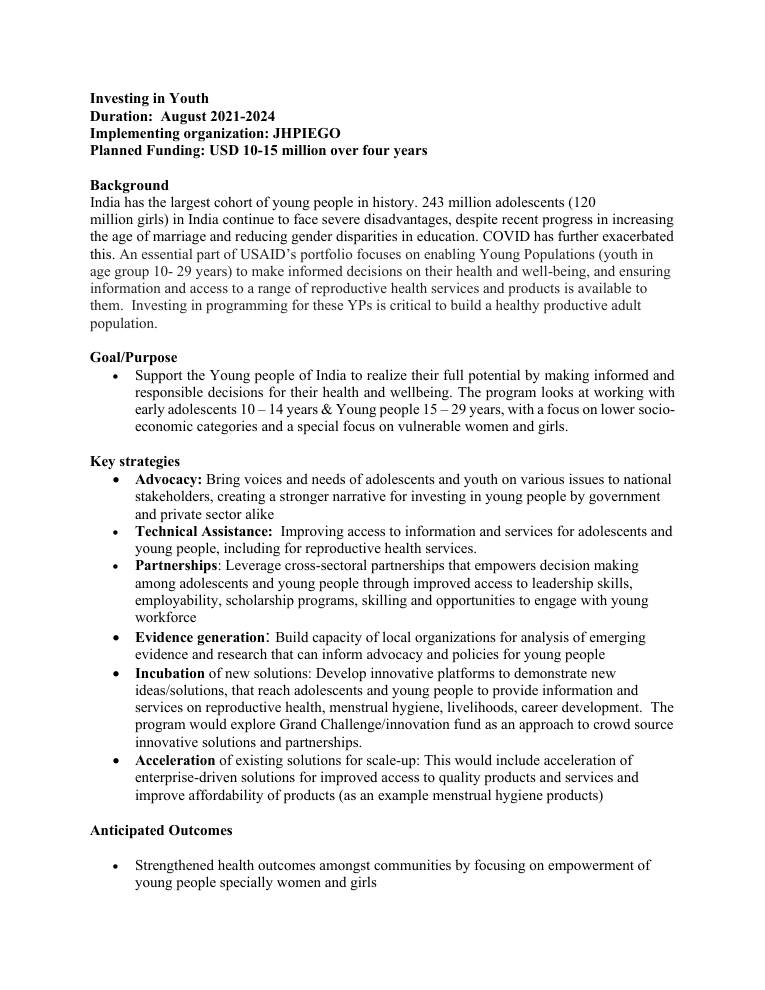
Investing in Youth
Duration: August 2021-2024
Implementing organization: JHPIEGO
Planned Funding: USD 10-15 million over four years
Background
India has the largest cohort of young people in history. 243 million adolescents (120 million girls) in India continue to face severe disadvantages, despite recent progress in increasing the age of marriage and reducing gender disparities in education. COVID has further exacerbated this. An essential part of USAID’s portfolio focuses on enabling Young Populations (youth in age group 10- 29 years) to make informed decisions on their health and well-being, and ensuring information and access to a range of reproductive health services and products is available to them. Investing in programming for these YPs is critical to build a healthy productive adult population.
Goal/Purpose
• Support the Young people of India to realize their full potential by making informed and responsible decisions for their health and wellbeing. The program looks at working with early adolescents 10 – 14 years & Young people 15 – 29 years, with a focus on lower socioeconomic categories and a special focus on vulnerable women and girls. Key strategies
• Advocacy: Bring voices and needs of adolescents and youth on various issues to national stakeholders, creating a stronger narrative for investing in young people by government and private sector alike
• Technical Assistance: Improving access to information and services for adolescents and young people, including for reproductive health services.
• Partnerships: Leverage cross-sectoral partnerships that empowers decision making among adolescents and young people through improved access to leadership skills, employability, scholarship programs, skilling and opportunities to engage with young workforce
• Evidence generation: Build capacity of local organizations for analysis of emerging evidence and research that can inform advocacy and policies for young people
• Incubation of new solutions: Develop innovative platforms to demonstrate new ideas/solutions, that reach adolescents and young people to provide information and services on reproductive health, menstrual hygiene, livelihoods, career development. The program would explore Grand Challenge/innovation fund as an approach to crowd source innovative solutions and partnerships.
• Acceleration of existing solutions for scale-up: This would include acceleration of enterprise-driven solutions for improved access to quality products and services and improve affordability of products (as an example menstrual hygiene products) Anticipated Outcomes
• Strengthened health outcomes amongst communities by focusing on empowerment of young people specially women and girls
• Increased agency of adolescents and young populations to demand for and access solutions that enable them to make positive choices for themselves. This includes activities that address adolescent well-being and empowerment more holistically such as career development, skilling and livelihoods. Improved accessibility and affordability of quality FP/RH care/products for adolescents and young people including menstrual hygiene and contraception Strengthened youth friendly ecosystem by increased community/ policy support for adolescents/young people’s well being
Potential collaboration opportunities
1. USAID and Facebook could potentially co-partner on an ‘Adolescent/young people Innovation platform’: The needs identified through the youth voices will inspire the ideation of solutions. We can also co-fund the winning innovative solutions that address the needs of adolescents/young people. The innovation platform will aim to demonstrate new ideas/solutions or scale up existing ones. This may include digital solutions, innovations using virtual reality, Artificial Intelligence, apps, chatbots, IVRS/ helpline, gaming solutions, social media tools etc. The platform will also demonstrate enterprise-driven solutions for improved access to quality products and services (such as epharmacy, digital apps, social enterprises for menstrual hygiene/ contraceptives). Youth voices will inform and guide the platform on solutions that meet their needs.
2. USAID and Facebook could explore platforms to develop/support the youth champions to build leadership skills, linking them to career opportunities and livelihoods. While youth led advocacy will help to understand youth needs and enhance their voices in decision making, this would also ensure that the youth are given the skills and the opportunity to enhance their employability and decision making skills.
3. We welcome any other ideas that can help young people have a stronger voice that can help amplify their needs/demands for youth friendly services and products.
The original document
Page through the PDF exactly as released. If it does not display, open it directly.