Memo answers Administrator's questions on USAID's disinformation response
A response dated October 31, 2022, drafted by USAID's head of information resilience, replies to the Administrator's questions on interagency process, funding and agency-wide disinformation efforts.
What this record contains
The memo says an interagency policy process ended after a draft National Security Memorandum could not reconcile domestic and foreign disinformation, and that the NSC is preparing to restart it with a focus abroad. It describes the Information Resilience Council and its four working groups, cites an analysis that about $358 million went to media, civil society and MDM efforts in Europe and Eurasia in 2021, with USAID providing 72 percent, and raises a possible $8 to 10 million annual disinformation fund. It also describes a pilot ad campaign in Kenya and East Africa and 24 OTI activities in Ethiopia.
Full text of the record
Text extracted from the original PDF. Layout, tables and images are not reproduced. About 1,434 words.
DATE: 10/31/2022
Response to Administrator’s October 30, 2022 Questions Regarding USAID response to disinformation efforts across bureaus (IM from Sophia Lalani, February 22, 2022)___________
Drafter: Vera Zakem, USAID head of Information Resilience and DRG Senior Advisor: vzakem@usaid.gov
Template instructions:
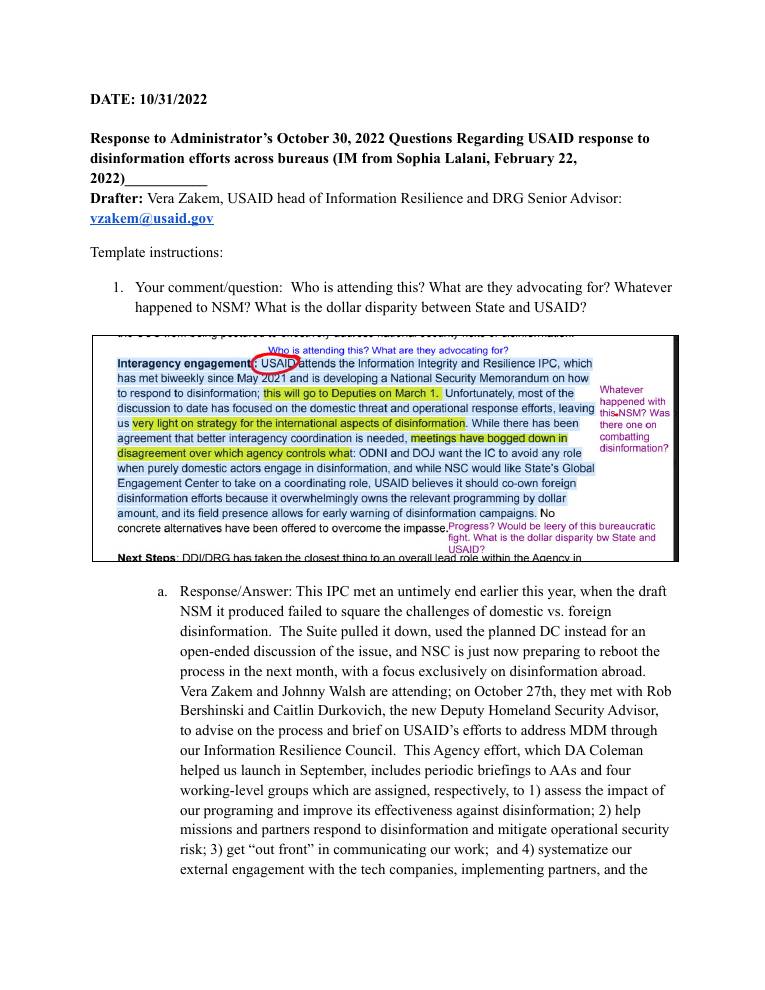
1. Your comment/question: Who is attending this? What are they advocating for? Whatever happened to NSM? What is the dollar disparity between State and USAID?
a. Response/Answer: This IPC met an untimely end earlier this year, when the draft NSM it produced failed to square the challenges of domestic vs. foreign disinformation. The Suite pulled it down, used the planned DC instead for an open-ended discussion of the issue, and NSC is just now preparing to reboot the process in the next month, with a focus exclusively on disinformation abroad. Vera Zakem and Johnny Walsh are attending; on October 27th, they met with Rob Bershinski and Caitlin Durkovich, the new Deputy Homeland Security Advisor, to advise on the process and brief on USAID’s efforts to address MDM through our Information Resilience Council. This Agency effort, which DA Coleman helped us launch in September, includes periodic briefings to AAs and four working-level groups which are assigned, respectively, to 1) assess the impact of our programing and improve its effectiveness against disinformation; 2) help missions and partners respond to disinformation and mitigate operational security risk; 3) get “out front” in communicating our work; and 4) systematize our external engagement with the tech companies, implementing partners, and the
interagency. Both Rob and Caitlin were “inspired” by our efforts, and wanted to incorporate our insights into the rebooted IPC process.
b. The question of “who leads” foreign disinformation efforts is a relic of the ill-fated NSM and no longer immediately relevant, though it may reemerge as the new process takes shape. On the dollar disparity between State and USAID, it is difficult to capture exact numbers since a variety of efforts could be considered relevant to disinformation. As one datapoint, according to a EUR/ACE and GEC analysis, in 2021 approximately $358 million were invested in media, civil society and MDM efforts, with USAID and State providing 72% and 28% respectively in E&E. USAID invests more in addressing MDM through our programs to support independent media, address media and digital literacy, messaging, and work by, with, and through partners to build resilience in the information environment. State primarily invests its limited resources in analytics through the Global Engagement Center and media literacy programming through DRL. We would need to do additional analysis to understand the full breadth of MDM programming at State vice at USAID for this FY.
c. The Information Resilience Council, as noted above, is currently beginning to take stock of its programming efforts and Mission needs. Of note, USAID has a standalone “whole-of-society” disinformation program in Georgia, which Vera will be visiting between November 8-10th. We hope to elevate this issue through the Summit for Democracy, potentially by adding a disinformation fund of ~$8 to 10M annually to the Presidential Initiative for Democratic Renewal (PIDR), or possibly to seek this funding separately, so as not to dilute other PIDR programs. .
2. Your comment: Updates on all this?
a. As noted above, we stood up the Information Resilience Council and Working Groups focused upon Programming, USAID Security and Operations, Communications, and External Engagement. Led by Vera Zakem, the IRC has representation from all regional bureaus and key functional bureaus including LPA, SEC, PPL, M, and DDI. The technical working group has had 3 meetings, and is finalizing preliminary insights, decisions, and initial resource requests, which it will bring forward to the senior leadership group the week after Thanksgiving. In addition, we are piloting an innovative ad buy campaign in Kenya and East Africa to better tell USAID’s story on food security as a way to address disinformation. The ads are going up on Facebook, You Tube, Twitter, and messages will be disseminated via influencers on WhatsApp starting the week of November 7th. Vera is leading this campaign from HQ and is coordinating with the Kenya DOC. During the senior leadership meeting of the IRC after Thanksgiving, we will examine preliminary results from this campaign, with an eye to whether this approach is scalable for us.
3. Your question: What about the rest of USG? Need broader perspective on what is being done by other agencies, surely.
a. As an update to the February info memo cited above, OTI currently has 24 activities addressing mis/disinformation (and hate speech) in Ethiopia. OTI has partnered with local media outlets, media professionals, community radio stations, youth groups, civil society organizations, traditional leaders, and other national and regional stakeholders in this effort, and supported a biweekly social media monitoring report to better understand the dynamics of online and conventional media rhetoric and intercommunal violence.
b. More broadly, OTI works through local, multi-stakeholder partnerships to mitigate the negative effects of MDM when it is defined as a critical obstacle to peaceful and democratic transitions. OTI does not expect its programs to stop
disinformation or hate speech; however, OTI can research its effects, mitigate its influence, and moderate its virality.
i. Interventions can include working with: 1) local media outlets on independent fact-checking and reporting, and developing content to help communities find commonalities around fact-counterfact debates; 2) local civil society organizations and community leaders to raise awareness about disinformation, hate speech, and respond to its effects; 3) local governments to improve the quality and distribution of their strategic communications related to public services and reforms; and 4) local creatives to produce social impact entertainment content that reframe the issues from immovable fact-counterfact debates to a conversation based on deeply held values. This work is grounded in locally-driven research and analysis on disinformation and hate speech, including the incentives, grievances, and networks behind them.
c. The core agencies that do counter messaging are DOD and State through the GEC and GPA. DOD has a comprehensive counter messaging program through the U.S. Special Operations Command and Military Information Support Operations (MISO). On October 20th, Vera Zakem attended and presented at the 11th Annual Information Operations Conference at INDOPACOM and built relationships with DOD to see how we can collaborate in this space. Vera is planning to visit USSOCOM in the new year to best synergize our efforts; she and others from DRG have also coordinated with OSD and other combatant commands on each one’s individual efforts. These efforts are also coordinated with USAID’s Office of Civil Military Cooperation.
d. State’s Digital Freedom Unit with the new Bureau for Cyber and Digital Policy has the mandate to lead the Department of State on setting foreign policy priorities related to information integrity and content moderation issues. However, their work is extremely nascent. The digital freedom unit is participating in the S4D Information Integrity Cohort along with USAID and State’s Global Engagement Center (GEC). GEC is the State Department analytic and technical lead regarding combating MDM and provides analytics organized around specific “threat actors.” This data is shared with USAID and other agencies, however it seems to have limited usage. Our consultations with USAID field offices are aware of GEC products but most said they are only somewhat helpful as they either aren’t focused on our countries or do not assess the impact of . In addition, the information isn’t shareable with implementing partners (and often even with FSN staff.) GEC also provides small grants for research and local media partners and USAID partners on some of those efforts to avoid duplication. DRL and EUR/ ACE provide research and grants for media and digital literacy, cyber
hygiene, and other resilience building activities. However, they are more limited in scope vis-a-vis USAID, which has programming in this space globally. e. The intelligence community has its own capabilities here, which are best discussed in other formats but which also have expanded over the last few years. Johnny and others have met with the key counterparts, and are interested in aligning (or at least deconflicting) our efforts better than AID and the IC sometimes do. As a next step,
has offered to help Vera and team to
put together a meeting with key IC representatives on MDM for increased information sharing on threat assessments.
f. Broadly speaking, USAID efforts in the field are always a joint effort with State, particularly the public affairs sections. The IR Council is currently conducting USAID Mission consultations to better understand their context, programming responses, and Embassy/Mission operational issues. Nearly all meetings have either included someone from the public affairs section or have indicated considerable USAID-State partnership in addressing MDM through programming, information sharing, or strategic communications.
The original document
Page through the PDF exactly as released. If it does not display, open it directly.