Alphabet briefs State Department and USAID on election protection lessons
A sensitive-but-unclassified readout of a December 7, 2022 briefing by Alphabet trust and safety and threat analysis leaders to State Department bureaus, USAID and DHS on elections.
What this record contains
The readout lists attendees from the State Department's Global Engagement Center and regional bureaus, a USAID adviser, and Alphabet officials including Google's trust and safety vice president and the Threat Analysis Group director. Alphabet said it saw fewer foreign threats than expected in the 2022 U.S. and Brazil elections, stressed authoritative content, noted growing Spanish-language disinformation and described preparations for 2023 and 2024. Next steps include possible quarterly senior-level meetings and an Alphabet suggestion of a red-teaming collaboration with State and USAID. The excerpt is truncated in places.
Full text of the record
Text extracted from the original PDF. Layout, tables and images are not reproduced. About 1,346 words.
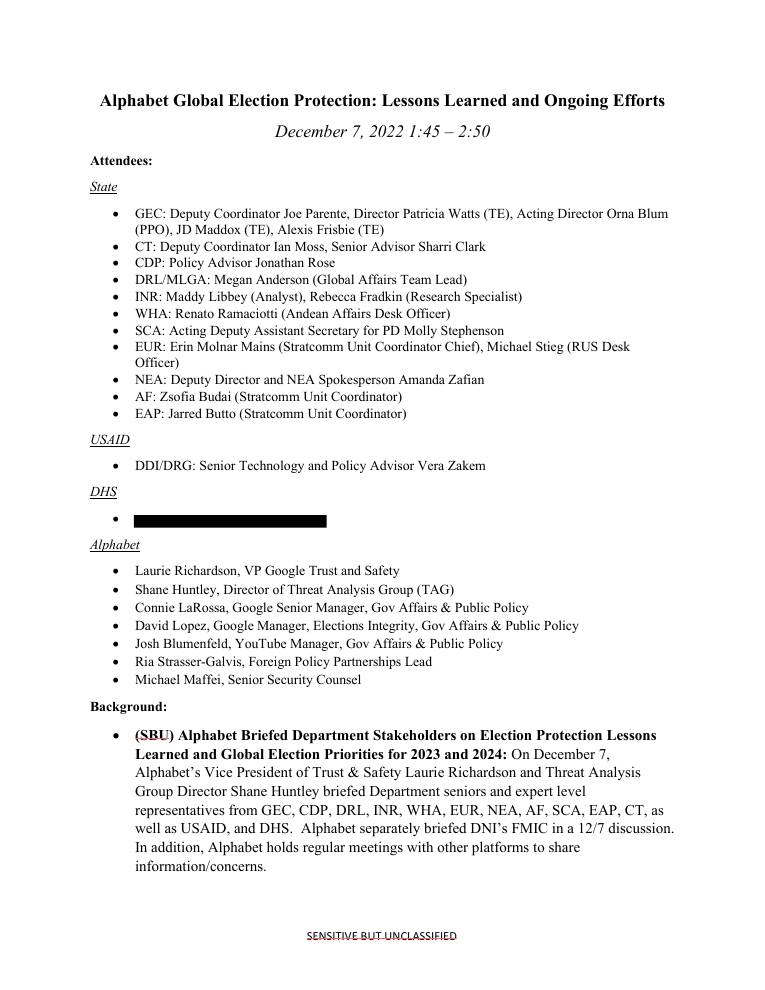
Alphabet Global Election Protection: Lessons Learned and Ongoing Efforts December 7, 2022 1:45 – 2:50
Attendees:
State
GEC: Deputy Coordinator Joe Parente, Director Patricia Watts (TE), Acting Director Orna Blum (PPO), JD Maddox (TE), Alexis Frisbie (TE)
CT: Deputy Coordinator Ian Moss, Senior Advisor Sharri Clark
CDP: Policy Advisor Jonathan Rose
DRL/MLGA: Megan Anderson (Global Affairs Team Lead)
INR: Maddy Libbey (Analyst), Rebecca Fradkin (Research Specialist)
WHA: Renato Ramaciotti (Andean Affairs Desk Officer)
SCA: Acting Deputy Assistant Secretary for PD Molly Stephenson
EUR: Erin Molnar Mains (Stratcomm Unit Coordinator Chief), Michael Stieg (RUS Desk Officer)
NEA: Deputy Director and NEA Spokesperson Amanda Zafian
AF: Zsofia Budai (Stratcomm Unit Coordinator)
EAP: Jarred Butto (Stratcomm Unit Coordinator)
USAID
DDI/DRG: Senior Technology and Policy Advisor Vera Zakem
DHS
Alphabet
Laurie Richardson, VP Google Trust and Safety
Shane Huntley, Director of Threat Analysis Group (TAG)
Connie LaRossa, Google Senior Manager, Gov Affairs & Public Policy David Lopez, Google Manager, Elections Integrity, Gov Affairs & Public Policy Josh Blumenfeld, YouTube Manager, Gov Affairs & Public Policy Ria Strasser-Galvis, Foreign Policy Partnerships Lead
Michael Maffei, Senior Security Counsel
Background:
(SBU) Alphabet Briefed Department Stakeholders on Election Protection Lessons Learned and Global Election Priorities for 2023 and 2024: On December 7, Alphabet’s Vice President of Trust & Safety Laurie Richardson and Threat Analysis Group Director Shane Huntley briefed Department seniors and expert level representatives from GEC, CDP, DRL, INR, WHA, EUR, NEA, AF, SCA, EAP, CT, as well as USAID, and DHS. Alphabet separately briefed DNI’s FMIC in a 12/7 discussion. In addition, Alphabet holds regular meetings with other platforms to share information/concerns.
Key Takeaways:
General Background on Trust & Safety, Threat Analysis Group (TAG) and 2022 Elections
(SBU) Alphabet stated 2016 was an inflection point, with a post-election drive of forensic review occurring among many platforms. A narrower set of actors (such as Russia’s Internet Research Agency – IRA) were the focus.
(SBU) Alphabet emphasized they saw fewer threats (focusing on foreign only) than expected during the 2022 U.S. and Brazil elections but noted there is a much more complex landscape of actors and information ecosystem health at play. This has made comprehensive policies and new tools/levers to address mis/disinformation important. Gray area speech, which can ultimately be harmful, is very difficult to address with specific policies, however, making authoritative voices and content critical.
• (SBU) Alphabet focused on potential threats to election workers and established the ability for persons (in certain regions) to remove PII from Google Search. They noted this PII removal is a new and important effort that they want to continue to expand.
• (SBU) TAG noted threat actors like Russia and PRC did not appear particularly focused on the US; most of what Alphabet saw were narratives that were tangentially related to other ongoing crises (like Ukraine) and linked to videos already published.
(SBU) Alphabet complements its policy and authoritative content work with Google’s TAG, which works to understand and counter serious abuses to its platforms. There are around 270 cyber threat actors, globally, and three buckets of categories that TAG focuses on: government backed threat actors, cyber threats, and global non-governmental threat actors (e.g., Dragonbridge – linked to China, though not directly to the PRC).
• (U) External information source: Google Threat Analytics Group (TAG) noted in its Q4 report that they “terminated 76 YouTube channels as part of [an] investigation into coordinated influence operations linked to Brazil. The campaign was sharing content in Brazilian Portuguese that was supportive of Brazilian President Jair Bolsonaro.” (TAG Blog)
• (U) External information source: Mandiant (acquired by Alphabet in 2022) “said a threat group known as Dragonbridge [attempted] to sway Americans to not vote during the upcoming election through fake social media accounts and falsified news articles. In its campaign, Dragonbridge...spread false narratives that a well-known hacking group based in China is actually a U.S. government group, and it claimed that the U.S. was responsible for the Nord Stream gas pipeline explosions.” (Axios)
(SBU) Since crafting policies to address gray-area language are very difficult, TAG’s work to trace threat signatures or themes to specific content/actors can be shared with Trust & Safety for review and action. This helps Alphabet refrain from having to review each video; clips where the content may fall in a gray-zone, but the signature is linked to threat actors, is critical to scaling and addressing possible platform abuses.
Broad Lessons Learned & Prep for Elections 2023, 2024
(SBU) Alphabet underscored the role and importance of authoritative content in protecting global elections and information consumers in general. In general, third parties that can support and corroborate results or information are critical to Alphabet’s Trust & Safety infrastructure.
(SBU) Alphabet noted it wants to increase its automated solutions, including languages, to scale response to disinformation and amplify authoritative content. Alphabet stated Spanish language disinformation was a large and growing issue.
(SBU) Alphabet is prepping for 2023 and 2024 by looking at what opportunities and tools are available for threat actors to leverage/apply. Alphabet will watch threat actors closely to identify inauthentic trends. In 2020, for example, a group of Iranian threat actors pretended to be a specific fringe U.S. group and pushed disinformation content. Overall, however, Alphabet is seeing fewer clear lines of distinction; lines are blurring between hacktivists and patriots, for example.
(SBU) Priority countries for of focus for Alphabet in 2023 include Argentina, Nigeria, and Poland. Part of the concern includes the view that these elections are where tactics, techniques, and procedures will be tested for major 2024 elections. (SBU) Priority countries/regions of focus for Alphabet in 2024 include the U.S., European Parliament, and India. Alphabet is already in preparation mode for these elections. Once concern focuses on themes that might prohibit the ability to share authoritative information (e.g. if the Associated Press was unable to call an election how can that information be validated?).
(SBU) Alphabet noted it has conversations with other platforms regularly and integrates certain company/websites’ information to update Google Search. When sites are not updated, Google will review and consider the appropriateness of its inclusion in the process. When asked about Twitter, specifically, Google stated they are working through what is actually happening vs. the noise. From their view, the product still seems to be working. If Twitter takes internal moderation and reviews a “different way” for elections, there may be consideration to revisit Twitter’s inclusion in the Google search “carousel” updating process.
(SBU) GEC noted to the group that Google’s priority language capabilities may not include some linguistic groups that are particularly vulnerable to disinformation. When asked whether Alphabet would consider expansion into additional languages, perhaps through cooperative programming, company reps responded affirmatively that they would be open to cooperation on the development of additional language capabilities.
Future Considerations
(SBU) All parties agreed that resiliency building – media literacy tools and information ecosystem health over all – is essential. Inquiries by USAID and State on resilience-building partnership opportunities with Alphabet were raised, with company reps concurring that this would be a great space to explore further partnership discussion. Google underscored that the creation of authoritative content (e.g. public service announcements) is critical and that democracies shouldn’t underestimate how much a population can change over generations; resiliency isn‘t a guarantee.
• (SBU) Alphabet noted people adapt to media over time and recognizing who is adapting where is key information. For example, Google’s Jigsaw research arm found younger generations are more likely to read the comment sections and was being used as a tool for additional information. (SBU) To address disinformation or potentially harmful content before it goes viral, Google stated AI/machine-learning, policies, and consensus were important.
GEC Next Steps/Actions
(SBU) Following the meeting, Alphabet stated the importance of these conversations with seniors included, noting in an aside to GEC that such an event held with Seniors quarterly would be great. GEC will coordinate with Alphabet POC’s and department stakeholders to get a plan of action in place.
(SBU) Alphabet also suggested to GEC a red teaming/threat ideation/hackathon collaboration between State, USAID, and Alphabet. GEC will work with contacts and Departments to organize.
The original document
Page through the PDF exactly as released. If it does not display, open it directly.