Meta follow-up document details Central America programs and integrity efforts
A four-page 2022 document from Meta, sent after a "Northern Triangle deep dive" with USAID, lists contacts, training offers, programs and election-related actions.
What this record contains
The document names Meta's contacts for USAID missions in El Salvador, Guatemala and Honduras and for Washington, and offers training on its Community Standards, platform best practices and programs tied to the Partnership for Central America. It describes digital skills programs for entrepreneurs and youth. On elections, it recounts removals of coordinated inauthentic networks, including 896 Facebook accounts linked to Nicaragua's government and ruling party in October 2021, and networks originating in Mexico, Costa Rica and El Salvador. It also describes the Trusted Partner and third-party fact-checking programs and a human rights report. The text is excerpted.
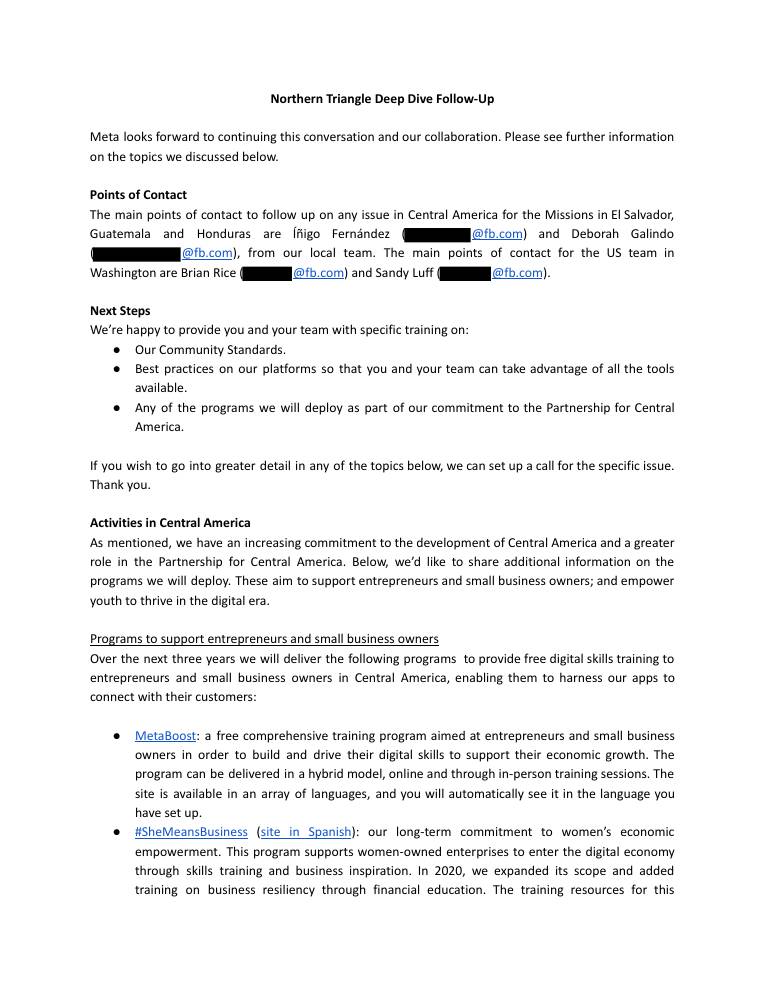
Full text of the record
Text extracted from the original PDF. Layout, tables and images are not reproduced. About 1,548 words.
Northern Triangle Deep Dive Follow-Up
Meta looks forward to continuing this conversation and our collaboration. Please see further information on the topics we discussed below.
Points of Contact
The main points of contact to follow up on any issue in Central America for the Missions in El Salvador, Guatemala and Honduras are Íñigo Fernández (
@fb.com) and Deborah Galindo
(
@fb.com), from our local team. The main points of contact for the US team in Washington are Brian Rice (
@fb.com) and Sandy Luff (
@fb.com).
Next Steps
We’re happy to provide you and your team with specific training on:
• Our Community Standards.
• Best practices on our platforms so that you and your team can take advantage of all the tools available.
• Any of the programs we will deploy as part of our commitment to the Partnership for Central America. If you wish to go into greater detail in any of the topics below, we can set up a call for the specific issue. Thank you. Activities in Central America As mentioned, we have an increasing commitment to the development of Central America and a greater role in the Partnership for Central America. Below, we’d like to share additional information on the programs we will deploy. These aim to support entrepreneurs and small business owners; and empower youth to thrive in the digital era. Programs to support entrepreneurs and small business owners Over the next three years we will deliver the following programs to provide free digital skills training to entrepreneurs and small business owners in Central America, enabling them to harness our apps to connect with their customers:
MetaBoost: a free comprehensive training program aimed at entrepreneurs and small business owners in order to build and drive their digital skills to support their economic growth. The program can be delivered in a hybrid model, online and through in-person training sessions. The site is available in an array of languages, and you will automatically see it in the language you have set up.
#SheMeansBusiness (site in Spanish): our long-term commitment to women’s economic empowerment. This program supports women-owned enterprises to enter the digital economy through skills training and business inspiration. In 2020, we expanded its scope and added training on business resiliency through financial education. The training resources for this
program are free and can be accessed in English and Spanish and several other languages all around the world.
Programs to empower youth to thrive in the digital era
With the following programs, young people will be able to acquire a variety of skills, including digital literacy, digital marketing, and the use of XR technologies, that will help them harness the opportunity of the digital revolution:
We Think Digital (site in Spanish): this program provides resources to build a global community of responsible digital citizens equipped with the necessary skills to thrive in a digital world. It was developed in collaboration with experts, academics, non-governmental organizations (NGOs), and civil society organizations across the globe. Our resources are designed to foster responsible citizenship and are available in both English and Spanish.
Meta Blueprint: our learning platform with hundreds of fast, free, self-guided online courses to help businesses build their marketing skills and take advantage of the tools available to them across our platforms.
Elections and Integrity Efforts
We are committed to protecting Election Integrity all over the world. Over the last few years, we have made significant investments in teams and technologies to better protect elections, provide transparency, empower people to vote, and create safe technologies. To achieve this, we have taken significant steps to prevent election interference, fight misinformation and increase transparency:
Our security teams investigate and take down coordinated networks of inauthentic accounts, Pages and Groups that seek to manipulate public debate. This year, we shared our pilot quarterly adversarial threat report that provides a broad view into the risks we see worldwide and across multiple policy violations (see version in Spanish here). Our next quarterly threat report will be published August 4.
• In October 2021, a month before the elections in Nicaragua, we removed a network of 896 Facebook accounts, 132 Pages, 24 Groups and 362 Instagram accounts in Nicaragua. This operation targeted domestic audiences in that country and was linked to the government of Nicaragua and the Sandinista National Liberation Front (FSLN) party. We found one portion of this network through our internal investigation into suspected coordinated inauthentic behavior in the region, and another portion — as a result of reviewing public reporting about some of this activity. More information in our October 2021 Coordinated Inauthentic Behavior Report.
• Also in 2021, we removed 12 Facebook accounts, 172 Pages and 11 accounts on Instagram of a network that originated primarily in Mexico and targeted audiences in Honduras, Ecuador, El Salvador, the Dominican Republic and Mexico. We found this activity as a result of reviewing public reporting about some of this activity. More information in our December 2021 Coordinated Inauthentic Behavior Report.
• This year, we removed 233 Facebook accounts, 84 Pages, two Groups, and 27 Instagram accounts for violating our policy against coordinated inauthentic behavior. This network originated in Costa Rica and El Salvador and targeted primarily Costa Rica and El Salvador. We found this network after reviewing public reporting about an off-platform portion of this activity and took action ahead of the election in Costa Rica. We work closely with civil society organizations that are critical partners in helping us better understand the impact of our platforms and the context of the diverse communities in which we operate around the globe. We’ve built the Trusted Partner program to foster this partnership with civil society, strengthen the social media monitoring capacity of local organizations and improve our policies, enforcement processes, and products to help keep users safe on our platforms. Through our Third-Party Fact-Checking Program we help prevent the spread of misinformation and provide additional context so people can make informed decisions. We work with independent, third-party fact-checking organizations who are certified through the non-partisan International Fact-Checking Network (IFCN) to identify, review and take action on this content. A map of our fact-checking partners can be found here. We provide an industry-leading level of transparency around political advertising and pages. Our Ads Transparency Tools are available globally for advertisers who want to place ads about social issues, elections or politics thanks to which these now require authorization and include “Paid for by” disclaimers. Recently, we announced the expansion of these tools to 19 additional countries in Latin America. We maintain a dedicated team to prevent abuse in WhatsApp focused on three lines of effort: maintaining the private nature of WhatsApp, preventing coordinated misuse of WhatsApp, and empowering users to counteract misinformation. The detailed actions we have taken regarding WhatsApp can be found here. We build strategic partnerships around the region to support the integrity of electoral processes. For example:
• We signed a Cooperation Agreement with the Organization of American States to continue improving responses to issues such as disinformation, electoral integrity, freedom of expression and the protection of human rights defenders, in pursuit of having an increasingly plural online and offline debate.
• This year, we partnered with the Electoral Authority of Costa Rica (TSE) and the local chapter of the United Nations to launched a safety guide to counter political violence against women. Likewise, in 2021 in Mexico, we partnered with the Electoral Authority (INE) and the local chapter of the United Nations to launch #SheLeads, a guide that includes safety tools and best practices for building communities on Facebook, as well as steps to take to report harassment; and an Instagram Safety Guide for Women in Politics.
• Towards the upcoming elections in Brazil, we are working with the Electoral Authority to protect the democratic process, identify and act on threats and help people gain access to reliable information about the vote. As part of this work, we will be directing people using Facebook and Instagram in Brazil to official information about the voting system and articles countering misinformation about the electoral process.
Finally, our Community Standards aim to find the right balance between giving people a place to express themselves and promoting a welcoming and safe environment for everyone. In our Transparency Center we detail the actions taken to create our policies, remove problematic content, reduce its distribution and inform people. A comprehensive explanation of our Community Standards can be found in this post. We have also made numerous efforts to give people control over what they share, who they share it with, the content they see and experience, and who can contact them. In our Safety Center you may find additional information on these actions as well as resources.
Recently, we launched our First Annual Human Rights Report on how we’re addressing our human rights impacts, including insights and actions from our human rights due diligence on products, countries and responses to emerging crises. As well as our work protecting the privacy of journalists and human rights defenders, increasing youth safety on Instagram, fighting exploitation across our apps and protecting free and fair elections around the world.
Again, if you wish to go into greater detail in any of the topics below, we would be happy to set up a call for the specific issue. Thank you.
The original document
Page through the PDF exactly as released. If it does not display, open it directly.