Information memo to Administrator Power outlines initial response to mis/disinformation
A June 2, 2022 memo from USAID's senior technology and democracy adviser summarizes a staff survey and workshop and proposes next steps for an agency-wide approach.
What this record contains
The memo, marked For Official Use Only, reports takeaways from a May 25 strategic planning workshop with about 50 participants and an agency-wide survey with over 100 responses. It lists needs: evaluating program impact, clarifying roles and response mechanisms, addressing reputational and security risks, stronger interagency coordination, localized solutions, and a stronger relationship with the tech sector, including direct communication on content moderation decisions affecting USAID. The author says she will lead the initiative through the DRG Center's Information Domain Task Team, with monthly senior-level and biweekly working-level meetings.
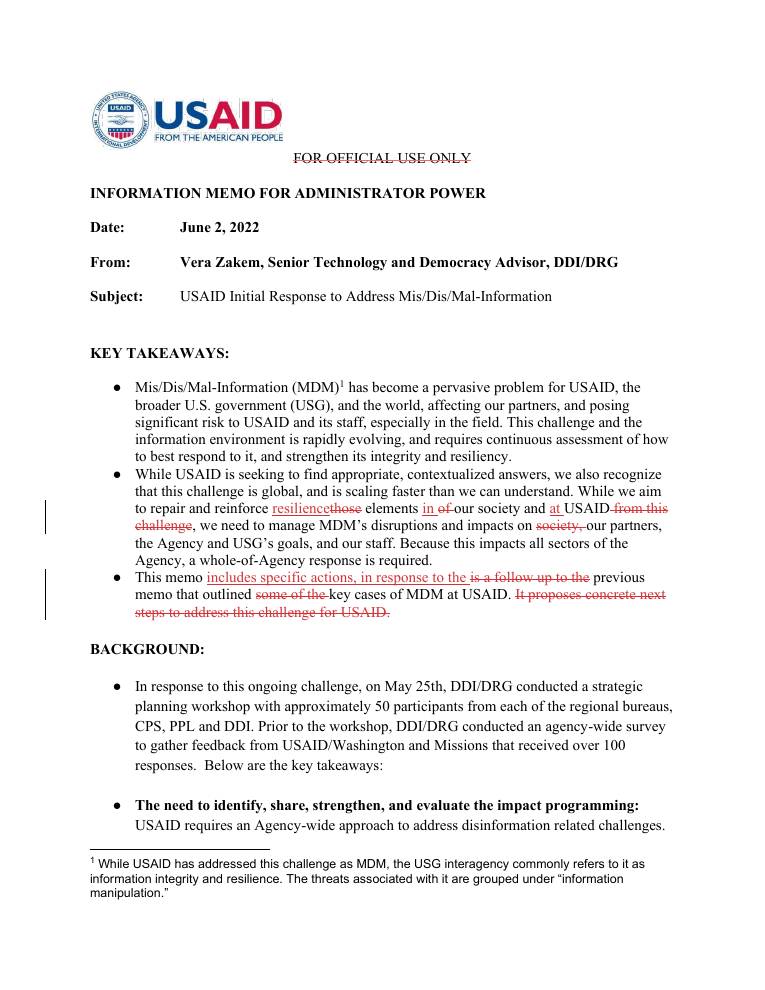
Full text of the record
Text extracted from the original PDF. Layout, tables and images are not reproduced. About 1,520 words.
FOR OFFICIAL USE ONLY
INFORMATION MEMO FOR ADMINISTRATOR POWER
Date:
June 2, 2022
From:
Vera Zakem, Senior Technology and Democracy Advisor, DDI/DRG
Subject:
USAID Initial Response to Address Mis/Dis/Mal-Information
KEY TAKEAWAYS:
• Mis/Dis/Mal-Information (MDM)1 has become a pervasive problem for USAID, the broader U.S. government (USG), and the world, affecting our partners, and posing significant risk to USAID and its staff, especially in the field. This challenge and the information environment is rapidly evolving, and requires continuous assessment of how to best respond to it, and strengthen its integrity and resiliency.
• While USAID is seeking to find appropriate, contextualized answers, we also recognize that this challenge is global, and is scaling faster than we can understand. While we aim to repair and reinforce resiliencethose elements in of our society and at USAID from this challenge, we need to manage MDM’s disruptions and impacts on society, our partners, the Agency and USG’s goals, and our staff. Because this impacts all sectors of the Agency, a whole-of-Agency response is required.
• This memo includes specific actions, in response to the is a follow up to the previous memo that outlined some of the key cases of MDM at USAID. It proposes concrete next steps to address this challenge for USAID. BACKGROUND:
• In response to this ongoing challenge, on May 25th, DDI/DRG conducted a strategic planning workshop with approximately 50 participants from each of the regional bureaus, CPS, PPL and DDI. Prior to the workshop, DDI/DRG conducted an agency-wide survey to gather feedback from USAID/Washington and Missions that received over 100 responses. Below are the key takeaways:
• The need to identify, share, strengthen, and evaluate the impact programming: USAID requires an Agency-wide approach to address disinformation related challenges.
While USAID has addressed this challenge as MDM, the USG interagency commonly refers to it as information integrity and resilience. The threats associated with it are grouped under “information manipulation.”
Current approaches across the Agency lack an understanding of the impact that our efforts have on strengthening the resilience of the information and media environment in order to reduce the damaging effects of MDM. In addition, a full lack of understanding exists on various approaches undertaken by USAID’s Bureaus and OUs to address this challenge.
• The need to assess, identify, and clarify roles, responsibilities, and response mechanisms: Roles, responsibilities, and response mechanisms are largely undefined both within respective B/IOs as well as Agency wide. While some B/IOs are leaning forward to program and measure the impact of the programs in this space (for example, DRG or GH on public health messaging), other B/IOs require deeper understanding of how MDM impacts their work as well as programming options and best practices to address it. Furthermore, there is insufficient research, monitoring and evaluation, and programmatic approaches to address this challenge in the Global South. While the scope of this challenge is truly global, USAID is uniquely positioned to fill this gap, given our global presence and work in diverse sectors.
• The need to assess our operations in order to respond to reputational and security risks: Information manipulation affects USAID’s reputation and security as well as those of its staff and implementing partners. USAID operates in countries where the USG has not mapped out the information environment landscape nor assessed the risks MDM may pose to its operations. USAID lacks communication guidance on how to message and communicate about MDM with our missions, implementing partners, adn civil society. Further, USAID lacks clear operational guidance on how to assess impact and report an MDM incident and respond effectively. A solution would entail clarifying USAID’s policies, organizational structures, training, resources, budget, and personnel to document these instances and to respond when a potentially harmful incident of MDM threatens.
• The need to strengthen interagency coordination: USAID could benefit from more intentional interagency coordination both in DC and in the field, to leverage resources within the USG in order to strengthen the integrity of the information environment. USAID employees are not systematically made aware of the tools available across the USG that may help them in their response. Moving forward, USAID has an opportunity to influence the USG interagency to develop strategy and policy, supported by our programs to address this challenge. In addition, USAID may suggest that the USG interagency revisit lessons learned from the last two decades of our efforts in counterterrorism and counter violent extremism, and the coordination mechanisms that were operationalized to advance that craft across the USG.
• The need for localized and contextual solutions to understand the information and media environment: Addressing MDM requires understanding of local cultures, people, and languages. Given USAID’s global footprint and partnerships with civil society, media, and local population, and the understanding of the impact that MDM has on local populations and movements, USAID has a substantial comparative advantage to bring these insights both to the interagency and to its partnership with the tech sector. However, to date, threat actor based approaches, also known as the “supply side” of MDM, have dominated USG discussions and national security agenda.
• The need to strengthen our relationship with the tech sector: USAID should solidify and expand partnerships with both digital platforms and emerging technologies to counter MDM in order to establish direct communication on MDM-related content moderation decisions, and advocate for greater transparency of content moderation processes that affect USAID. To facilitate this engagement, USAID’s missions could partner with digital platforms and emerging technologies, particularly in places where these companies lack significant local presence or operations. Moreover, USAID has a unique opportunity to work with the tech sector to build an affirmative agenda that includes creating resilience mechanisms to strengthen the information environment such as media, digital literacy, and cyber hygiene trainings, and ways for local media and civil society to report disinformation campaigns. NEXT STEPS: To address and accelerate mitigation strategies, on behalf of the DRG Center, I will be leading this initiative. To do so, I will leverage DRG’s Information Domain Task Team (IDTT), with cross-agency representation to stand up a broader body, with participation from senior leadership at the DAA / Director level to achieve the following objectives in the initial 60 to 90 days, and build on the existing body of work. We will create outcome-oriented sub-working groups to lead on issues identified in this memo in order to align various Agency activities and efforts with Agency, interagency, and Administration strategic priorities: Defining the Problem
• Agree upon a definition to categorize this challenge that is consistent with the USG interagency, and a definition that minimizes reputational and security risk to USAID. Finalize Problem/Needs Assessment
• Assess the best way to prioritize identified gaps; Develop coordinated whole-of-Agency Response
• Develop an interim framework document to address the challenge and provide guidance to USAID Missions and B/IOs. This framework document will align USAID’s mission
and goals against proposed strategic priorities across operational, programmatic, and multi-sector engagement lines of effort in order to address MDM gaps and challenges for the Agency, including identification of a few select countries to pilot specific our efforts;
• Expand Programmatic Responses:
• Develop the strategic objectives for USAID’s response to this challenge;
• Conduct a scoping of existing programs that are directly/indirectly addressing MDM and establish mechanisms to share best practices;
• Identify gaps in programming, identify opportunities for innovation such as Grand Challenges or other approaches;
• Reform USAID Operations:
• Through Agency consultations and co-led with PPL, LPA, SEC and HCTM among others, identify operational changes to address reputational, security risk, and employee resilience;
• Establish clear strategic communication guidelines, in collaboration with LPA;
• Strengthen partnerships and coordination:
• Expand and solidify a relationship with the technology sector, both digital platforms and emerging technologies, including on content moderation and strengthening resilience of the information environment;
• Expand USAID’s relationship with the USG interagency, including the NSC, DOD, State, and other equities;
• Establish a cross-sector community of practice with implementing partners/NGO/ academia/think tanks to elevate and share MDM challenges, identify new partners and share best practices in the field;
• Long Term Priorities
• Explore and assess longterm Agency requirements to address disinformation related challenges, including organizational structure, policy, resourcing, processing, and operational response;
• Continue to document lessons learned and incorporate Agency’s best practices to respond to disinformation in the Year of Action, leading up to the next Summit for Democracy.
• Assess continuous research and analysis needs to meet this challenge.
• Promote a whole-of-community approach to help empower citizens and civil society to address MDM, and increase social capital. Organization
This initiative will elevate the DRG-led IDTT, with Agency-wide representation and include senior leadership participation at the DAA level to action the deliverables identified above. We will meet with senior level leadership on a monthly basis and at the working level on a biweekly basis.
Background Links:
• USAID MDM Survey Results
• Initial Memo
CLEARANCE PAGE
Drafter: Vera Zakem, DDI/ DRG vzakem@usaid.gov and Diana Parzik: DDI/DRG/DRI dparzik@usaid.gov
Approved: DDI/A-AA: Karl Fickenscher, kfickenscher@usaid.gov Bureau Level Clearances
Clearance Status
Date
DDI/DAA: JWalsh
DDI/DRG/Dir: RTucci
DDI/DRG/Dep Dir: DBlack
DDI/DRG/DRI: MKaran
DDI/DRG/CSM: MDouglas
OTI
LPA
PPL
The original document
Page through the PDF exactly as released. If it does not display, open it directly.