Draft language outlines a formalized USAID–Facebook strategic partnership
An undated two-page draft proposes giving USAID local partners streamlined access to Facebook tools, training, ad credits, fact-checking and Trusted Partner networks, plus named points of contact.
What this record contains
The draft says USAID and Facebook seek a more formalized strategic partnership focused on information integrity and content with potential to cause harm. Proposed elements include partner access to CrowdTangle, ad credits, the International Fact-Checking Network, the Trusted Partners program, Info Centers and digital literacy initiatives. It also proposes sharing an annually updated list of countries of concern and a point of contact through which State, USAID and partners can raise concerns about violations of Facebook policies, including inauthentic behavior, along with contacts on Facebook's product support and election teams.
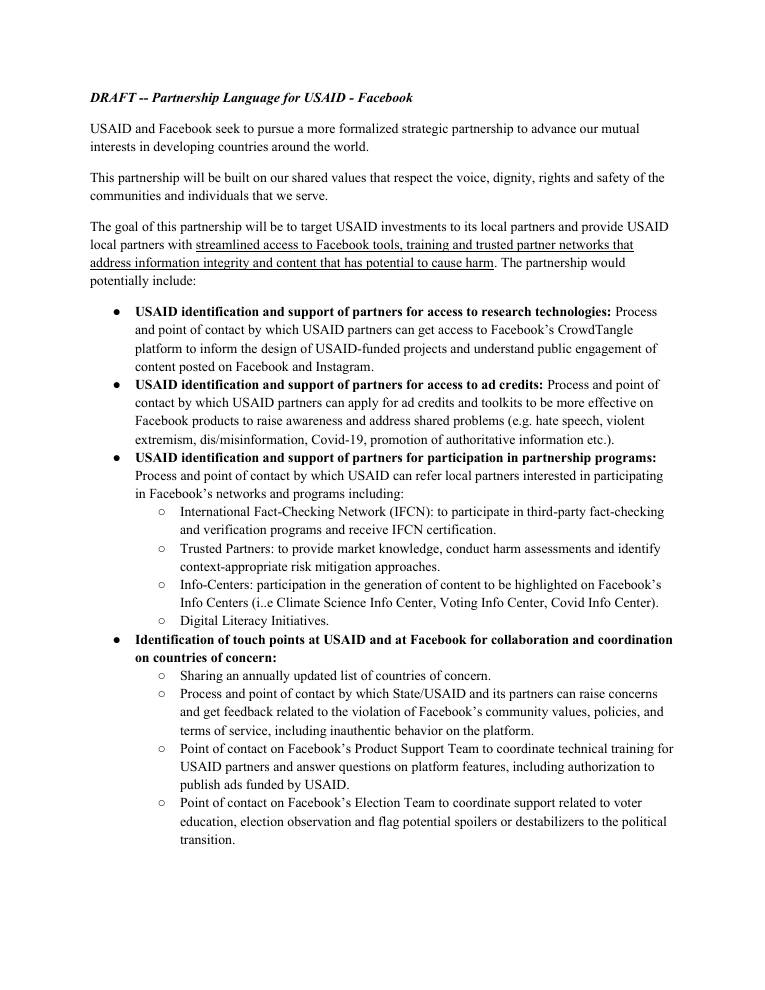
Full text of the record
Text extracted from the original PDF. Layout, tables and images are not reproduced. About 477 words.
DRAFT -- Partnership Language for USAID - Facebook
USAID and Facebook seek to pursue a more formalized strategic partnership to advance our mutual interests in developing countries around the world.
This partnership will be built on our shared values that respect the voice, dignity, rights and safety of the communities and individuals that we serve.
The goal of this partnership will be to target USAID investments to its local partners and provide USAID local partners with streamlined access to Facebook tools, training and trusted partner networks that address information integrity and content that has potential to cause harm. The partnership would potentially include:
• USAID identification and support of partners for access to research technologies: Process and point of contact by which USAID partners can get access to Facebook’s CrowdTangle platform to inform the design of USAID-funded projects and understand public engagement of content posted on Facebook and Instagram. USAID identification and support of partners for access to ad credits: Process and point of contact by which USAID partners can apply for ad credits and toolkits to be more effective on Facebook products to raise awareness and address shared problems (e.g. hate speech, violent extremism, dis/misinformation, Covid-19, promotion of authoritative information etc.). USAID identification and support of partners for participation in partnership programs: Process and point of contact by which USAID can refer local partners interested in participating in Facebook’s networks and programs including:
• International Fact-Checking Network (IFCN): to participate in third-party fact-checking and verification programs and receive IFCN certification.
• Trusted Partners: to provide market knowledge, conduct harm assessments and identify context-appropriate risk mitigation approaches.
• Info-Centers: participation in the generation of content to be highlighted on Facebook’s Info Centers (i..e Climate Science Info Center, Voting Info Center, Covid Info Center).
• Digital Literacy Initiatives. Identification of touch points at USAID and at Facebook for collaboration and coordination on countries of concern:
• Sharing an annually updated list of countries of concern.
• Process and point of contact by which State/USAID and its partners can raise concerns and get feedback related to the violation of Facebook’s community values, policies, and terms of service, including inauthentic behavior on the platform.
• Point of contact on Facebook’s Product Support Team to coordinate technical training for USAID partners and answer questions on platform features, including authorization to publish ads funded by USAID.
• Point of contact on Facebook’s Election Team to coordinate support related to voter education, election observation and flag potential spoilers or destabilizers to the political transition.
• Point of contact for Facebook’s Information Hubs to refer local partners who are pushing authoritative content on trending whole-of-society issues (e.g. Covid-19, climate change, etc.) and looking to maximize their reach. Acceptance of common language to build in information-domain interventions into agreements. Joint alignment of resources to / investment in local organizations to engage with Facebook to promote authoritative messaging
The original document
Page through the PDF exactly as released. If it does not display, open it directly.