Global Disinformation Index proposes media market reviews in Moldova, Zambia and Armenia
An August 2022 concept note from the non-profit Global Disinformation Index pitches USAID on rating online news sites in three countries and a pilot involving large platforms.
What this record contains
The concept note describes the Global Disinformation Index's method for rating news sites' disinformation risk and its exclusion list used by ad tech companies. It proposes six-month Media Market Reviews in Moldova, Zambia and Armenia, producing site-level risk ratings shared privately with USAID and a public report. A final section says USAID has indicated its growing relationships with platforms including Alphabet and Meta offer an opportunity to act on the data, and proposes working with platforms to defund, downrank and deplatform the highest-risk outlets that violate platform policies.
Full text of the record
Text extracted from the original PDF. Layout, tables and images are not reproduced. About 1,156 words.
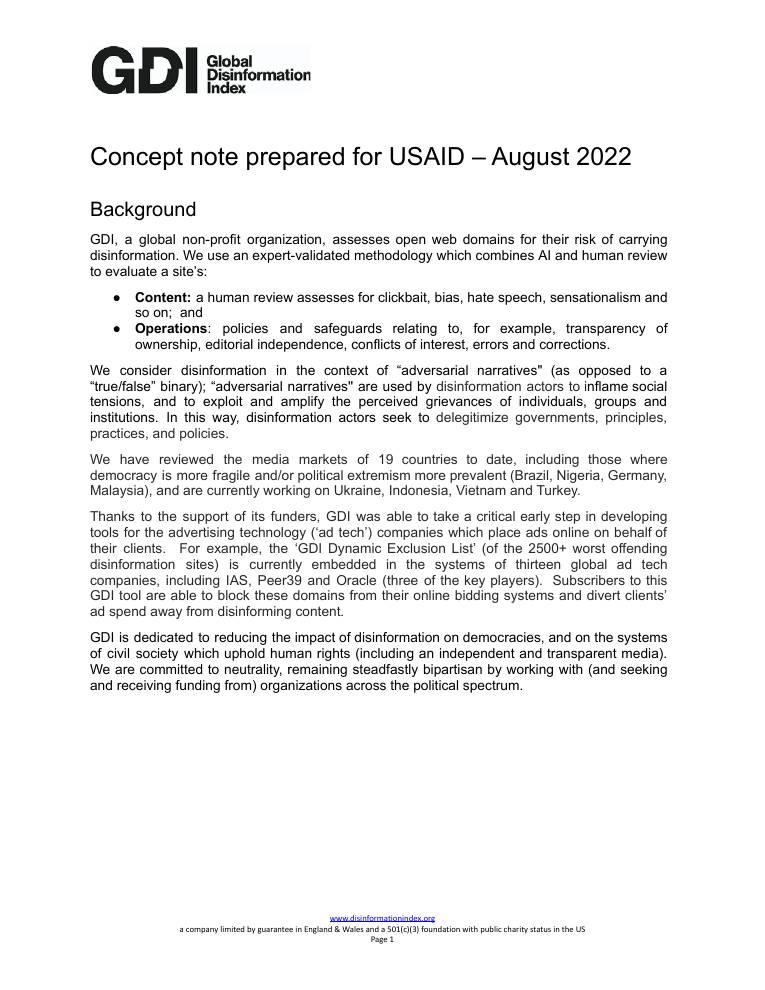
Concept note prepared for USAID – August 2022
Background
GDI, a global non-profit organization, assesses open web domains for their risk of carrying disinformation. We use an expert-validated methodology which combines AI and human review to evaluate a site’s:
• Content: a human review assesses for clickbait, bias, hate speech, sensationalism and so on; and Operations: policies and safeguards relating to, for example, transparency of ownership, editorial independence, conflicts of interest, errors and corrections.
We consider disinformation in the context of “adversarial narratives" (as opposed to a “true/false” binary); “adversarial narratives'' are used by disinformation actors to inflame social tensions, and to exploit and amplify the perceived grievances of individuals, groups and institutions. In this way, disinformation actors seek to delegitimize governments, principles, practices, and policies.
We have reviewed the media markets of 19 countries to date, including those where democracy is more fragile and/or political extremism more prevalent (Brazil, Nigeria, Germany, Malaysia), and are currently working on Ukraine, Indonesia, Vietnam and Turkey. Thanks to the support of its funders, GDI was able to take a critical early step in developing tools for the advertising technology (‘ad tech’) companies which place ads online on behalf of their clients. For example, the ‘GDI Dynamic Exclusion List’ (of the 2500+ worst offending disinformation sites) is currently embedded in the systems of thirteen global ad tech companies, including IAS, Peer39 and Oracle (three of the key players). Subscribers to this GDI tool are able to block these domains from their online bidding systems and divert clients’ ad spend away from disinforming content.
GDI is dedicated to reducing the impact of disinformation on democracies, and on the systems of civil society which uphold human rights (including an independent and transparent media). We are committed to neutrality, remaining steadfastly bipartisan by working with (and seeking and receiving funding from) organizations across the political spectrum.
a company limited by guarantee in England & Wales and a 501(c)(3) foundation with public charity status in the US
Proposed Activities
GDI proposes to carry out Media Market Reviews (MMRs) in three of USAID’s priority countries in order to identify online news and information sources that are at high-risk of disinforming readers. We develop a sample of pertinent online news sources for each market, training a local research team to execute GDI’s data collection methodology and calculate risk rating scores based on the data collected. We support the local team in drafting a report on disinformation risks in the media market. Each project takes roughly six months to complete and yields two key outputs:
1. Risk ratings per site that can be shared privately with USAID (as well as with licensees of GDI’s data); and
2. A public report which supports local stakeholders (journalists, civil society, etc.) in addressing disinformation risk factors in their own media environment. We propose to conduct MMRs in Moldova, Zambia, and Armenia. Disinformation undermines development goals in different ways in each context. The Fourth Estate is critical to development and democracy, but underdevelopment is a risk factor for disinformation, tempting government intervention in the media space. GDI believes that third-party support for a media environment free of disinformation and its harms is a critical component of modern democratic development.
Moldova
GDI proposes to work with USAID to identify a partner organization that can execute GDI’s MMR methodology for the Moldovan media market.
Moldova is experiencing an ongoing information war1 in the wake of Russia’s invasion of Ukraine. Internet actors are turning the influx of Ukrainian refugees into a divisive issue in Moldovan society, which has enormous implications for peace and security, development, and democratic stability. Furthermore, pro-Russian narratives are thought to be an attempt to turn the country away from the West and toward Russia. In this context, support for trustworthy, quality journalism can act as a bulwark against other influences.
Zambia
Zambia is a strategic choice for this proposal because the context very much calls for such a study, and GDI has an existing partnership in place to undertake the work.
According to Vadim Pistrinciuc, Executive Director of the Chișinău-based Institute for Strategic Initiatives, quoted in: https://www.wired.com/story/moldova-disinformation-war-ukraine/. a company limited by guarantee in England & Wales and a 501(c)(3) foundation with public charity status in the US
Reporters Without Borders has identified a number of vulnerabilities in Zambia’s media environment, but also reports that, for the first time in many years, no journalists were detained by the state at the end of 2021,2 following the August 2021 election of Hakainde Hichilema. President Hichilema ran on a promise to end government interference in Zambian media. However, even amidst a respite from political interference, independent journalism faces economic challenges, making this a crucial moment to direct advertising spending toward quality media outlets.
Based on our successful collaboration in Nigeria, GDI is currently developing a strategic regional partnership with Paradigm Initiative, a digital rights organization with offices in six sub-Saharan African countries, including Zambia.3 Paradigm Initiative will coordinate a team of Zambian researchers to undertake the review in English and the local language(s) relevant to the media market.
Armenia
In lts latest annual report “Nations in Transit 2022”, the Freedom House organization has drawn attention to regression in the field of media independence in Armenia and to the new article in the Armenian criminal code on “grave insult”.
Further, at the time of writing, reports of escalation in Nagorno-Karabakh/Artsakh claim that Azerbaijan has been violating the ceasefire regime and trying to capture new positions in the Northern and North-western parts of Nagorno-Karabakh. Disinformation about this escalation will likely spread very quickly in Russia, with those narratives further escalating the conflicts themselves.
GDI has already identified a potential (and very strong) partner in Armenia, Union of Informed Citizens (https://uic.am/en/).
USAID / Platform Intervention Pilot
USAID has indicated that its growing relationships with the large online platforms, including Alphabet and Meta, offer an opportunity to take action in these three countries based on the data that GDI’s MMRs produce. To take advantage of this unique opportunity for impact, GDI proposes to work cooperatively with USAID to identify the highest risk media in each country and guide work with the platforms to take action in the following areas:
Reporters Without Borders, “Zambia,” https://rsf.org/en/country/zambia. GDI and Paradigm Initiative previously published a Media Market Review for Nigeria: https://www.disinformationindex.org/country-studies/2021-6-30-the-online-news-market-in-nigeria/.
a company limited by guarantee in England & Wales and a 501(c)(3) foundation with public charity status in the US
• Defund: Work with platforms to defund high disinformation risk media in these countries, including through advertising and other audience monetisation techniques. Downrank: Work with platforms to downrank this content in search, newsfeed, and other recommender systems that suggest content to users in these countries. Deplatform: Work with platforms to block or eliminate the most egregious disinformation peddlers in these countries that violate existing platform policies, as identified by the GDI MMRs.
a company limited by guarantee in England & Wales and a 501(c)(3) foundation with public charity status in the US
The original document
Page through the PDF exactly as released. If it does not display, open it directly.